By Andrew Heck

The 12th annual Porc Show took place at the Quebec City Convention Centre on Dec. 9 & 10, inviting hundreds of Canadian and international guests to hear keynote speeches looking at market dynamics, public perceptions and the future of the pork sector, along with workshop presentations in the areas of animal health, farm management and consumer marketing.
This year, a new format debuted, which included more balanced presentation delivery between the two days, the evening reception on the first day instead of the second, and a novel approach to real-time language translation, using a phone-based app. All three decisions resulted in a more well-rounded and action-packed conference, which was appreciated by guests.
Enhanced nutrition, management reduces mortality
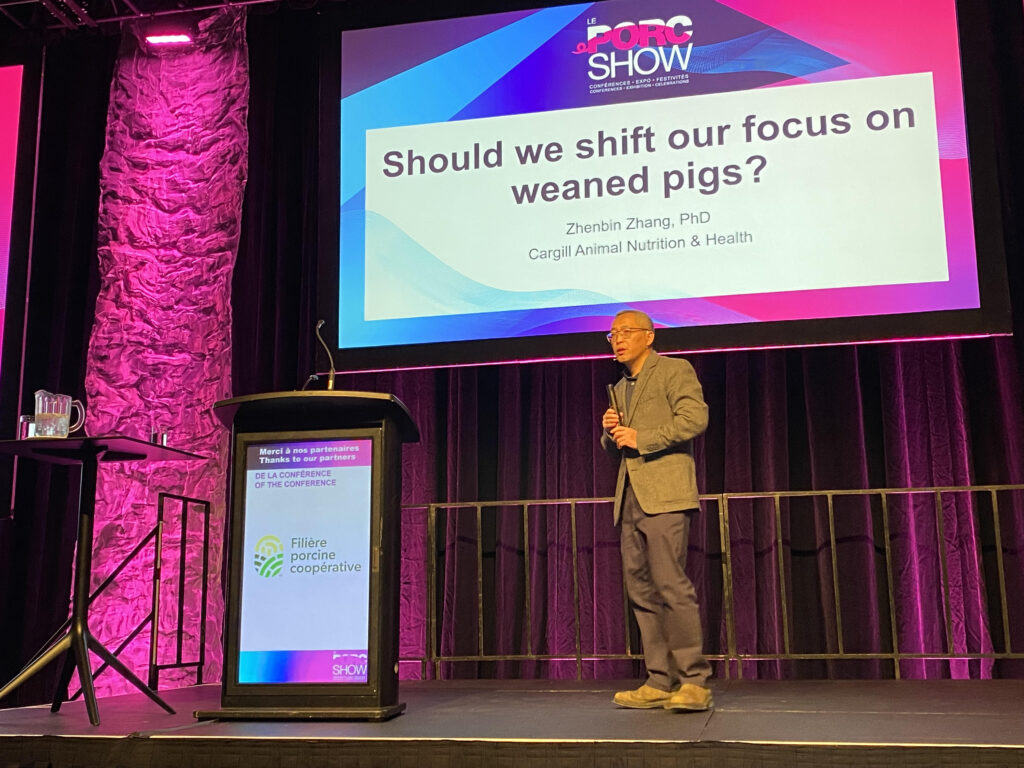
Zhenbin Zhang, Swine Nutritionist, Cargill Animal Nutrition & Health raised an important question: should we shift our focus on weaned pigs? Post-weaning mortality remains a significant problem for many producers, and the impacts should not be underestimated.
Among the main causes of post-weaning mortality, Zhang suggested that increasingly lower birth rates, due to increasingly larger litter sizes, may account for much of the problem, alongside sow farm health status.
“A reduction of 200 grams in birth weight can easily lead to 400 grams of reduction in post-weaning weight,” said Zhang.
Porcine Epidemic Diarrhea (PED) is another significant issue, along with Porcine Reproductive and Respiratory Syndrome (PRRS). Zhang also pointed out that PRRS-positive unstable herds are likely to have Strep. suis, for which he offers two possible solutions: reduce cumulative physiologic stress, and incorporate anti-inflammatory or anti-oxidative phenolic compounds in diets.
With the incoming ban on zinc oxide in 2027, this will create challenges for immune system health, as there is no effective, non-anti-microbial alternative. The shift will also increase costs for producers.
“Unlike high-zinc diets, it is hard to chase gut health and performance simultaneously from nutrients alone,” said Zhang.
Diarrhea caused by E. Coli is another concern. Zhang indicated that water acidification is an important consideration, since acidified water reduces E. Coli shedding, decreases feed consumption and has no impact on performance.
About three-quarters of the pig population has a post-weaning mortality rate between one and five per cent, with the remaining quarter sitting at above five per cent. This latter category, which is usually not targeted by nutritionists, could benefit from a nutrition program.
Research by Cargill has shown that decreasing gut fermentable protein can help control diarrhea, as fermentable gut protein intake is correlated to mortality. Provisoy by Cargill has a lot less fermentable gut protein than bone meal, corn, or similar products, relying on structural carbohydrates to support gut health. Additional research by Cargill has shown that an increase in structural carbs can decrease mortality by at least half.
Alongside nutritional approaches, Zhang also recommends enhancing production management practices.
“Look for the four elements: air, water, space and feed,” said Zhang.
The right air temperature and humidity, along with low ammonia and carbon dioxide, provide an optimal barn atmosphere. Water should be made available at a rate of 10 to 12 pigs per drinker, adjusted to an appropriate height and flow rate.
Taken together, Zhang believes a combination of these approaches can make a big difference in reducing post-weaning mortality.
Lower sow slaughter could indicate expansion
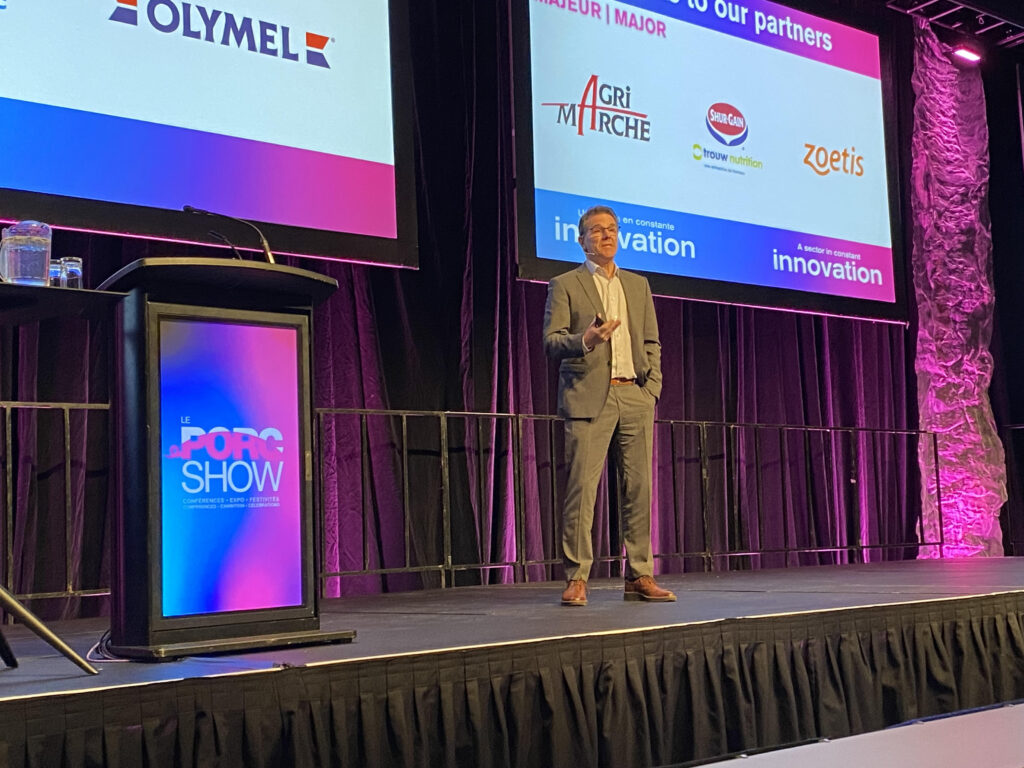
Jean-Philippe Gervais,Executive Vice-President, Strategy & Impact, Chief Economist, Farm Credit Canada provided a timely update about the state of the Canadian economy.
Gervais suggested that inflation currently seems to be well anchored around two per cent, and Statistics Canada’s latest projections look optimistic, to the point that we could expect interest rate cuts in the second half of 2026.
“In the short term, we should see some interest rate cuts in 2026,” said Gervais. “In the long term, they could continue to rise due to what’s happening between Canada and the U.S. I would say there’s a greater chance we’ll see them rise than see them fall.”
The Canadian economy continues to grow but is under pressure. Population growth seen in recent years has cooled off, which has caused some economic slowdown, including in agri-food. Speaking about pork markets, Gervais believes Canadian pork exports overall are showing resilience, thanks to market diversification in the face of falling demand in China. Chinese demand for Canadian pork is falling, but Japanese demand is growing, as Canada recently surpassed the U.S. as the country’s main pork supplier.
However, the impacts of looming potential threats – such as the introduction to voluntary country-of-origin labeling (vCOOL) – remain to be seen. When the U.S. introduced mandatory country-of-origin labelling (mCOOL) in 2014, Canadian pig production and live exports were at an all-time high. Not long after mCOOL, production and exports dropped and have yet to recover to similar levels, though they are trending in that direction.
“Sow slaughter right now is lower relative to total slaughter, which usually indicates expansion,” said Gervais. “When I put it all together, record cattle prices from the small herd in Northem America may lead to some support for hog prices.”
On the feed side, Gervais mentioned record U.S. corn production, coupled with above-average production in Argentina, which should lead to stable prices in the coming year. Soybean demand in the U.S. demand for biofuel, however, has created a demand surge and could lead to higher feed prices.
On a more sobering note, Gervais dug into consumer trends. Pork remains competitively priced for consumers, which is good; however, if you could eliminate all the economic factors that affect consumption, Statistics Canada research indicates that pork demand would fall, beef would stay the same, and chicken would increase. Whether domestically or internationally, Canadian pork has plenty of opportunities.
Looking ahead, Gervais offered his vision for how Canadian agriculture can remain competitive in a changing world, including increased efficiency, scale-up and innovation to sustain and de-risk technology adoption.
“It’s true we have a major productivity challenge in Canada,” said Gervais. “We need to rethink agriculture productivity, which won’t look the same as 20 years ago.”
To help illustrate his point, Gervais compared Canada and the U.S., as our main competitor in the pork market. With the U.S. having eight times more people than Canada, it’s easy to see how we are naturally disadvantaged in scale; yet, the U.S. agri-food sector is considered only six times larger than Canada’s, with agri-food exports only five times larger.
Looking at the situation through an optimistic yet pragmatic lens, Gervais is confident that the Canadian agri-food industry can maintain a larger proportional impact on global markets, if the industry continues to adapt.
Regenerative agriculture pays off
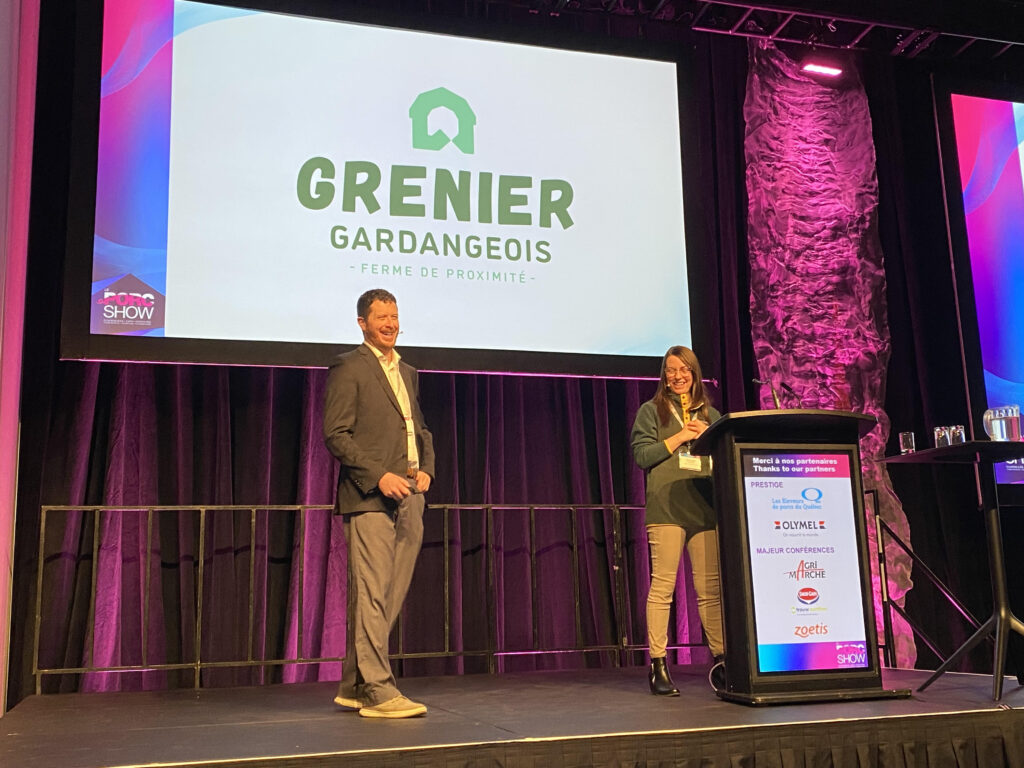
Christian Grenier, President, Grenier Gardengeois & Stéphanie Taylor, CEO, Grenier Gardengeois explored their unique approach to regenerative agriculture.
Trained as an agricultural economist, Grenier worked for more than a decade in the banking sector before returning to his roots by taking over the family farm, representing the fourth generation at the helm. With a bachelor’s degree in business administration, Taylor first spent a decade working in marketing and then four years in the environmental sector before giving new meaning to her career.
Three years ago, Taylor took the leap into agriculture by taking over, alongside her husband.
“I say she’s my wife, but she’s my manager,” said Grenier. “She oversees different things and makes sure sufficient resources are available to move projects forward.”
Grenier Gardengeois’s business umbrella connects the farm, Fermes Grenier, with its incoming biogas generation component, known as GPK Bioenergie. The farm’s multi-purpose facility includes a pig barn with an upstairs greenhouse, and on the land, they have a composter, cover crops and biodiversity islands to showcase the natural beauty of the landscape. Currently, 22 staff help run the various business elements, which has grown from only eight staff in recent years.
Biomethanization uses inputs like manure, biosolids from secondary sludge, food waste and other organics in an anerobic digester to produce biogas and digestate, which can include fertilizer, animal bedding and even construction materials. The primary product, biogas, represents renewable energy and a revenue stream. GPK Bioenergie recently entered a 20-year partnership with Quebec-based natural gas provider, Énergir, and received provincial government financial support to construct the facility.
“Agriculture must play its part in Quebec’s energy independence,” said Grenier. “Heating a condo block in Montreal using existing sources is fine, but we can’t simply keep doing this to heat pig or poultry barns.”
Once fully operational, GPK Bioenergie will use Fermes Grenier’s hog slurry, along with manure from local dairy operations. For biosecurity reasons, GPK Bioenergie will not accept hog manure from other farms, and an on-farm truck wash will be part of their protocols.
“These projects make us who we are,” said Taylor.
The new plant is based off tried-and-tested technology used in France, which is expected to be able to process 100,000 tonnes of feedstock, resulting in the production of more than three million cubic metres of biogas – enough to heat the equivalent of more than 1,000 homes.
On the consumer-facing side, Grenier Gardengeois also operates a boutique shop selling their pork, chicken and other local artisanal products.
“It’s important that social acceptability is there,” said Taylor. “We take time to tell our neighbours about our processes.”
The underlying philosophy of Grenier Gardengeois is simple: change starts at home, and through intentional growth, change can influence others.
“People want to get on board,” said Grenier. “People want to believe.”
Quebec’s charm continues to attract interest

The Porc Show’s attractive mix of timely and important subject matter, networking opportunities and hospitality continues to draw guests from far and wide every year.
The second day of the event featured a plated lunch – the outcome of a culinary student contest that comes with a cash prize for those involved, along with the prestige of having their dish showcased for guests. This year’s lunch began with a tribute to David Boissonneault, former President, Éleveurs de porcs du Québec, who served in the role from 2011 to 2017. Boissonneault sadly passed away in 2025, but his legacy endures across the Canadian pork industry and beyond.
The show’s organizers, sponsors and presenters routinely churn out a high-calibre event, and Quebec City’s French-Canadian history and charm remain an enjoyable bonus for visitors.