In my last two commentaries I’ve suggested the industry was a mess, maybe even a hot mess. What can I say now other than we’ve either got used to it or have become numb?
Carrying on from my table last commentary of Ontario Pork’s weekly reporting of the average, low and high total return to producers per 100 kilograms dressed weight.
Date
Average Price per ckg DW Total Value
Low Price per ckg DW Total Value
High Price per ckg DW Total Value
July 19, 2020
$174
$131
$240
You can see the spread now extends to over $100 per hog. Resulting in some producers maybe thinking they should expand to producers bleeding to death by a thousand pin pricks, across the road from each other. I would question whether the spread has ever been this wide. All this as shown above with 25% of the global sow herd gone, primarily from ASF causing prices pretty much everywhere other than North American to be at historical highs.
So, if this isn’t broken, I don’t know what is. Andrew Heck, Editor of Canadian Hog Journal does an excellent job in their Summer 2020 magazine of highlighting some of the issues in his article “Producer-packer tensions threaten viability.”
In mid-May the pork producer organizations in B.C. Alberta, Saskatchewan and Manitoba issued a joint invitation to executives from Maple leaf Foods, Olymel and Donald’s Fine Foods to have an open frank discussion on the state of the industry, and work to solutions that generate shared value for producers and processors. Part of the written invitation reads:
“As a result of our flawed value sharing system, pig producers in Canada have needed to rely on the goodwill of the federal and provincial governments and taxpayer dollars to support producers’ very survival.” It continues, “For too long, the producer and packer have been at odds with each other, and it has created an unmanageable and antagonistic relationship that is weakening the industry and the brand in the global marketplace. This approach must come to an end.”
source: “Producer-packer tensions threaten viability”, Canadian Hog Journal
I think most producers would agree with the synopsis if taking exception to the extent of government goodwill helping them. However, although a commendable effort, in a capitalist system with packers making previously unimaginable margins it will be challenging for them to see a lot wrong with this present picture. Even when some in their midst understand killing your supplier is ultimately bad for business. Similarly, as many producers are fighting for survival difficult to take “the long view”. I believe the saying is “when you’re up to your ass in alligators, it’s hard to remember your original intention was to drain the swamp.”
But now would seem the very time for vision for the industry. In the past, the one solution to this conundrum between the packer and producer has been for the packer to integrate down. Although more extensive in the US in percentage terms perhaps not that much different in Canada.
Olymel along with being Canada’s largest pork packer is Canada’s largest pork producer and appears to wish to integrate even further. If not, full integration at least sell producers genetics, feed and perhaps other inputs for them to gain shackle space. Giving with on hand, while taking away with the other.
Maple Leaf Foods, although having some ebb and flow to being a pork producer, remains a large pork producer in Canada.
HyLife although starting as a pork producer with their Neepawa pork plant, the acquisition of 75% of Prime pork plant in Minnesota and the 37,000-sow pork production of ProVista in Manitoba appears their model is an integrated one.
Such that would be difficult to tell which tail is wagging the dog.
An alternate solution is for the producer to integrate up. As with Conestoga Meats/ Progressive Pork Producers (3P) here in Ontario. Right now, they appear “the smartest guys in the room” as they share in the value of the hog with enviable margins compared to many producers in the province. However, this model requires overlooking the better part of a twenty-dollar bill they put on the back of every hog for ten plus years
Which is the better model? Don’t know that there’s any convincing evidence that packers make better hog producers than hog producers. Anymore than producers make better pork packers than packers. Most economic theory would suggest the greatest prosperity comes from all the players sticking to what they’re best at. That being said the old way of producers and packers taking turns making and losing money no longer seems sustainable. Particularly when the playing field appears tilted against producers perhaps permanently.
Pork producers have proven themselves to be extremely resilient and innovative amongst agriculture producers. Appears time to think BIG!
Again Bob Hunsberger, Wallenstein Feeds, Hog Economics Summary Sheet shows little in the way of encouragement or change from eight weeks ago, profitability going from per pig with average production loss of (-$37.90) to loss per pig with an average production of (-$30.23). A $7.67 per pig increase in revenues that for some at least only says “you’re not bleeding as fast”. Then with the next twelve-month projection moving from (-$6.52) to (-$5.11) – arguably moving in the right direction but hardly comforting. Seems time for a better mousetrap.
Pork Commentary, August 10th, 2020 Jim Long, President-CEO, Genesus Inc.
Global Mega Producer Exits
Last Friday it was announced that Goldsboro Milling – Maxwell Foods would be exiting the Swine Industry. A year ago, at this time Maxwell Foods was a Global Mega Producer with 100,000 sows. Last August 19 Maxwell sold about 46,000 sows and production contracts to Country View Farms whom are part of the Clemons Food Group.
Maxwell has announced that it will begin phasing out current production of about 54,000 sows beginning August 6th. See link below.
This is unprecedented in our industry. We understand most if not all breeding of sows has stopped.
“To breed a sow is to believe in tomorrow.”
There has never been a liquidation plan of this magnitude by one entity in the U.S. swine industry history. It appears that there were no buyers for the business. In the past when large producers such as Maxwell had an exiting plan another large producer took them over. IE Smithfield Foods – Murphy, Carrol, Premium Standard. Maschoff – Sands, Christiansen – Heartland, JBS – Cargill and so on.
Maxwell Foods continues to be a major shareholder in Butterball Turkey. The exiting of Maxwell from the swine industry is in our opinion a real reflection of the financial losses our industry has been enduring. Be real sure they aren’t quitting because of making too much money. When we hear from independent producers that the “Big Guys” aren’t being hurt by our negative margins we always disagree. The more hogs you have the more you can lose. There is no magic in the business, Maxwell wasn’t directly involved in the packing plant. They were like a big independent producer. Let’s say selling 25,000 hogs a week times $30 per head loss = negative $750,000. At some point you might ask “What’s the future?” If you don’t see one. Stop breeding, exit stage right.
54,000 sows equal about 1.2 million market hogs per year, almost all currently to Smithfield Foods. If one needs confirmation sow herd liquidation is ongoing this is it. Who knows if this market continues as is who might be the next large entity to stop breeding? To assume there won’t be is reckless.
Other Observations
If slaughter weights and field reports from our customer base are an indication, we believe few if any hogs are backed up. Our opinion is far different from the commodity traders and vested interest that say “3 million hogs backed up” a crude but effective way to depress hog prices.
Despite the best efforts of the vested interest to continue to hype huge pork supply. Cut outs were $73.84 Friday. Lean Hog futures even showed some life Friday with a significant bounce.
Pig Production is decreasing. From Dec 1st to June 1st, 150,000 fewer breeding sows. June sow slaughter 52,000 more than last June. We are aware of several farms beyond Maxwell Foods that have decided to exit. Euthanization, sow herd abortions & lower gilt retention are all factors in decreasing the pig production. June 1 USDA report projected 5% less farrowing in this time frame. That is about 150,000 less pigs a week. We are being offered empty barns both nurseries and finishers. The hog supply is dropping. Barns are becoming available. When does price increase? When the market realises there are not millions of hogs backed up. When is that? Hopefully sooner rather than later.
“Surest cure for low prices is low prices!”
Potential PRRS Game Changer
In Feedstuffs a report that the University of Connecticut assistant professor of animal science Young Tan and professor of pathology and veterinary science have now identified compounds that successfully use a vaccine to block the PRRS Virus. Click below to see article.
If this technology is effective this has huge ramifications in the future of our industry. Unlike Gene Editing (GMO) being done by companies like Genus – PIC which face huge regulatory and consumer acceptance of GMO food. No one has much issue with vaccines. Vaccines can be available to the world industry unlike a GMO Pig which will have huge restrictive, cost and litigate issues beyond consumer acceptance.
We can only imagine the fear at companies that have invested 10’s of millions to produce a GMO-PRRS resistant pig to see the vaccine option potentially destroy the value in the GMO technology investment.
At the end of the day, we need to produce Pork that consumers will feel comfortable with. GMO pork has been banned in Europe. Not sure GMO pork is a direction that will drive consumer demand in North America. A vaccine is a real solution that doesn’t collide with consumer or regulatory issues.
Pork Commentary, August 4th, 2020 Jim Long, President-CEO, Genesus Inc.
When you are an optimist you look for the positive. Last week, Thursday to Thursday U.S. National Base 53-54% lean hogs went up from 48.79 to 53.27. Still a miserable price but going in the right direction.
“I am an optimist. It does not seem too much use being anything else.” – Winston Churchill –
Other Observations
One of our U.S. customers got offered 10¢ a lb. more for this past Saturday’s delivery compared to the week before. This for spot cash delivery.
Three of our customers in Northern Midwest are no longer backed up with hogs as of last week. Good sign.
Some customers have pulled hogs down to a 265 lb. average in preparation if there are plants slow down due to coronavirus. Of note, their plants had room to get hogs to this Iowa weight.
From the feeder pig world
More calls coming in by buyers. Buy lists more than supply list in some instances. Probably a sign of market price floor. Current early weans are February market hogs. Pig supply is being cut due to sow herd liquidation from higher sow slaughter (+180,000 Jan-June), lower gilt retention, euthanization of small pigs and some planned abortions. Also, demand is being enhanced by more finishing barn space being made available by higher market hog slaughter.
We expect we are seeing the beginning of a relentless increase in small pig prices over the next few months as supply continues to decline.
“I’d rather be optimistic and wrong, than pessimistic and right.” – Elon Musk –
Hogs backed up
The multi-million-dollar question that hangs over our industry is whether hogs are backed up by over 2 million head as some claim or are we close to current.
The prevailing consensus it appears is that 2 million are backed up. That belief hangs over the market. Every Retail, Foodservice and Foreign buyer reads the pork news. The drumbeat of the hogs backed up takes away any stimulus for any buyer to worry about pork supply. This in itself limits any market price momentum.
We watch market weights. Last week, the first four days of the National Daily Base Hog Slaughter report had an average carcass weight of 207.56 lbs; the week before averaged 210.46 lbs; same week a year ago 208.28 lbs; June this year averaged 213.41 lbs.
Our observation, it would be the first time in history that hogs are backed up significantly and hog weights are below a year ago and falling weekly.
We have written to watch slaughter weights and many do, but most focus on the Iowa–S.Minnesota weights. That is if there were hogs backed up is where they are regionally. We watched the National weights as it’s in our opinion gives more of the national picture. We believe there are hogs backed up at some farms but also farms that have pulled hogs ahead. The net effect is what matters.
This coming week if Packers driven by excellent gross packer margins keep up slaughter numbers of about 200,000 more a week then a year ago, watch the weights, if they continue to plummet the likelihood of massive numbers of backed up hogs is less likely.
“To breed a sow is to believe in tomorrow.”
Government’s responsibility is to ensure proper food supply for its citizens. In the time of this pandemic, this has been a challenge for not only the government but retailers, packers, and producers. The drumbeat of attacks on the meat industry by a couple of prominent east coast Senators (NJ, Mass.) has been steady (both states are far from food self-reliant). This has led to some retorts from Tyson and Smithfield on how they are dealing with the pandemic.
Packer Sentiments from Bloomberg articles
Tyson Foods
“As we look beyond this year, we’re prepared to navigate prolonged pandemic related uncertainty … We are investing in operational flexibility to ensure that we can continue to meet customer demand, while living in a potentially long-term COVID-19 environment.” said Noel White, President & Chief Executive Officer at Tyson Foods
Sunday’s spread echoes a national Tyson Foods Inc. commercial with the tagline “We take care of our family so you can feed yours.”
Smithfield Foods
Smithfield Foods Inc. took out a full-page ad in Sunday’s edition of the New York Times to accuse its critics of false narratives and misinformation and to defend its operations to keep the nation fed during the pandemic.
The Virginia-based company calls its 42,000 employees “heroes” in the ad, and says it has implemented measures to keep staff safe and reward them for their work.
The ad accuses others of trying to use Smithfield and its industry as “political pawns,” while the company has stayed apolitical to make hard decisions and confront challenges that are “rooted in responsibility and delivered with integrity.”
“We must produce food, and someone has to do it,” the Smithfield ad reads. “Certainly it is not the critics who have answered the bell. No, it is our nation’s food and agriculture workers who have done so.”
As producers we need all slaughter plants to be operational. Any attempt to slow down the plants by politicians is a direct assault on our livelihood and future. All producers should stand with packers to ensure maximum packer capacity. Our livelihoods matter.
“I am too positive to be doubtful, too optimistic to be fearful, and too determined to be defeated.”
Pork Commentary, July 27th, 2020 Jim Long, President-CEO, Genesus Inc.
June U.S. Sow Slaughter was 294,500, up from last year’s 241,900 – that’s 52,000 more sows gone to market in June compared to a year ago. Year to date U.S. sow slaughter (Jan-June) is 1,678,600, up from last year’s 1,498,810. – year to date 180,000 more. For those who think the sow number this year is being inflated by overweight market hogs, we offer this year average slaughter weight, Jan-June 304 lbs, last year’s same time frame 304 lbs.
From Dec 1 to June 1 the USDA breeding inventory showed a decline of 152,000 sows. We believe that what is ongoing is a further reduction of the sow herd. The financial losses of many producers are unprecedented. Current losses of $40 per head on top of already many months of losses are accelerating herd decreases.
Compound that we are in summer when mortality increases due to high temperatures, while gilt replacements have slowed. All these factors lead us to believe sow herd is decreasing significantly at this time. Fewer sows mean fewer pigs.
U.S. hog slaughter last week was 2,589,000, up from last year’s 2,359,000. Packers have good margins to motivate them to keep slaughter numbers up. Saturday was 231,000 head, a year ago 12,000. We need to work into whatever hogs are backed up and it appears it’s happening.
U.S. pork cut-outs held last week closing Friday at $70.53. This despite more hogs being harvested.
U.S. pork in cold storage at the end of June was 464,373 compared to 619,454 a year ago. A huge difference. Despite record low seasonal prices, Pork has not gone into storage. Good news if we get any momentum in the market cold storage levels will not slow down a rebound.
Rabobank as the world’s largest agriculture lender has a good handle on what’s going on in the global swine market. Last week they reported that they expect Global Pork Production to decline 8%. “The biggest year-over-year declines are expected in China (-17%), the Philippines (-9%) and Vietnam (-8-11%).”
We would agree with these observations. Genesus has Genetic sales and production in each of these three countries and the decline in production from ASF related issues is significant. If anything, we question if both Vietnam and the Philippines might have even greater declines they observe.
Rabobank reports “In the United States, live hog prices have dropped 41% year-over-year in early July, as meatpackers continue to work through a backlog of animals that could take months to process. Analysts said market prices for hogs are well below breakeven and could cause some producers to trim their herds or exit the business.”
We note 52,000 more sows in June (180,000+ YTD) to slaughter than a year ago would indicate “trimming”.
Seems bizarre to us with projected 8% less pork in the world, why the North American Industry is sucking air. Even more bizarre that the 8% decline includes a 1.5% increase in the United States. At the rate things are going with the rapid decline of the breeding herd accompanied by euthanized pigs there will be less U.S. pork in the not so distant future.
“The great thing about rock bottom is that you cannot sink deeper” – Winston Churchill
A Personal Note
24 years ago, I traveled from Ontario to Manitoba for the first time. I had been asked to speak to the Hutterite District of the Manitoba Pork Board by their director Henry Maendel.
Henry prior to the meeting invited me to the Rosebank Colony where he was hog boss. I had never been to a Hutterite Colony indeed I had never met a Hutterite. That day will be ever etched in my mind as Henry who had a very strong personality showed the workings of Rosebank. The church, housing, hog barn, shops, land and kitchen. All very impressive. I remember the dinner we had duck; it was good. The ladies who cooked the dinner watched us. We talked and I ate slow. At that time, I didn’t know eating slow isn’t what you do. I wondered why the ladies kept staring, later I learned they wouldn’t leave until we were done. Lesson learned.
Later Henry told me about the history of the Hutterite Community. A religion-focused in the early 16th-century agrarian-based communal living and common ownership founded by Jacob Hutter as part of the Anabaptist movement of the reformation. He told me the 500-year journey to where today there are over 400 colonies in the USA and Canada. It was an enlightening and memorable day for me.
Unfortunately, Henry Maendel passed away last week. I pay tribute to Henry as a powerful personality who embodied the Hutterite religion and culture. Since first meeting Henry I have come to know many Hutterites as friends and customers. In the 24 years, I have come to admire the tremendous will and dedication it takes to maintain a distinct community and culture.
Henry was an impassionate leader of the Manitoba Pork Industry. A number of years as director of the Manitoba Pork Board he pushed for producers’ interests. At his passing, he was overseeing as Hog Boss the building of a new swine barns at Rosebank Colony. A continued belief in the future of the swine industry.
Our condolences to Henry’s Family and all at Rosebank Colony. May he rest in peace.
COVID-restricted home baking and indoor cooking has turned into backyard BBQing as the weather has warmed up.
Since the start of the COVID-19 pandemic, one message has remained the same: home is the safest place to be. As a means to combat home confinement, coupled with a reduction in restaurant and take-away dining options, one thing is certain: Canadians are spending more time cooking.
Today, most Canadians have access to more than 250 hours of cooking or food-related shows a week on television. YouTube offers an endless supply of cooking demonstrations and videos produced by everyone from home cooks to celebrity chefs, and during the COVID pandemic, the demand for online culinary inspiration has been increasing across web and social media platforms.
Celebrity chefs provide encouragement
Social media has allowed Anna Olson to keep inspiring Canadian home cooks during the pandemic.
Since the March 2020 onset of the pandemic, Chefs Anna & Michael Olson of Welland, Ontario have both increased their online presence with regular social media videos. As a celebrity chef with cooking shows viewed around the world, Anna has seen a dramatic spike in followers to her YouTube channel, “Oh Yum with Anna Olson,” mostly from people searching for baking recipes.
COVID restrictions have impacted options for Canadians that were accustomed to eating out or ordering take away a few nights a week, leaving many searching for new recipes to add to their previously limited repertoire. For many, the excess of time at home is proving to be the perfect opportunity to getting their hands dirty in the kitchen and expanding their culinary skills.
“We have a lot of time to think about food; it is no wonder that people are digging out those unused cookbooks and looking for inspiration online,” said Anna. “With absolutely no social commitment, the math is clear: there are seven dinner opportunities each week to try something new.”
For the past two decades, Michael has made a career out of inspiring young chefs as a Professor at Niagara College’s Canadian Food and Wine Institute. Through his cooking demonstration videos, Michael has attracted increased interest to his Instagram feed for his ‘keep it simple’ approach to cooking.
“I’m very sensitive to showing how to make something in the kitchen or on the grill that is not overly complicated, expensive or includes hard-to-access ingredients,” Michael explained. “With excess time at home, I think there are a lot of people trying to embrace and overcome cooking as a chore. The last thing anyone needs right now is to feel inadequate.”
Michael Olson’s popular all-pork cookbook, Living High Off the Hog, was published in 2019.
Last year, when Michael launched his all-pork cookbook Living High Off the Hog, he was adamant that all of the recipes in the book were achievable to any home cook with access to the ingredients and enough time. In November 2019, Alberta Pork even gifted the book to guests during the organization’s 50th anniversary celebration, and Ontario Pork has been actively promoting sales.
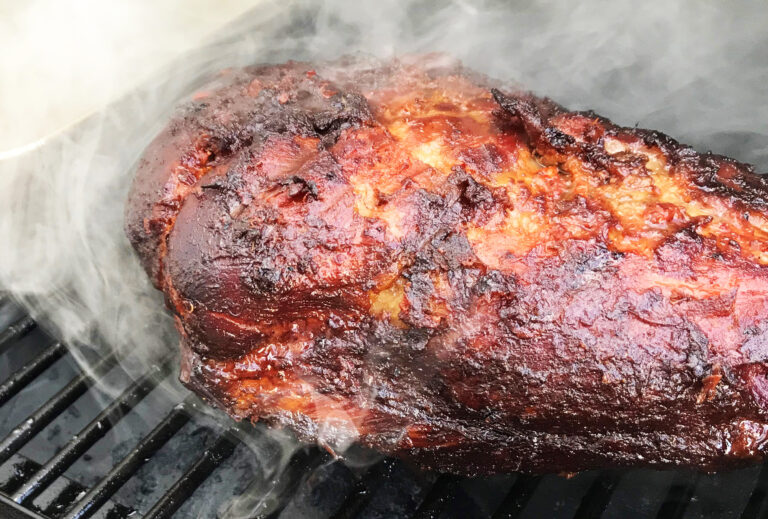
As the COVID response continues into summer, the search for something new to bake or cook has evolved into something new to BBQ or smoke.
Summer plans go up in smoke
Being housebound has not limited Canadians from shopping online, and BBQ stores across the country have reported increased sales of smokers and grills.
“I keep hearing, ‘I got a smoker,’ or I get questions through social media about pellets or smoke,” added Michael. “COVID has provided an excellent opportunity to learn something new, and staying close to home presents the perfect opportunity experiment with learning to smoke meat. With all the excess time, and BBQ season upon us, why not spend money on something you can enjoy at home?”
In the early days of the pandemic, panic-buying of both fresh and non-perishable goods left grocery store shelves empty. A Food and Consumer Products of Canada survey released in early April reported that leading food and consumer goods manufacturers experienced an all-time high in the last two weeks of March, representing a 500 per cent increase in demand.
While many restaurants have struggled during the pandemic, business is booming for small butchers like Edmonton’s Corey Meyer, who now wears a mask while working.
For Corey Meyer, third-generation butcher and owner of ACME Meat Market in Edmonton, business has never been better. While his butcher shop survived the panic-buying early days of the COVID response, things have returned to a newer sense of normal, but sales remain high.
“More than ever, there seems to be an emphasis on supporting local producers and businesses during the pandemic,” said Meyer. “We enhanced our social media presence in recent years to attract a younger clientele to the shop, but COVID has certainly brought new faces making a conscious effort to support local.”
The summer BBQ season is always popular at ACME, but this year is the highest volume the butcher shop has ever seen since being founded in 1921.
“People are spending more time at home watching cooking shows and cracking open cookbooks, and it is resulting in more customers, more frequent shopping and requests for new or different cuts of meat,” Meyer added.
A renewed sense of culinary appreciation
Even as the COVID situation continues to evolve and restrictions are lifted, many will continue to carry on with newly developed cooking habits as a new normal.
Canadian consumers accustomed to paying restaurant prices are learning the value of quality local cuts at their grocery stores and butcher shops. Armed with new confidence in the kitchen, many have learned how cooking at home can help save money, help their families eat healthier and, perhaps most importantly, help their families spend time together.
“Years from now, people will remember the time they spent together during the pandemic, and many will be talking about the food they ate,” said Michael. “They’ll be telling stories about sourdough bread mom made for the first time or those BBQ back ribs – the best they ever had – that dad made.”
For Anna and Michael, the two believe they have never been closer or more in love than during their confined time together since COVID restrictions started in Canada.
“Children will remember this time differently than adults. Hopefully they are the ones to remind us of the importance that making food and eating together played during the pandemic as we go back to our functioning lives,” said Anna. “I hope that in six months from now, or as long as it takes for things to start to normalize, Canadians are still taking the time to cook together and sit down to eat as a family.”
Growing calls for anti-trespassing laws to protect producers
The Government of Alberta took swift action last year following the invasion of a turkey barn. Premier Jason Kenney showed his support in a press conference hosted at the affected farm.
In December 2019, CTV News reported that 11 animal rights activists had occupied a pig breeding barn in Saint-Hyacinthe, Quebec “demanding full access inside the agri-business operation and a meeting with Quebec Premier Francois Legault to discuss animal rights.” The activists had entered the barn before dawn, and they kept a live video stream going of the entire event on social media.
Earlier last fall, this barn occupation was preceded by an incident near Fort Macleod, Alberta, where 30 activists entered a turkey farm. This spurred quick action by Alberta’s provincial government, which passed the Protecting Law-abiding Property Owners Act and brought it into force in December. Last year, Saskatchewan also strengthened its anti-trespassing legislation, but the changes have yet to come into force.
The Alberta law provides more protection for “law-abiding property owners” from civil liability related to injuries to trespassers where the owner has reasonable grounds to believe the trespasser is committing, or about to commit, a criminal offence. The law also boosts the consequences for trespassers, increasing maximum fines to $10,000 for a first offence and $25,000 for subsequent offences, along with possible prison time of up to six months. It also includes a maximum fine of $200,000 for corporations that help or direct trespassers.
In the view of national animal welfare advocacy group Animal Justice, however, this law “seeks to intimidate people who want to call attention to animal abuse.” Executive Director and lawyer Camille Labchuk added that “Alberta’s ‘ag gag’ law violates the Charter protection for freedom of expression, because it prevents whistleblowers from exposing unethical and illegal acts on farms. It is my view that Alberta’s ag gag law will likely be challenged in court.” She points to a letter signed by more than 40 constitutional and criminal law experts, outlining outlines the reasons why similar legislation in Ontario is unconstitutional.
For his part, Patrice Juneau, Communications Director, Quebec Union of Agricultural Producers (UPA), believes that, “When it comes to breaking and entering on farms, these are no longer demonstrations to raise public awareness. Breaking and entering is a Criminal Code offense. These acts aim to impose an ideology through defamation, propaganda, threat and fear. This type of behavior is strongly condemned by society and must be reprimanded.”
Entering and occupying barns, said Juneau, can cause stress to the animals, creates disease transmission and other biosecurity issues, risks the herd’s health status, harms farm business by hampering market access and can negatively impact farm employees and the targeted farm-owning family. They can even affect the insurability of the farm. Juneau added, “Depending on the damage, the costs can be enormous.”
Ontario’s Bill 156 follows Alberta’s lead
Organizations including Ontario Pork have strongly advocated for better protections for producers.
The rationale for the Ontario government’s proposed legislation, the Security From Trespass and Protecting Food Safety Act, is described by the government in safety terms. In the press release, Ernie Hardeman, Minister, Agriculture, Food and Rural Affairs stated: “We’ve heard from farmers who no longer feel safe in their homes, who have expressed concerns with increasing on-farm trespassing and the safety of their families, employees and livestock.”
The Act proposes a first-time fine of up to $15,000 and $25,000 for subsequent offences. It also prescribes “aggravating factors” that would allow the court to consider increased fines and also allow the court to order restitution for damage in prescribed circumstances, which could include damage to a farmer’s livestock or from theft. It also increases protection for farmers against civil liability from people “who were hurt while trespassing or contravening the Act.”
There is also an added dimension in the bill of prohibiting interference with a livestock transport vehicle – such as stopping, hindering or obstructing its movement – and the animals in the vehicle without explicit prior consent.
This aspect of the bill no doubt stems from the now-famous event from four years back when a woman named Anita Krajnc was criminally charged but later acquitted for giving water to pigs on a livestock truck in Burlington, Ontario that was heading to a slaughter plant. Krajnc’s group, Toronto Pig Save, held a protest in December against enacting Bill 156.
However, a spokesperson for Ontario Agriculture, Food and Rural Affairs said the government has received hundreds of letters calling on it to do something about trespassing on farms and obstruction of livestock transport trucks. In addition, more than 130 municipalities have passed or supported calls to strengthen protections for these operations.
In mid-June, Bill 156 was passed with support from Ontario’s majority government. The government will continue to seek input on the legislation, as legal challenges from opponents are likely forthcoming.
Other provinces mulling similar anti-trespassing campaigns
In Quebec, the UPA believes similar farm-specific legislation should be passed.
“In the meantime, in February, the UPA obtained from the Quebec Superior Court a temporary injunction to prevent any further illegal intrusions on farms and is looking to render it permanent,” said Juneau. “But this type of legal proceeding can take a long time.”
As in Quebec, there was a protest on a pig farm near Abbotsford, B.C. last year. The 50 activists present claimed to be there because video footage taken previously at the farm demonstrated abuse of pigs. Charges for break-and-enter and mischief were laid against one of the trespassers.
In a statement responding to situation, B.C. Pork noted that while the video “has been edited and lacks context and understanding, some of the scenes are of concern.” Following the incident, a swine veterinarian was sent to the farm to investigate animal welfare.
Talks in B.C. for farm-specific anti-trespassing laws are proceeding. At least one meeting with the province’s Deputy Minister of Agriculture has been held, and another is planned, said Jack Dewit, Chair, B.C. Pork.
He added that, “We do realize that the animal activists are still quietly working behind the scenes as we focus on other things. We need to be prepared should another farm become the target of another protest, and we need to continue working with the authorities to protect producers.”
In eastern Canada a few months ago, trespassing on farms was addressed by Christian Michaud, President, Agricultural Alliance of New Brunswick in an article published in Atlantic Farm Focus. His organization is looking to engage the provincial government and other stakeholders to develop meaningful mechanisms of deterrence against trespassing on farmland and significant penalties for doing so.
“There is currently no legal recourse in this province, because legislation requires the perpetrator to be caught in the act or with ‘sufficient’ evidence,” stated Michaud. “Enforcement has been very weak, leaving producers with no meaningful legal options for protection. The onus of liability or permission remains in the hands of producers.”
Political support for anti-trespassing on the national level
To address the issue on a country-wide level, John Barlow, Member of Parliament, Foothills (Alberta) & Shadow Minister, Agriculture and Agri-Food Canada, has introduced a private member’s bill to amend the federal Health of Animals Act.
The Act currently features nothing to address the impact of trespassers on animal health. This amendment, says Barlow, will make farm trespassing a more serious crime in order to better protect livestock health, but it will also help protect farmers and their mental health. In creating this bill, Barlow wants to recognize the extreme stress faced by farmers who have had to wake up to intruders in their barns.
He further explains that while the bill, if it becomes law, will see increased penalties for groups and organizations who encourage individuals to threaten the biosecurity of animals and security of workers, it does not in any way limit the individual right to peacefully protest on public property.
“We want to send a strong message that entering farm properties will not be tolerated,” said Barlow. “And we want people to understand the risk in terms of disease transmission.”
The bill has gone through first reading, and Barlow hopes it will be debated this fall.
Undercover employees can deceive producers
Activists are emboldened when strong action against them is not taken. Sympathetic journalists use major platforms to mislead the public and spread falsehoods about producers and their partners.
While these new and proposed laws on the provincial and federal levels may do a lot to deter trespassing on farms, none of the legislation touches on prevalence of “undercover employees” – legal trespassing, if you will, by activists who are hired by farmers and later attempt to expose negative conditions relating to animal care through photographs or videos. In Ontario a few years ago, for example, CTV News reported on undercover video taken at a farm, showing questionable pig handling practices.
In the U.S. over the last few years, several state governments have passed laws which prohibit capturing livestock images without farmer consent. Some of these have been challenged, and in Idaho so far, overturned. But even if illegal, attempts by activists to capture images are likely to continue. So, that leaves prevention – in other words, making sure you do not hire activists.
There are many tips available on the internet, but here are a few of the best: Have each applicant sign a document swearing the application is accurate and beware of applicants with things like high levels of education and no ag experience. Require references and follow through to check them, making sure to contact references through their company offices. Do a thorough social media search as well.
In taking on new hires, state in the employment contract that cell phones must be left in vehicles or lockers. Red flags in new hires include being where they should not be, coming in early or staying late for no reason and other strange behaviour.
With care in hiring, adherence to animal welfare standards and further expansion of anti-trespassing laws, it seems that Canadian farmers are becoming better positioned against the risk of waking up to a barn full of protesters. Time will tell.
Pork Commentary, July 20th, 2020 Jim Long, President-CEO, Genesus Inc.
This past week we saw some improvement once again in pork cut-outs. A week ago, last Friday they were $68.95 while on Friday the pork cut-outs closed $71.19. The increase has been 9¢ lb. over the last two weeks. We firmly believe it has to be strength in the pork cut-outs to push hog prices higher. Cut-outs show demand relative to supply. The psychology of the market is one of huge negativity. It’s almost like there is no light at the end of the tunnel. It’s hard to find much if any positivity. The only solace is it’s so bad it has to get better?
Other Observations
U.S. weekly hog marketing’s 2,518,000 up 130,000 from a year ago. Packers are getting hogs killed with Excellent Gross Packer Margin being great stimulus
3 area lean hog price went from 07/08 – 42.72 to 45.36 – 07/16. Right direction but dismal price.
We expect breeding herd liquidation is ongoing. Sow slaughter is up, gilt retention is down. It would be the first time in history if liquidation isn’t ongoing in the face of losses of $40 plus per head.
Last week in Eastern Corn Belt – 3 packers were actively looking for hogs. Doesn’t appear to be many or any backed up hogs there.
China
China’s hog prices continue to stay at a high level. 36.08 RMB/kg or $2.34 U.S. liveweight a lb.
Early wean pigs at 100 RMB per kg.
China slaughtered 251.03 million hogs down 50 million from a year ago (20%).
Inventory end of June 339.96 million head down 2.2% from a year ago.
China sow herd is increasing according to the government statistics up 5.4% at end of June compared to a year ago.
The real fact is the hog price $2.34 U.S. lb. liveweight indicates a real pork shortage and strong demand. Rabobank estimates China Pork output will decline 20% this year to 42.6 million tonnes.
China has imported 2.12 million tonnes of pork January – June. Up 140% from a year ago. There is no doubt China will need massive levels of pork in the coming months. The question who will benefit?
Pork Commentary, July 13th, 2020 Jim Long, President-CEO, Genesus Inc.
At the end of last week, U.S. Pork cuts gained about 7¢ lb. or $14.00 plus a carcass (Friday’s close $68.95). Is this an aberration of a sign of some newfound strength in the pork market? Our observation is no one pays more than they have too to get what they want. Maybe we are the boy who sees the manure pile and thinks there is pay inside. One thing for sure this business seems to be one big manure pile for producers.
We believe the hog market, if it gains strength, it will be led by Pork cut-outs. We don’t think it will be lean hog futures. Cut-outs will reflect pork demand and supply.
The market is currently ham struck by the story of a huge number of backed-up hogs. If you were a Pork Buyer would you be aggressively purchasing Pork when all you read is a deluge of Pork is coming? The same buyers can see lean hog futures circling 50¢ lb. Not exactly an indicator that the pork price will explode on you.
Foreign buyers also read our industry news, our global contacts have asked us if we think U.S. packers will be able due to coronavirus to keep operating to supply them import needs.
Three factors – Supply, Futures, and Coronavirus all negatives for hog price appreciation. That’s why the Pork cut-outs price has to lead the way. Only the reality of an appreciating pork price can push back the negatives.
Last week U.S. Packers were aggressive. They handled 2,606,00 up 187,000 from a year ago. We also saw slaughter weights continue to decline. Weights have come down 12 lbs. plus from the May highs. We still can’t rationalize how 3 million-plus pigs are alleged to be backed up across USA but weights continue to drop. We have had hogs four decades, when we backed up hogs, weights went up, not down. Maybe it’s a new paradigm?
In our opinion, the breeding herd continues to decline – the latest week about 68,000. Last year averaged 57,000. We expect every day the number of sows is decreasing.
Last week we asked the Genesus U.S. sales team to name sow herds liquidated or liquidating. Also who they know backed up with hogs. A number of sow herds were named across the Midwest. Few if any backed up hogs in Eastern Corn Belt. In the Western Corn Belt there are some for sure but certainly not all producers. Over the next two weeks watch the hog weights. There at around 280-282 lbs. now. If average weights go into 270’s it tells us the number of hogs net backed up is next to nothing.
If Pork Cut-outs continue to climb it will reflect that buyers have to pay more, not that they want to. With Gross Packer Margins good to excellent, we expect Packers to keep pushing kill numbers.
The surest cure for low prices is low prices.
Tom Stinson appointed as U.S. Director of Sales
We are pleased to announce, Tom Stinson has accepted the role as U.S. Director of Sales for Genesus.
Tom has been with Genesus for two years in the role of Cooperate Sales Lead. Tom grew up on a Purebred Yorkshire and Duroc farm.
After attending Kansas State University in Horticulture Science, he was recruited to Murphy Family Farms in N.C. Tom served in a number of roles including Nevada Missouri Start-Up Production, Construction and Grower Development Lead, then started up the High Plains Operation in Laverne Oklahoma.
Tom has owned contract nursery farms in Oklahoma as well as other businesses. Tom has a deep understanding of business and production practices.
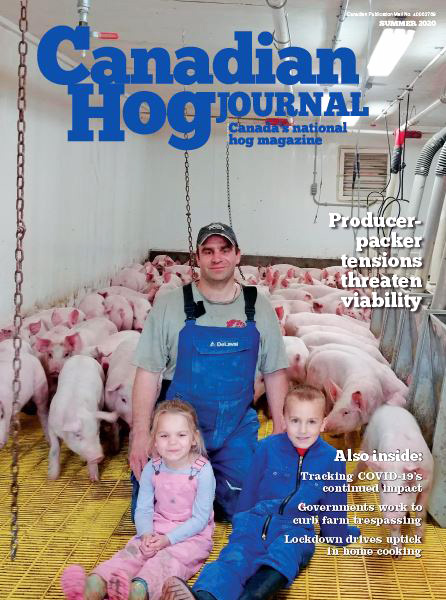
The Summer 2020 edition of the Canadian Hog Journal is here!
After a few months that have seemed like an eternity, life is creeping back toward the [new] normal we have been told to expect. With any luck, we will now be better prepared to handle the predicted second wave of COVID-19, if and whenever it comes.
This edition prominently includes an exploration of shared value between producers and packers. It should come as no surprise that this matter is quite controversial and divisive. Many producers I encounter pull no punches when it comes to describing their deep-seated frustrations regarding pricing, and this article is an attempt at reflecting those concerns in a way that can hopefully inspire positive change and a collaborative path forward.
This edition also includes an update on the Spring 2020 coverage of COVID-19’s impacts on the Canadian pork industry. It is a lot to digest, and quite frankly, the news has been happening too fast to cover with an entirely clear picture of the situation. It is a tricky story to tell, and out in the world beyond our industry, our story has, unfortunately, been told badly. This has likely resulted in undue harm to our collective reputation, and we will now have to work even harder to share accurate, balanced news to raise public awareness.
In 2019, several hog and poultry farms in B.C., Alberta, Ontario and Quebec were the victims of animal activist organized crime. It is an indescribable insult to producers’ livelihoods and a black mark on the legal institutions that are supposed to protect farmers but fail miserably. Thankfully, some sympathetic political representatives have been aiming to change the game. This edition looks at what progress has been made.
If you manage to make it all the way through the heavy content, you will enjoy a summer-focussed look at the growth of home cooking, as a result of the COVID-19 pandemic. The story reminds us how, in spite of challenges, we are ready to continue enjoying the brighter side of life to the best of our ability.
Research in this edition covers the potential cost savings of including enrichment for your herd, the intestinal fate of dietary zinc and copper, along with the role of protected acids in sow performance.
I have once again included a “Letters to the editor” section featuring reader feedback. Got something to say about what you see here? Do not hesitate to reach out and let me know. Email andrew.heck@albertapork.com with your thoughts, and they could make it into the next edition!
Letters to the editor
In reply to “Defending the pork value chain during COVID-19” (Spring 2020)
“Marie-Claude Bibeau, Minister, Agriculture and Agri-Food Canada, recently said agriculture needs to ‘make better use of existing [financial] support.’ What support is she referring to? AgriStability, AgriInvest or provincial programs? AgriStability is based on the last five years with the highest and lowest drops, with the remaining three years generating your average. My farm’s average sucks because government refuses to acknowledge what trade wars have done to us. Under AgriInvest, the support is matched up to $15,000. Hell, the carbon tax alone is going to eat that up!” – Maaike Campbell, Arkona, Ontario
In reply to “Defending the pork value chain during COVID-19” (Spring 2020)
“Since COVID started, my family and I have been enjoying lots of Canadian pork. It’s yummy and supports local producers and the economy!” – Karin Melnyk, Red Deer, Alberta
In reply to “Producers should seek better share of export values” (Spring 2020)
“Exports obviously form an important part of the Canadian pork industry, but consumers sometimes forget that there are great local products close to home. I’m proud to serve local food and beverage at my business, The Copper Coil Grill and Still, and I think it’s really important these days especially to support producers.” – Scott Gadsby, Squamish, B.C.
With half a billion active or recovered cases and nearly half a million deaths worldwide, the COVID-19 pandemic has proven to be the most significant public health and economic disaster of the past century.
The pandemic has affected practically everyone around the world in so many ways, including the Canadian pork sector. Since then, much has happened, including the reopening of many previously closed processing facilities, the lifting of restrictions on conducting business, along with other factors that have helped the industry bounce back in some ways, while fundamentally transforming it in others.
Market impacts reverberate across borders
The U.S. Pork Checkoff organization has created an interactive map to show the status of processing facilities. Active plants are indicated in green, partially active plants in yellow and inactive plants in red, as shown in this example from early May.
The impact of COVID-19 on pork markets continues to be observed with a combination of grief and cautious optimism that the Canadian pork value chain will be able to claw its way out of the spring pricing slump. As slaughter capacity returns closer to normal in the U.S., the effect on pricing has been a gradual climb toward the black.
Data from China customs suggests that the country imported more than 400,000 tonnes of pork in April, representing a 170 per cent increase over the previous year. Record-low prices likely encouraged stockpiling, which is no surprise. Meanwhile in Canada, prices for producers plunged to nearly $60 below cost of production during the same period, following initial reports that China would put a stop to pork imports while trying to contain the spread of the virus. This speculation has since proven to be unfounded.
While Chinese domestic pork prices can fluctuate rapidly, they were around three times higher than U.S. pork prices prior to plant shutdowns resulting from COVID-19. The total price gap, for nearly two years, can be attributed largely to the extended African Swine Fever (ASF) hangover that persists to date and continues to silently spread through Asia.
Government support generates mixed response
With hog futures plunging and a great deal of uncertainty around processing capacity, various market factors influenced provincial pork boards and the Canadian Pork Council (CPC) to step up and request support for producers.
In late April, the CPC asked the Government of Canada for an immediate injection of $20 per hog to help producers overcome the projected direct financial losses caused by COVID-19 in 2020. While this ask has not been specifically addressed, producer organizations on the provincial level have been calling on their Premiers and key elected representatives to extend support on a localized level.
Canadian pork margins in late April were well below cost of production.
In early May, the federal government announced an initial agri-food support package that totalled more than $250 million, of which $125 million was earmarked for a producer AgriRecovery program, while $75 million was dedicated to supporting processing, with the $50 million balance going toward a food surplus purchase program.
The government response came as a harsh blow to most commodity sectors, including pork, with many producers stunned by the value of support offered, which was only a fraction of the $2.6 billion requested by the Canadian Federation of Agriculture. Reacting to lacklustre support, the CPC published an open letter to Canadian consumers, calling for their help to vouch for the pork industry.
“Farmers have been telling the government about the need to act for weeks, but it hasn’t been enough to get governments to get meaningful help to the producers that need it today,” wrote Rick Bergmann, Chair, CPC. “That is why farmers need your help. We need you to tell the Prime Minister, ministers, Members of Parliament and senators that now is the time to be serious about protecting our food supply by helping farmers.”
In Quebec, the province’s Union of Agricultural Producers (UPA), Sollio Groupe Coopératif (parent company of Olymel) and other partners issued a combined statement calling on the two levels of government to create a specific assistance program for the agri-food sector to ensure its viability.
“The agri-food sector has managed to maintain a continuous supply throughout the [COVID-19] crisis, but many companies are coming to the end of their resilience,” said Marcel Groleau, President, UPA. “The federal announcement promising $252 million in aid is clearly below the needs formulated by the industry as a whole. In addition, the current programs absolutely do not respond to the exceptional challenges we face.”
The Agriculture Producers Association of Saskatchewan (APAS), likewise, called for further support.
“Any assistance to producers is welcome, but this package is only a small first step in addressing the needs at the farm gate,” explained Todd Lewis, President, APAS. “We need more action from the government to help reduce our risk and secure Canada’s agricultural industry and food supply.”
In mid-March, the Government of Canada announced a $5 billion lending capacity increase to Farm Credit Canada (FCC), in addition to loan deferrals. Since that announcement, more than 4,800 producers and agri-food businesses have used payment deferral options on FCC loans totaling $4 billion and have established credit lines totaling more than $500 million to alleviate short-term cash flow concerns.
To complement that original lending capacity increase, the $100-million federal Agriculture and Food Business Solutions Fund was launched to support a wide range of agri-food businesses, with the goal of returning recipient companies to sound financial footing.
In addition, in late May, eligibility criteria were expanded for the Canada Emergency Business Account (CEBA) to include many owner-operated small businesses, including farms, which were previously unable to access the program. The program is now available to a greater number of sole-proprietor businesses and family-owned corporations that pay employees through dividends rather than payroll.
On the labour front, the government also announced an investment of up to $9.2 million to enhance the Youth Employment and Skills Program (YESP) and fund up to 700 new positions for youth in agriculture. The goal of the additional funding is to help attract Canadian workers aged 15 to 30, to assist with labour shortages brought on by the pandemic. The program will provide employers up to 50 per cent of the cost of hiring a youth worker, up to $14,000.
Many of these initiatives may appear good on paper, and they do much to influence public perception about support for agriculture. Despite that, pork producers have largely failed to benefit from the support, which is geared toward crop and other livestock sectors. The chorus of voices asking for further measures has not been enough to sway Marie-Claude Bibeau, Minister, Agriculture and Agri-Food Canada, who doubled down on her government’s actions.
“We are a government who is proud of taking decisions based on evidence. We’re not taking decisions only based on emotions,” Minister Bibeau said. “Please go and get this money and then it will be much easier for me to identify the gaps and to get the money where it should be going.”
While the federal announcements did little to satisfy most agri-food stakeholders, provincial announcements were welcomed in Alberta, where the government has increased the interim AgriStability payment from 50 to 75 per cent for the hog sector, with a total value of up to $25 million for the sector or up to $20 per pig. It remains to be seen whether producers will be able to benefit from this funding, which does not favour mixed-commodity operations. Timeliness is also key, as the money could arrive too late to make much of a positive difference.
Even if provincial support proves to be helpful in the medium- and long-term for producers, short-term cash flow issues still plague production, which is a message that the industry has carried for some time since well before COVID-19.
Processing capacity changes rapidly
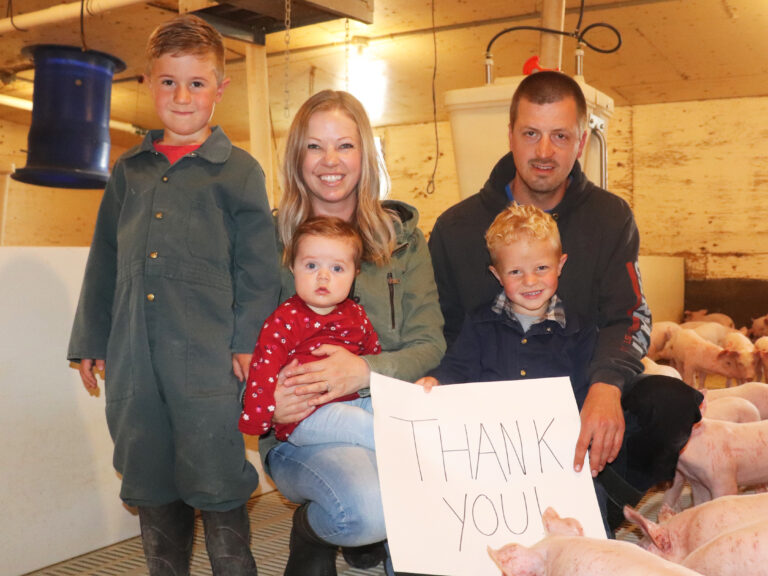
Producers across Canada – like the Pastink family near Taber, Alberta – have taken to social media to offer thanks to essential workers, especially those on the front lines in meat processing facilities, grocery stores, food banks and restaurants.
The pandemic’s threat to staffing and business continuity was felt very strongly by Canada’s meat processors. Given the close-quarters nature of meat cutting, it did not take long for the virus to take hold and spread widely within some plants.
Rather quickly, processors across Canada made commitments to address the safety concerns of workers by providing additional personal protective equipment (PPE) and training, working closely alongside provincial occupational health and safety officials to satisfy requirements. Companies including Olymel and Maple Leaf even offered hourly wage bonuses for workers, recognizing their employees’ important contributions.
Retrofitting measures on the plant floor include taking temperatures of employees, additional cleaning and disinfection, monitoring of hand-washing stations and the requirement for employees to stay home if observable symptoms are present. Physical distancing has been addressed through added space or plexiglass barriers between workers where possible.
Despite these efforts, no amount of cooperation could shield processors from the wrath of certain parties that have been calling for full, immediate, indefinite shutdowns of any plant where even one worker tests positive. These calls for shutdowns have been inspired mostly by two high-profile cases in Alberta beef plants.
With the deeply divided sides – processors and critics – in a political tug-of-war, producers continued to ride the pricing waves, while talk of potential welfare culls generated some backlash online from largely misinformed individuals.
Throughout the pandemic, the Canadian pork industry has been fortunate (if that term can be used) to have experienced only two plant shutdowns affecting domestic slaughter capacity: the Olymel facility at Yamachiche, Quebec, northeast of Montreal, along with the Conestoga facility at Breslau, Ontario, northeast of Kitchener.
The Olymel plant reopened after a two-week hiatus, while Conestoga was able to get up and running after only one week of stalling. The closures caused a backlog of more than 90,000 hogs, many of which were marketed through alternative channels, while others were able to be held in barns for longer periods of time and had their growth deliberately slowed.
In some highly exceptional cases, small numbers of market-ready hogs were euthanized in accordance with the National Farm Animal Care Council’s (NFACC) Code of Practice for the Care and Handling of Pigs, including one publicized example in Prince Edward Island. Reports out of Manitoba suggest that some isolated weaners were also disposed due to backlogs in Minnesota and Iowa, where these animals are typically sold. Despite these off-hand cases, no significant depopulation efforts have taken place in Canada, unlike some locations south of the border.
On the food safety side, processors continue to work with the Canadian Food Inspection Agency (CFIA) and provincial health authorities whenever plant closures are under consideration. Together, these stakeholders determine the length of potential closures and when business operations on-site would be able to resume.
To help create pathways for the secure, continued movement of meat and poultry, in late May, the CFIA established a temporary process to allow inter-provincial trade of goods produced at provincially inspected facilities. The goal is to alleviate any potential food shortages in one jurisdiction if food surplus is found elsewhere.
While political gamesmanship and other influences have received a disproportionate share of attention, processors have been the unfortunate victims of a reputational hit. However, producers and consumers alike should feel confident that Canada’s meat processors are making the necessary efforts to protect our supply chain, even if mainstream media and special interest groups sometimes distort this truth.
Producer organizations forced to adapt practices
Full validations under the Canadian Quality Assurance (CQA) and Canadian Pork Excellence (CPE) programs, which require on-farm visits, were postponed due to COVID-19.
Rather quickly in mid-March, provincial pork producer organizations and other industry partners made decisions to cancel, postpone or adapt upcoming in-person meetings, conferences and other events.
Nearly all pork producer organization staff members temporarily shifted to working from home for more than two months, while waiting on provincial and federal authorities to determine it was safe to return to regular work. For clerical staff, the effect was minimal, but for production and traceability staff, a lack of office access and postponing on-farm visits inevitably caused some interruptions for producers who typically rely on in-person support.
One specific impact was related to completing full validations under the Canadian Quality Assurance (CQA) and Animal Care Assessment (ACA) programs, along with the new Canadian Pork Excellence (CPE) program. These programs represent more than 1,000 producers across the country and all hogs sent to federally inspected processing facilities.
In early June, the Canadian Pork Council (CPC), working through its constituent provincial organizations, resumed full validations under the CQA/ACA and CPE programs, in accordance with provincial public health guidelines – a major relief for those who were coming due to renew certification. Full validations require on-farm visits, which had previously been postponed indefinitely in mid-March.
As the COVID-19 air begins to clear, producer organizations are eager to resume their normal support activities for producers, who are looking for that helping hand more than ever.
Canadian meat industry supports communities
Ontario Pork’s charitable goals this year include raising $100,000 for food banks and also providing boxed lunches for workers in the province’s three federally inspected processing plants.
Support for communities across Canada during COVID-19 has been offered by many Canadian agri-food sectors, including pork.
As food banks across Canada struggle to keep up with rising demand and declining donations, Ontario pork producers met this challenge as an opportunity to get fresh pork to families and individuals in need, through Ontario Pork’s Friends of the Food Bank program and community-based food giving.
The $100,000 fundraising goal includes $36,000 to provide boxed lunches to workers at the province’s three largest processing facilities: Conestoga, Sofina, Domingo’s. The remaining $64,000 will go toward maximizing food bank donations. Ontario Pork will coordinate donations of up to 10,000 lbs. of fresh ground pork per week – or approximately 60,000 servings – based on available funding.
Since late March, Alberta food banks have collected more than $25,000 in donations, and Saskatchewan food banks have collected more than $11,000, specifically thanks to those provinces’ Hutterite colonies. These efforts were spearheaded by a colony near Warner, Alberta, and were recognized in a formal letter from Food Banks Canada.
Processors, like producers, have been stepping up to the plate.
In mid-April, Maple Leaf Foods announced a partnership with Food Banks Canada and Community Food Centres Canada to commit more than $1 million in financial contributions and a further $350,000 in product donations to communities across the country.
HyLife has donated $750,000 to six hospitals, including the Bethesda Regional Health Centre in Steinbach, Manitoba.
In late May, HyLife made a combined $750,000 donation to six hospitals, in recognition for those institutions’ efforts to fight COVID-19. These included four facilities in Manitoba, one in Saskatchewan and one in North Dakota, in locations where HyLife centres much of its production.
Also in late May, Olymel announced that more than 800 employees at three of its Quebec plants had volunteered to work overtime shifts in order to help reduce the backlog of hogs caused by the two-week closure of the Yamachiche plant in April. In addition, for each hog slaughtered on May 30, the company donated $2 to a charitable organization chosen by the employees of each plant, up to a maximum of $5,000.
Altogether, these efforts, untaken during a very difficult time, demonstrate the industry’s ongoing commitment to Canadians – a relationship that is not always fully appreciated. With application details released in mid-June on the Government of Canada’s $50 million food surplus program, it is likely we will see additional charitable efforts, thanks to the new support.
Virus woes decrease but anxiety remains
Hope has been extremely sparse for many over the past few months, but farmers, of anyone, are known to be resilient to a fault. Thankfully, for millions of Canadians and customers around the world, pork producers stand tall with the entire value chain, working together to maintain food security, even while being attacked from so many angles.
COVID-19 will undoubtedly have further consequences for our sector, often unpredictably and unintentionally. In other cases, it is possible that lessons learned will have us emerge stronger and better than ever. Our survival depends on it.
















Genesus Global Market Report Canada, August 2020
Bob Fraser – Sales & Service, Genesus Ontario
bfraser@genesus.com
In my last two commentaries I’ve suggested the industry was a mess, maybe even a hot mess. What can I say now other than we’ve either got used to it or have become numb?
Carrying on from my table last commentary of Ontario Pork’s weekly reporting of the average, low and high total return to producers per 100 kilograms dressed weight.
You can see the spread now extends to over $100 per hog. Resulting in some producers maybe thinking they should expand to producers bleeding to death by a thousand pin pricks, across the road from each other. I would question whether the spread has ever been this wide. All this as shown above with 25% of the global sow herd gone, primarily from ASF causing prices pretty much everywhere other than North American to be at historical highs.
So, if this isn’t broken, I don’t know what is. Andrew Heck, Editor of Canadian Hog Journal does an excellent job in their Summer 2020 magazine of highlighting some of the issues in his article “Producer-packer tensions threaten viability.”
In mid-May the pork producer organizations in B.C. Alberta, Saskatchewan and Manitoba issued a joint invitation to executives from Maple leaf Foods, Olymel and Donald’s Fine Foods to have an open frank discussion on the state of the industry, and work to solutions that generate shared value for producers and processors. Part of the written invitation reads:
“As a result of our flawed value sharing system, pig producers in Canada have needed to rely on the goodwill of the federal and provincial governments and taxpayer dollars to support producers’ very survival.” It continues, “For too long, the producer and packer have been at odds with each other, and it has created an unmanageable and antagonistic relationship that is weakening the industry and the brand in the global marketplace. This approach must come to an end.”
source: “Producer-packer tensions threaten viability”, Canadian Hog Journal
I think most producers would agree with the synopsis if taking exception to the extent of government goodwill helping them. However, although a commendable effort, in a capitalist system with packers making previously unimaginable margins it will be challenging for them to see a lot wrong with this present picture. Even when some in their midst understand killing your supplier is ultimately bad for business. Similarly, as many producers are fighting for survival difficult to take “the long view”. I believe the saying is “when you’re up to your ass in alligators, it’s hard to remember your original intention was to drain the swamp.”
But now would seem the very time for vision for the industry. In the past, the one solution to this conundrum between the packer and producer has been for the packer to integrate down. Although more extensive in the US in percentage terms perhaps not that much different in Canada.
Such that would be difficult to tell which tail is wagging the dog.
An alternate solution is for the producer to integrate up. As with Conestoga Meats/ Progressive Pork Producers (3P) here in Ontario. Right now, they appear “the smartest guys in the room” as they share in the value of the hog with enviable margins compared to many producers in the province. However, this model requires overlooking the better part of a twenty-dollar bill they put on the back of every hog for ten plus years
Which is the better model? Don’t know that there’s any convincing evidence that packers make better hog producers than hog producers. Anymore than producers make better pork packers than packers. Most economic theory would suggest the greatest prosperity comes from all the players sticking to what they’re best at. That being said the old way of producers and packers taking turns making and losing money no longer seems sustainable. Particularly when the playing field appears tilted against producers perhaps permanently.
Pork producers have proven themselves to be extremely resilient and innovative amongst agriculture producers. Appears time to think BIG!
Again Bob Hunsberger, Wallenstein Feeds, Hog Economics Summary Sheet shows little in the way of encouragement or change from eight weeks ago, profitability going from per pig with average production loss of (-$37.90) to loss per pig with an average production of (-$30.23). A $7.67 per pig increase in revenues that for some at least only says “you’re not bleeding as fast”. Then with the next twelve-month projection moving from (-$6.52) to (-$5.11) – arguably moving in the right direction but hardly comforting. Seems time for a better mousetrap.