In reply to “Hog Journal hits 50: a look back” (Spring 2022)
“Here I am watching the Oilers-Flames game and thumbing through the Hog Journal during the TV ads. I read the ‘Hog Journal hits 50’ article and got to the end where it mentions few producers are left who were in business then. I guess I must be getting old, because I’ve been reading the Hog Journal for all 50 years raising pigs the whole time! While the industry has seen many changes over that time, one thing has not changed: there are still very good and dedicated people involved in all areas.” – Bryan Perkins, Wainwright, Alberta
Last week the USDA released the September 1 Hogs and Pigs Report. What we saw was less market hogs (1 million), less sows (1%). We thought it would be interesting where markets are at now compared to a year ago.
Futures
Oct. 8, 2022
Oct. 8, 2021
2022
2021
October
92.88
90.20
December
77.08
81.50
February
79.08
83.975
April
85.23
87.150
May
90.30
90.70
June
96.55
95.475
July
97.08
95.225
August
96.40
93.475
As you can see the lean hog futures last Friday compared to a year ago are very similar. We all know what happened this year. We didn’t have mid-90 lean hogs this summer as lean hogs were projecting a year ago. How about 120.16. We expect with even fewer hogs in spring – summer 2023 the hog price will be the same or better. All hogs that will go to market between now and the end of August have been bred in a smaller sow herd compared to a year ago. We believe lean hog futures are undervalued compared to where the market will be. It’s not if but when a big price adjustment will happen.
Weekly U.S. Pork Sales
U.S. export sales the latest week were 34,300 metric tonnes. A strong number the latest five weeks have averaged over 30,000 a week, the previous four weeks were in the 20,000 metric tonne range. Of the 34,300 MT, 10,110 MT were to China. It’s a number to watch, year to date China has been closer to 3,500 MT a week. If China ramps up pork imports, it will indicate pork moving to China from many countries. What goes to China is out of all other markets. We have no doubt soon China will be importing greater amounts of pork.
Market
U.S. hog slaughter last week was 2,558,000, a year ago 2,599,000. Average net price lean hogs 93.55 – USDA pork cut-outs Friday close $101.54. Iowa – S. Minnesota slaughter weights 280.3 lbs., a year ago 283.5 lbs. A year-over-year difference of -3.2 lbs. certainly indicates a hog inventory is very current.
Europe
The latest European pig meat production is down year over year June -5.7%, July -8.4%. The total June-July production was 3.44 million tonnes, a decline year over year of about 140 million tonnes. That’s a large amount of pork. The EU decline in production is about equal to the total amount of U.S. pork exports over the same time. We expect EU production will continue to decline as the result of massive sow herd liquidation. Hog prices in Europe have been at record levels but high feed prices have limited returns. Europe will have less pork over the next coming months.
Summary
Are markets rational? Maybe over time. One thing is for sure hog production and all its challenges is a humbling experience. So much can go wrong. The only arrogance we experienced in our industry is with people who don’t own hogs. Arrogance can’t be found in hog farmers; we have been humbled too many times.
We believe lots of upside to lean hog future market. Exports seeing strength. Hog weights lower than a year ago while we slaughter fewer hogs. Less pork in Europe, Less pork in China, Less pork in the USA – at least a combined 75% of the world’s pork production is declining. We haven’t seen how high hog prices can go yet.
Sébastien Angers is one of duBreton’s independent producer-suppliers. He is an agronomist by training and, since 2007, has operated an outdoor, organic farm near Ste.-Monique de Nicolet, about halfway between Montreal and Quebec City.
One of the few prospects more daunting than change itself, is forced change. In livestock production, the use of legislation to satisfy lofty social pressures has often placed farmers and consumers at loggerheads, to the detriment of both.
In 2016 and 2018, respectively, governments in the U.S. states of Massachusetts and California brought forth proposals to update spacing standards for livestock. Voters in both states approved. Massachusetts’ Question 3 was set to go into effect this year, but an industry-led court challenge has stayed its implementation, for now. Likewise, California’s Proposition 12 has faced implementation hurdles but is currently poised to come online early next year. Meanwhile in Canada, updates to the National Farm Animal Care Council’s (NFACC) Code of Practice for the Care and Handling of Pigs will mandate group housing for all sows by 2029, after an extension from the earlier 2024 deadline.
In business, setting yourself apart from your competition is one path to success. For duBreton, that path is well-travelled. The Quebec-based, integrated producer-processor raises hogs on its own farms, fed by its own feed mills, and also purchases from independent producers in Quebec, Ontario and the Maritimes. The hogs are slaughtered at the company’s own facility and further processed at its two other Quebec plants and one in New Hampshire, with a focus on cured products like bacon and sausage. With niche markets primarily in Japan, the U.S. and soon-to-be Europe, the business has grown steadily with ‘the times.’
The difference between duBreton and other major players on the Canadian scene is that, since the late 1990s, duBreton has actively pursued specialized designations for its products, including ‘organic’ and ‘certified humane.’ For many producers, and some consumers, it is easy to scoff at these descriptions. Products bearing such distinctions cost more to create, and they are more expensive at retail. As many consumers are already very price-sensitive, it may not make sense to dedicate so much energy to generating products that come with a higher price tag than comparable goods.
Opinions on the heavy-handed legislative approach to governing animal welfare varies widely within and outside of the industry. However, the proactive leadership historically shown by producers and processors – when it comes to taking small steps toward improvement – may not be enough for long, for some critical observers. As time goes on, the call for new requirements – whether scientifically based or not – grows stronger, and not just from animal activists but also among increasingly informed consumers. For at least some of those consumers, the inflated dollar amount is worth the money, and for the suppliers who are prepared to meet those expectations, like duBreton, the window of opportunity is wide open.
duBreton does it differently
Vincent Breton is proud to carry on his grandparents’ and parents’ legacy of producing high-quality food. Today, duBreton products are found in Canada, the U.S., Japan and Europe.
In 1944, Napoléon Breton and his wife, Adrienne, purchased a general store in Saint-Bernard, Quebec, about 50 kilometres southeast of Quebec City. The Bretons were looking at expand the business interests of their farming operation, which was established in 1928. In the 1960s, Lucien Breton took over from his father, and in 2019, Vincent Breton from his. Today, Napoléon’s grandson remains as President & CEO of the storied company.
“We want to do agriculture differently,” said Breton. “Being competitive in this area can be difficult, but we stand behind our values, and we strive for excellence, teamwork and sustainability.”
Constant evolution has been the name of the game for duBreton and the speciality pork market. In Japan, the company sells into Costco – one of the country’s most popular retailers – and in the U.S., Whole Foods, which has struggled to gain a foothold in the Canadian market.
“When we first started talking to Whole Foods, they were highly decentralized and did not have a lot of clear guidelines,” said Breton. “They used to visit our farms one at a time to determine whether they were acceptable.”
Over time, the company has earned certifications such as the Canada Organic Trade Association’s ‘Certified Organic,’ the U.S. Department of Agriculture’s (USDA) ‘Certified Organic,’ the Global Animal Partnership’s ‘Animal Welfare Certified’ and Humane Farm Animal Care’s ‘Certified Humane,’ all of which have contributed to demonstrating duBreton’s value proposition. As voluntary programs, they have given the company a boost over competitors that are now left wondering how quickly, cheaply and easily it may be to convert to a system that aligns with incoming legislative changes.
“It’s a huge commitment,” said Breton. “It’s not just a business aspect; it’s a cultural standpoint. People have to believe in it, and some people have not been able to embrace that change.”
The Whole Foods grocery chain’s growth in the U.S. is a testament to shifting consumer attitudes toward product claims that associate ethics with quality.
Speaking about the expectations and understanding of producers, Breton believes a shift in mindset may be in order: “Some producers believe they are the experts and the only ones who know about animal welfare. But at the end of the day, what does the customer like or dislike about what you’re doing?”
One of the most contentious issues between producers and packers surrounds profitability and value-sharing. The same legislative approach that has arbitrated hog and pork prices in Quebec has also handcuffed duBreton to an extent, when it comes to transitioning, since contract lengths are capped at three years.
“Integration has been the only way around this,” said Breton. “The regulations don’t work for us, currently, since it takes longer than three years to retrofit a farm and start producing pigs that meet our standards, so it’s a barrier for those who want to start working with us but also need to get paid.”
In addition to the problem of contract lengths, Breton rejects the concept of arbitrated pricing. Instead, he believes equity should come from the within the company, rather than external impositions.
“We pay based on cost of production,” said Breton. “One of the advantages of being integrated is that we control a lot of what we do, but we still rely on independent farms. We pay them like we pay ourselves, not based entirely on market fluctuations for the price of the animal.”
Despite obstacles that have taken years to overcome, duBreton has always prioritized its end-users over mass production and unchecked expansion.
“If we want farmers to survive and thrive, how do we do that?” Breton asked. “I don’t think it’s about trying to be the biggest company. I think it’s about raising the animal in the way that the consumer wants. If they want a red barn with windows and animals going outside, why not?”
Passion in pursuit of excellence
Whether in the office or on the gridiron, duBreton staff members believe strongly in the company’s values, and the commitment to upholding those values shows.
Marco Dubois is a human resources advisor with duBreton. He also moonlights as a professional football player. Hailing from La Salle, Quebec – a Montreal suburb – Dubois trades in his office attire for pads and cleats each spring. Currently, he is a receiver with the Ottawa Redblacks of the Canadian Football League (CFL).
“I was playing football at Laval University with Vincent’s nephew, who is also the son of our Vice President of Human Resources,” said Dubois. “At the time, I was looking for a job in my field of study, and duBreton was looking to hire someone in HR, so it worked out nicely.”
During the CFL season, Dubois and duBreton have a mutual understanding that football comes first, though Dubois remains as a permanent employee year-round. He works remotely as needed, but during the off-season and during bye weeks in the football season, he splits his time between duBreton’s corporate and processing offices in Saint-Bernard.
“I train every day, so work-life balance is very important,” said Dubois. “In my first year with the company, I even set up my own gym in a barn, but now, the company has gyms at its offices.”
Not only does duBreton offer employees on-site fitness opportunities, but the company also funds employees’ children’s enrolment in sports programs, and they recently began offering on-site daycare services.
“The company culture helps us stand out just as much as our product,” said Dubois. “The company values align with my own, including leadership.”
While he is fully committed to his football career, Dubois knows his playing days will not last forever. Post-playing, he would like to settle into a coaching role, while also staying in the pork industry, continuing to exercise his easily transferrable skills as people-person who works toward team success, lifting others up and helping them reach their potential.
Family connections run deep in the Dubois family as in the Breton family. Earlier this year, Marco’s grandfather, Jean-Guy, passed away. Jean-Guy lived with Marco’s immediate family for the better part of Marco’s childhood. He remembers Jean-Guy fondly, as his biggest supporter in sports, growing up.
“I learned a lot from my grandfather,” said Dubois. “He was very proud of me and happy I was able to get this job from such an awesome second family [duBreton]. They’re passionate people. They work hard and play hard.”
duBreton’s attempts to distinguish its products through forward-thinking production and processing have helped the company score significant touchdowns over the years. The company’s caring approach to pigs and pork translates into care for employees, cultivating an atmosphere in which winning comes naturally, though not without putting in effort.
Not every producer is willing or capable of taking their business back to the drawing board, as duBreton has done. And for the sake of diversity in the sector and consumer choice, that is fine. Hog prices in 2022 have been at a five-year high for most producers outside of Quebec, and packers processing conventional pork have experienced no shortage of revenue either. High on-farm costs continue to dampen profits, but the situation has certainly improved over recent years of sheer losses for many.
Values aside, the free market has a way of reflecting what consumers will tolerate. In most parts of Canada, average-income shoppers are likely not yet ready or willing to buy pork on product claims alone, especially at a premium price. But, globally, the appetite is there, and bellies are rumbling. duBreton’s game plan of creating niche products with a compelling story has driven the company’s success, and in the case of addressing societal conditions, the business case has proven itself.
It can be hard during good times to actively remember tougher moments in the industry, but it would be unwise for anyone to ignore the elephant in the room, which is legislative change and cultural evolution. With the clock winding down on incoming sow spacing requirements in Canada and the U.S., now may be as good a time as any to seriously consider making the investment in new practices, before it becomes a ‘hail Mary’ situation.
Editor’s note: Kevin Mosser is the Senior Director, Global Marketing, Canada Pork. He can be contacted at mosser@canadapork.com.
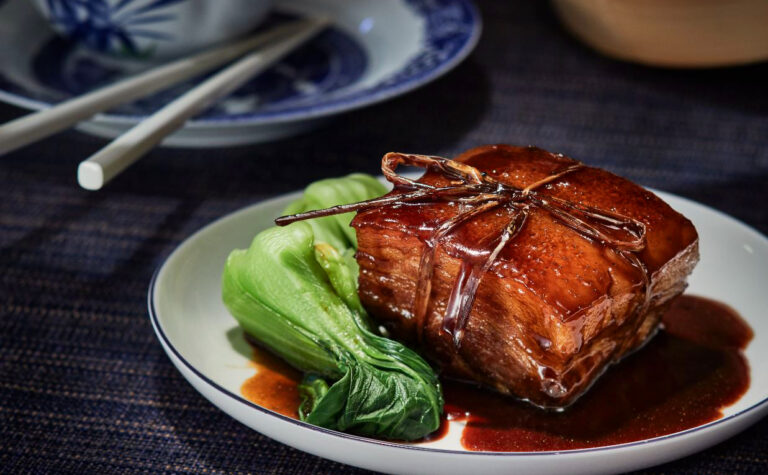
Pork is a staple in many Asian cuisines. Braised Canadian pork belly and bok choy (a type of cabbage), shown here, is one example of Asian inspiration using Canadian ingredients.
The Canadian pork industry has enjoyed considerable growth over the last three to four decades, due in large part to a focus on developing export opportunities for Canadian pork products around the globe. For years, markets in Asia have been considered highly regarded outlets for quality-assured pork processed by Canada’s federally inspected packers, from pigs raised by the many farmers found from coast-to-coast.
Today, Canada is the world’s third-largest exporter of pork behind the European Union (E.U.) and the U.S. Currently, Canada exports 71 per cent of all pork produced, which is higher than any other international producer. Chile exports 42 per cent of its pork, followed by Brazil at 30 per cent, the United Kingdom (U.K.) at 27 per cent and the U.S. at 24 per cent.
Competition is fierce as countries look to expand their share of the export marketplace. Competitive market access for Canadian pork products remains one of the most important challenges facing the industry, for packers and producers alike.
Recently, a delegation of representatives from Canada Pork and Canada Beef visited several Asian countries to meet with protein industry players and showcase Canadian red meat. Canada Pork, formerly known as ‘Canada Pork International,’ is the market intelligence and promotional organization for the Canadian pork industry, established in 1991 by the Canadian Pork Council (CPC) and Canadian Meat Council (CMC).
International trade show attendance has long been a critical relationship-building exercise for Canada Pork. COVID-19 encouraged us to adapt to virtual options for reaching our audiences, but there is no doubt that face-to-face interactions are better at reinforcing Canada’s respected reputation in the red meat sector.
In addition, trade shows provide an opportunity to conduct technical or marketing seminars to maximize our impact and share the Canadian pork story with current and prospective foreign partners. Given these realities, trade show participation continues to be one of Canada Pork’s highest-rated activities for member companies, according to annual stakeholder satisfaction surveys.
Canadian pork’s a ‘thrilla in Manila’
World Food Expo attendees in the Philippines flocked to the Canada Pork booth to learn about the quality and taste of Canadian pork.
To kick off our latest mission to Asia, Canada Pork participated in the World Food Expo (WOFEX) held in Manila, the Philippines, in early August. WOFEX hosts more than 50,000 attendees annually and is the largest food and beverage show in the country. Canada Pork’s Market Development team exhibited alongside 12 Canada Pork members from six Canadian pork export companies.
The Philippines was the fifth-largest market destination for Canadian pork in 2021 by both volume and value, representing 125,000 tonnes and $300 million.
While in Manila, Canada Pork collaborated with the Trade Commissioner Service in the Philippines – the Government of Canada’s overseas business development bureau – to organize a series of meetings between Canadian pork exporters and local meat importers. More than 75 Filipino in-market buyers were matched with Canadian companies during the three-day event.
Trevor Sears, President & CEO, Canada Pork delivered a presentation on the importance of the Philippines market to the industry.
“Premium-quality Canadian pork is the result of the hard work of our many producers and processors,” said Sears. “At home in Canada, and here in the Philippines, consumers are afforded the same trustworthy, delicious, nutritious protein that is incredibly versatile and reliable.”
‘Sling’ing Canadian pork in Singapore
Trevor Sears was interviewed by a local food blogger at Food and Hotel Asia about Canada Pork’s experience at the event.
In September, Canada Pork took part in two international events in southeast Asia. First was the Food and Hotel Asia (FHA) trade show in Singapore. FHA took place early in the month at the Singapore Expo, featuring more than 2,000 exhibitors and 50 international group pavilions, hosting more than 57,000 visitors from around the world. Six Canada Pork member exporter companies participated in the Canada Pork booth at FHA.
The event also included a joint Canadian Meat Seminar, presented by Canada Pork and Canada Beef for 45 meat buyers from all over the region to learn more about Canada’s commitment to offering premium quality meat that global consumers know and love. Presentations were delivered by Sears and Albert Eringfeld, Executive Director, Export Market Development, Canada Beef.
On the pork side, the seminar provided a look at global market conditions, an overview of the Canadian pork industry and available supporting resources, along with an exploration of the Verified Canadian Pork brand. The Verified Canadian Pork logo appears on packaged pork products sold at the retail level in Canada and overseas, informing consumers that these products are backed by top industry standards in food safety, animal care and traceability.
The Verified Canadian Pork value proposition is built upon the connection between Canada’s on-farm and in-plant quality assurance systems. For producers, those are represented by the PigSAFE and PigCARE components of the Canadian Quality Assurance (CQA) and Canadian Pork Excellence (CPE) programs.
Don’t ‘Pho’-get Vietnam
Information session participants are provided various resources to keep Canadian pork on their minds.
Following FHA, in late September, Canada Pork traveled to Ho Chi Minh City and Hanoi, Vietnam to host meetings between Canada Pork member delegates and local importers.
Vietnam was the seventh-largest market for Canadian pork by volume and eighth-largest by value in 2021, representing almost 25,000 tonnes and more than $50 million.
The visit to Ho Chi Minh City also provided the opportunity for the Canadian delegation to visit with several large importers to conduct high-level meetings at their corporate offices, followed by tours of local grocery stores around the city.
Between Singapore and Vietnam, the two-week trip provided the occasion to meet new customers, create market development opportunities, and build profile and awareness for Canada Pork in southeast Asia – a fast-growing market for Canadian pork.
Canadian quality, enjoyed globally
Up next, Canada Pork will meet the world in France for SIAL Paris.
Following the successful visit to Asia, in mid-October, Canada Pork will accompany Canadian pork exporters at SIAL Paris, held every two years. The Salon International de l’Alimentation (SIAL) network was founded in 1964 and today includes 14 leading food and beverage shows across the world.
Whether in Asia, Europe or elsewhere, international trade shows and market development activities, including seminars and business-to-business sessions, are important components of an overall strategy to improve market access and establish a global preference for Canadian pork.
Market access and global preference, in turn, benefits not only our trusted international buyers but also the tens of thousands of individuals whose livelihoods are based in Canadian pork production, processing and related parts of the value chain. Canada Pork is proud to represent these members and works tirelessly to promote their good work and products.
Pork Commentary Jim Long President-CEO Genesus Inc. October 3, 2022
Here Come $1.20 Lean Hogs
Last week the USDA released the September 1 Hogs and Pigs Report:
2020
2021
2022
2022 as a percent of 2021
2022 as a percent of 2020
(1,000 head)
Kept for breeding
6,333
6,190
6,152
99
97
Market
72,766
68,677
67,648
99
93
Under 50 lbs.
22,559
21,690
21,343
98
95
50 – 119 lbs.
20,490
20,211
19,887
98
97
120 – 179 lb.
15,547
14,246
14,073
99
91
180 lbs. and over
14,169
12,529
12,345
99
87
Sows Farrowing
June – Aug
3,260
3,050
3,018
99
93
Sept – Nov
3,165
3,049
2,973
98
94
Pig Crop
June – Aug
36,056
33,944
33,581
99
93
The U.S. breeding herd continues to decline. It reached its recent peak in December of 2019 at 6.471 million. This September USDA report 6.152 million. An almost steady decline over the last three years to over 300,000 less (-4%). A reflection of the general lack of profitability in the industry. Less sows mean less hogs.
The decrease in sows is reflected in market inventory with the September 1 report indicating 5.118 million fewer hogs (-7%) than in September 2020. Compared to last September 1 about 1 million fewer. We expect the current market inventory will result in 200,000 fewer hogs per week over the next 6 months compared to 2020.
USDA also projects fewer sow farrowing’s in the future.
Summary
Less sows, Less markets, Fewer sows to farrow, Less supply of hogs. This is bullish.
We thought it would be interesting to look at where the breeding herd inventory of each state has evolved since September 2019.
September 1 Breeding Herd
(1,000 head)
2019 ranking
2019 size
2022 size
ranking
1
Iowa
1,030
930
1
2
North Carolina
900
820
2
3
Minnesota
580
510
4 (tie)
4
Illinois
560
590
3
5
Missouri
470
430
6
6
Nebraska
450
410
7
7
Oklahoma
450
510
4 (tie)
8
Indiana
260
250
9
9
South Dakota
245
300
8
10
Ohio
190
190
10
11
Kansas
170
160
12
12
Colorado
155
125
14
13
Texas
150
170
11
14 (tie)
Michigan
120
110
15
14 (tie)
Pennsylvania
120
140
13
The big decline in the breeding herd has been in Iowa, North Carolina, and Minnesota. The growth in Oklahoma and South Dakota. Probably lots of reasons for the decline some due to the health of herds. Feed costs in North Carolina, Oklahoma, and South Dakota has relative isolation and demand for market hogs. When all is said and done few quit pig production when they are making money. The general erosion of the U.S. pig inventory is a reality of a lack of profits.
Other Observations
U.S. market weights in latest report 280.3 lbs. a year ago 283.5 lbs. 3.2 lbs. lower. They are reflecting the current market inventory.
U.S. sow slaughter in August was 273,020, a year ago 257,800. The week of September 17 was 65,727. Sow slaughter in our opinion indicates no sow herd expansion, maybe in continued sow herd contraction
The September USDA Hogs and Pigs Inventory Report sure indicates that the U.S. Quarterly Pork Production Projection indicating an increase in Pork Production in 2023 is wrong.
USDA Quarterly Production
(million pounds)
2022
2023
Quarter 1
6904 (actual)
7000
Quarter 2
6639 (actual)
6545
Annual Projection
27,133
27,520
The USDA has been projecting about 400 million more pounds of pork in 2023 than in 2022. We find that hard to believe with less sows and hogs in inventory. USDA projections are 2 out of 3 times overestimating supply in Pig Report which is always to the detriment of production as it drives down expectations and gives futures traders a reason to bad mouth the market.
Market Prices
June lean hogs are at 96.625 and close on Friday. Lean hogs reached over $1.20 this summer and the previous summer. There are significantly less hogs in inventory now than the last two years. Only the insanity of futures trading could lead one to believe that June will be 96¢ in 2023. Other Observations.
China released 200,000 tonnes of Pork Reserves in the first 3 releases. China produced 53 million tonnes of pork in 2021. 200,000 tonnes are next to nothing in a market of 1.4 billion people. It’s why the hog price in China continues to climb. Last week 24.59 RMB/kg ($1.56 lb.) was up from 23.56 RMB/kg on the first of September. China will be importing pork; the release of pork reserves is the government’s attempt to hold down price. It will slow it but the lack of hogs can’t be overcome.
Mexico bought 23,750 tonnes of pork in the latest data week. The largest amount since July 2021. I have done business in Mexico for decades. Usually, the price of market hogs is about 10¢ lb. higher in Mexico than in the USA.
Last week in Mexico it was liveweight $1.02 U.S. lb. (45 pesos/kg). In the USA price was 73¢ lb., 29¢ lb. difference. The reason for the big export sale. That spread will pull massive levels of pork into Mexico. Trucks will be rolling.
Summary
There is much talk of the economy, currency, and inflation cutting pork demand. Maybe? When we look at hog profitability over the last 40 years there is little correlation between the hog cycle and the economy. One example is 1983 which had 13% inflation – 17% interest rates – Iowa state farrow to finish profitability that year over $40 per head. The key to us is the continued liquidation of hog supply in the USA, Europe, and China – 75% plus of the world’s production. There will be less pork which will push prices higher. Supply – demand – attitude – 96¢ lb. June futures – a terrible travesty – $1.20 June futures write it on the wall.
Pork Commentary Jim Long President-CEO Genesus Inc. September 26, 2022
U.S. Lean Hog futures took a hit last Friday due to two reported events. One is the third release of China’s pork reserves and the other ASF breaks in South Korea. Our take:
China releasing pork reserves should be positive for the market not a negative. This third release of pork reserves indicates the Chinese government’s attempt to hold their domestic hog and pork prices down. So far, the China domestic hog price has continued to increase despite the release of pork reserves on September 8th, 18th, and now on the 21st, the third batch. No one seems to know how much pork is being released. It would need to be a significant amount to affect a market of 1.4 billion pork-eating people.
China Hog Price
RMB/kg
U.S. Dollar Liveweight
April 1
12.59
90¢
June 1
15.81
$1.07
August 1
21.68
$1.45
September 1
22.76
$1.49
September 16
23.72
$1.53
September 23
24.29
$1.54
As you can observe from the above pricing the price of hogs has actually increased with the September release of China’s pork reserves. Last week was the highest price in 2022. There is no doubt in our opinion that China’s massive sow liquidation in the last half of 2021 and the first part of 2022 has cut production. We expect the only way China can limit pork price increases is from increased pork imports. We speculate the Chinese government will prefer pork imports to inflation enhancing rising domestic pork prices.
Doesn’t make any sense to us why U.S. futures would decrease due to the ASF break in South Korea. Any country that so far has had ASF breaks ends up very quickly having higher hog prices, especially in a pork importing country like South Korea. On the South Korean ASF break, we were with South Korean Genesus customers this past week. They expect like prior ASF breaks in South Korea it will be contained quickly and have little effect on Korean pork production or prices.
Last week South Korean market hogs were 5,425 KRW/kg carcass of $1.77 U.S./lb.
Other Observations
Beyond Meat – Chief Operating Officer got into legal problems when allegedly biting another person’s nose after an Arkansas Razorbacks football game. Beyond Meat (NASDAQ: BYND) stock has fallen from a high of $234 per share to $15.69 last week. In the last year, it has lost 86% of its share value. Also, it appears McDonald’s has stopped its Beyond Meat burger experiment. No doubt because consumers don’t buy their fake burgers. Taste Matters. You sure wonder how investors will look at the Fake Meat industry going forward with billions of dollars lost so far. You wonder what would happen if that money would be put into real meat production for producing innovative products with better taste.
Last week Danish Crown announced they were cutting hog slaughter in Denmark. Less pigs are available due to sow herd liquidation; the Danish herd is down 6% on the latest data.
The latest U.S. slaughter weights 279.6 lbs. a year ago 281.9 lbs. Hogs 2.3 lbs. lighter than a year ago. We are learning of some packers aggressively encouraging hogs to slaughter. We have lighter hogs and weekly kills lower than a year ago. Tells us less hogs than a year ago out there. No reason this isn’t price-supportive.
One of the factors affecting all ag exports including pork is the strength of the U.S. dollar which makes U.S.-produced products less competitive in global markets. The U.S. dollar to Euro was .85 a year ago, and last Friday 1.03. The U.S. dollar index (a bundle of foreign currencies) a year ago was 93, last Friday it closed at 111. A higher U.S. dollar limits pork exports relative to other suppliers and makes pork most costly in buyers’ countries’ currency. The one upside is most countries’ pig (pork) price is high and the EU our major export competition has high hog prices.
The major swine genetic company in the world is Genus plc (PIC). They are a publicly owned company on the London Stock Exchange (LON: GNS). Their share value was 5,575 pounds a year ago, and last Friday 2,818 pounds. The swine industry has been hit hard over the last year with sow liquidation in China-Europe, USA not much better. Whether hog producers, packers, feed companies, or genetic suppliers, the effect of a contracting global industry due to continued financial losses affects all. The hog cycle is alive and well, we expect lower global hog supply will lead to even stronger hog prices. The cliché a high tide raises all boats comes to mind.
Pork Commentary Jim Long President-CEO Genesus Inc. September 19, 2022
Even the trading players in the Lean Hog Futures are starting to realize that lean hogs have an upside in 2023. June hogs have risen from a contract low of 92.85 to a close last Friday of 104.875, a new June 2023 contract high.
We believe June and other 2023 months are still undervalued.
Why?
No more hogs in the USA – sow herd smaller than a year ago.
Less U.S. beef in 2023 – USDA projects 7% less beef in 2023.
Less hogs in China and Europe – a combined 65% of global hog production.
Avian flu in Europe and USA – decreasing poultry production.
Less, less, less. The only way to ration lower supply is higher prices.
Our rationale we had $1.20 plus lean hogs this summer. Who would believe June 2023 would only be 104.875 with less global meat protein supplies in 2023? Our thought $1.20 plus is the reality for summer 2023.
Pork
Was in a retail store last week. Have to say it was upsetting.
Boneless Loins – $2.25 lb. Advertised as everyday price.
Lean Ground Beef – $2.95 lb.
Prime Rib Roast – $17 lb.
What a sad testament to our industry as we observed a pile of white loins devoid of marbling. The packer of loins is a proud user of the world’s largest genetic company. The Prime Rib is 8 times the price of loins. It tells us without a doubt what consumers are willing to pay.
If we hear one more time that consumers won’t pay for better-tasting pork we will scream. One thing is for sure “The Other White Meat” program successfully created loins that have a lower value than lean ground beef. Job well done. We will continue to fight for our industry to make better-tasting pork. Sometimes seems like pushing a chain uphill but we will keep pushing. It’s how our industry will find a path to higher prices and demand. Prime Rib 8 times the price of Loins – Taste trumps all.
China
In the first half of 2022, the four largest public swine companies in China lost a combined 18.6 billion RMB ($2.66 billion U.S.) selling 50.98 million pigs. A loss of $52 per head on average.
The losses in the last half of 2021 were quite similar.
Let’s assume the four largest public companies losing $52 per head on average are a reflection of the whole industry.
Let’s do farmer arithmetic: total China industry losses on 600 million market hogs in the last twelve months. Loss of $52 per head = $30 billion U.S. total loss.
When losses mount producers do what’s necessary to cash flow. Zhengbang is one of the four largest producers. In January 2022 they reported the average weight of market hogs was 105 kg (231 lbs.) July 71 kg (156 lbs.). A huge drop of 75 lbs. January to July. When you read reports the reason price of hogs has increased in China because producers are holding hogs back. As if.
Producers need cash to survive. Zhengbang weights explain China’s hog slaughter numbers but hog prices are up. It’s not only heads of hogs but tonnes of pork produced that drive price. Lighter carcasses indicate pull-ahead hogs and less in inventory.
The Chinese government has announced they were releasing pork reserves to dampen hog prices. Last week China’s hog market averaged 23.72 RMB/kg ($1.53 U.S. lb.). The highest price this year. The mid-March price was 85¢ U.S. lb. On a 270 lb. hog now $413 U.S. per head. March was $229 U.S. per head. An increase of $184 U.S. per head. No reason this can happen but from less pork in the system. The huge losses from last year and the first part of this year have no doubt cut millions of sows.
The Chinese government doesn’t want higher pork prices driving inflation. That’s why they are releasing pork reserves. The next option to hold down China’s pork prices is increasing pork imports. It’s not if but how fast does China’s pork imports increase to a major extent? Market hogs of over $400 U.S. per head leave lots of room for China importers to make money importing pork. Profits and need are great motivators and incentive.
Pork Commentary Jim Long President – CEO Genesus Inc. Sept 12, 2022
This past week saw continued pressure on U.S. hog markets as Lean Hogs continue their drop from summer highs.
Some Observations
Last week’s slaughter was 2,243,000, almost the same as last year’s same week of 2,248,000. Year-to-date slaughter is down 3.3%.
Iowa – S. Minnesota slaughter weights a week ago 277.7 lbs. the year before 278.9 lbs. Hog inventory is certainly not backed up.
Average Lean Hog Futures on Friday average from September 2022 – August 2023 – 92.73. What’s the over/under on that?
We have been writing about Europe’s sow liquidation ongoing for months. Last week the United Kingdom released its sow inventory for June. Compared to a year before down 18%. A real reflection of the financial challenge in the UK and much of Europe have faced. The current carcass price in the UK is 198.40 British pounds/kg ($1.05 U.S. lb.) (what we understand is a record price). In February it was 138.1 (85¢ U.S. lb.). The price increase to date is from about 3% less hogs year over year. What happens when it is 18%? At the current prices, producers in the UK are losing money due to high energy costs.
In our opinion, Europe will be seeing less pork production per month year over year for the foreseeable future. This will push hog prices ever higher.
Avian Flu seems to be acting up again. Reports in the U.S. and France are indicating renewed activity. It seems to hit mostly Turkey and Egg flocks in the U.S. Broilers in France. A 3 million commercial Table Egg Layer flock broke in Ohio a week ago. In the last couple of weeks, 600,000 Turkeys in California and Minnesota hit. Turkeys a big item for Thanksgiving are hitting record prices around $1.50/lb. up about 24% from the prior year. Higher Turkey prices are probably supportive of Ham prices, especially during the holiday season.
The USDA is projecting Beef production to fall by almost 2 billion lbs. (-7%) in 2023 compared to 2022. The U.S. – Canada inventory report for July 1st was just released.
(1,000 head)
2020
2021
2022
Cattle and Calves
114,875
113,445
111,090
Almost 4 million less cattle from 2 years ago with the ongoing drought in the U.S. west there’s a good chance liquidation continues. Less Beef is price supportive for Pork. Beef cut-outs are $2.65 U.S./lb. Pork is $1.03 U.S./lb. Consumers are willing to pay more for Beef. Why? Is it our industry’s failure to deliver a better-tasting product?
Current weekly Beef Production is about 500 million lbs. a week. The USDA estimate of almost 2 billion less lbs. of Beef in 2023 would equal to 4 weeks of production disappearing. That’s a lot of meat not available.
USDA is projecting Latin American pork production to increase slightly in 2023 (0.4%). They expect less exports and more imports. Consumption they believe will have a significant jump of 3.3%.
Mexico the U.S. largest pork export market is projected by the USDA to increase imports by 8.2% compared to 2022 from 1.155 – 1.250 million tons.
China
According to public data, 17 publicly listed pig companies lost a total of 21.819 billion RMB ($3.50 billion U.S.) in the first half of 2022.
Losses Include
Muyuan
-6.871 billion RMB (-$991 million U.S.)
Zhengbang
-4.009 billion RMB (-$578 million U.S.)
Wens
-3.864 billion RMB (-$557 million U.S.)
Lots of money lost. These enterprises all with over a million sows at the beginning of 2022 are a reflection of the situation that China’s industry was in the first half of the year and the last half of 2021. The losses have cut China’s sow herd significantly and like Europe will see continued year-over declines in production for the foreseeable future.
Pork Commentary Jim Long President-CEO Genesus Inc.
September 6, 2022
We have been writing for several months about the reality of Europe’s challenge of profitability in the swine sector and that has been leading to sow herd liquidation.
InterPIG, is an international group of economists that gather together physical and financial data to a standard methodology so that the cost of production can be compared across a select group of countries. Below is a chart that showed the 2021 cost of production and selling price in different countries. U.S. dollars/kilogram liveweight.
Using a 120 kg liveweight basis we calculate the returns or lack of per country.
2021 – Full Year
Country
Profit/Loss per head
Netherlands
-$38.40 Loss per head
Germany
-$34.20 Loss per head
InterPIG Includes: Austria, Belgium, Czech Republic, Finland, France, Great Britain, Ireland, Italy, Sweden (Over 2.5 million sows)
-$14.40 Loss per head
Spain
$3.60 Profit per head
Canada
$15.60 Profit per head
Denmark
$3.60 Profit per head
U.S.
$39.60 Profit per head
Brazil Mt.
$0 Profit per head
Brazil SC.
$9.60 Profit per head
It doesn’t take an ag-economist to see that producing pigs in Europe in 2021 wasn’t a profitable experience. The Netherlands, Germany, and many other countries are quite dismal. We expect in the first six months of 2022 the financial picture didn’t change much as higher hog prices in 2022 have been negated by higher feed prices. Last week the U.S. national corn price was estimated to be $7.25 a bushel. Corn in Spain last week was $9.50 a bushel.
InterPIG estimates would put Denmark at a $3.60 per head profit in 2021. Denmark data indicates the Danish sow herd is down 8% year over year this July. Imagine what has happened in the countries that lost big money?
We expect the EU sow herd declined significantly from the end of 2021 through up to at least July this year. Lower slaughter numbers year over year is being seen. We are now marketing pigs that these mothers were bred last October-November, in our opinion, the sow herd has gotten continually smaller from then. Less Pigs to market in the coming months and less Pork to sell. We wrote last October after our visit to Europe that we expected the EU sow herd would decline up to 1 million sows due to the losses the industry was seeing. Looks like our opinion might have been correct.
One point on InterPIG data we have a hard time believing is the average U.S. market hog in 2021 led to a profit of $39.60 per head. If that much money was being made the U.S. sow herd wouldn’t have got smaller.
Pork Commentary Jim Long President-CEO Genesus Inc.
This past week Lean Hog futures, pork cut-outs, and hog prices declined while corn and soybeans jumped higher. There is certainly not a week for joy in Hogville. Our observations:
We aren’t smart enough to understand the sudden decline in hog pricing factors. The pork cut-outs and hog prices dropped but there were no more hogs to slaughter than the week before. Beef cut-outs didn’t move.
Corn and soybean prices jumped on reports of an expected smaller U.S. crop. Keep in mind Brazil, Russia, and Western Canada all have or expect excellent crop production, and all are major exporters of grains and oilseeds. The strong U.S. dollar will encourage global buyers to look at these countries as sources.
Ukraine, a major global exporter appears to be back in the game. After no ships moving for 6 months. As of last week, over 44-grain ships have left, 70 pending. More grain into world markets.
China has relisted approval of several of Canada’s hog packing plants. They did this on their own accord. We speculate China realizes they will need to import pork and want as many options as possible to source pork for competitive reasons. Pork moving to China is supportive for all Global Pork Exporters.
The Canadian government estimates that total Grain and Oilseed production will increase this year to 87,297 (K+) from 65,039 (K+) last year. A huge increase and recovery from the drought of last year.
Germany’s hog slaughter has been running between 700 – 750,000 a week in the last while. A couple of years ago it was around 1 million. No wonder Europe’s hog prices are near record levels as the massive liquidation of sows is being felt in lower supply.
European hog prices are at record levels – China’s hog price has almost doubled since the first of April. We are currently marketing hogs bred in October – November last year. Our observation is the sow herds of Europe – China both saw major liquidation since October. They both had huge financial losses until late spring. In our opinion the supply of hogs in both areas is going to see even greater year-over-year production declines in the coming months. Year over year global pork supply is declining. How do you ration less supply? Higher prices.
U.S. hog supply. Farmer Arithmetic – Smithfield Foods has announced the decrease of their sow herd in Utah tied to the closing of the Los Angeles slaughter plant. Our opinion is the Utah decline means the net U.S. sow herd is not expanding.
U.S. sow slaughter in July this year was 237,000 a year ago 246,000. There was one less workday in July this year. Year to date U.S. sow slaughter 2.5% of total slaughter the same as a year ago less sows have been slaughtered but the sow herd is smaller. In July though less sows were slaughtered than a year ago the percentage of slaughter was 2.6% higher than last year’s 2.5%. This tells us net U.S. sow herd not moving much one way or another.
It’s been really uplifting for us to see the reaction in the marketplace with the Genesus – Jersey Red Duroc. We continue to win taste tests domestically and globally. For more than two decades we have believed that taste trumps all with consumers. As my father used to say, “It’s like pushing a chain uphill” and that’s how it has felt. Genesus has been the lone and lonely genetic company that has believed the key to increasing per capita consumption is a better eating experience. Don’t we sell pork to compete with beef? Beef gets more money because consumers will pay more, they vote with their money. Those who say consumers won’t pay more miss the point. They will but they want to get a good predictable eating experience, not disappointment from too many marble-devoid loins.
Genesus is the Number #1 genetics imported to South Korea and has been for several years. It’s a market where consumers demand high marbling to get a better taste but producers need feed costs and disease challenge resistance at a competitive cost of production. Our Korean dealer summed up why Genesus is Number #1:












Fall 2022 – Letters to the editor
In reply to “Hog Journal hits 50: a look back” (Spring 2022)
“Here I am watching the Oilers-Flames game and thumbing through the Hog Journal during the TV ads. I read the ‘Hog Journal hits 50’ article and got to the end where it mentions few producers are left who were in business then. I guess I must be getting old, because I’ve been reading the Hog Journal for all 50 years raising pigs the whole time! While the industry has seen many changes over that time, one thing has not changed: there are still very good and dedicated people involved in all areas.” – Bryan Perkins, Wainwright, Alberta