Saturday, January 10, 2026

High grain prices drive feed costs

By Bijon Brown

Editor’s note: Bijon Brown is the Production Economist for Alberta Pork. He is currently collecting and analyzing cost and pricing data to improve producer success. He can be contacted at bijon.brown@albertapork.com.
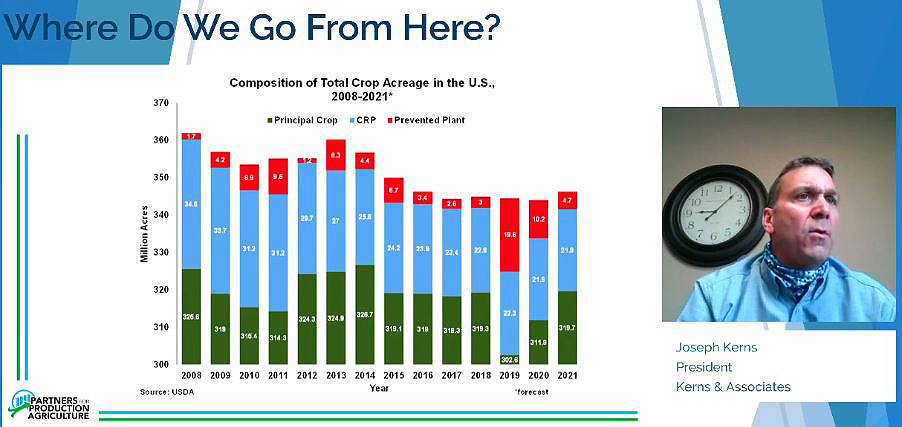
Joseph Kerns believes the grain market could potentially have a significant impact on hog margins in the coming year.

“Listen to the whispers, not the big headlines, in the market,” said Joseph Kerns, as he opened his keynote presentation during the 2021 Banff Pork Seminar. Kerns is the President of Iowa-based Kerns & Associates, with 30 years’ experience working with producers, suppliers and feed mills to support agricultural operations.

In his presentation, Kerns provided an overview of three economic topics of interest for 2021: the U.S. grains market, the U.S. livestock market and the actions that can be done to safeguard producers’ financial well-being.

Current grain price surge reflects tight U.S. supplies

“The grain market has awakened from its slumber… For the last five years, I have been saying, ‘The grain market is boring, guys – don’t worry.’ Now I am changing my song,” said Kerns.

U.S. supplies of both corn and grain are limited, based on last harvest and the outlook for supplies. With the downward revision to U.S. Department of Agriculture (USDA) numbers, wind damage and drought-like conditions in the late summer to fall, corn harvest numbers in the U.S. fell to almost half of initial expectations.

Looking forward into this upcoming crop year, as dry conditions remain in the major grain-producing regions of the U.S., and with expected fulfilled sale commitments to China, supplies are predicted to remain tight. A mitigating factor is that ethanol stocks were extremely high in 2020 due to a fall in demand for gasoline, driven by COVID-19. As such, it is expected that corn demand for ethanol will remain subdued, as the market adjusts its inventory. Kerns highlighted that, even with a bumper crop in 2021, ending stocks should remain average at best, meaning prices should stay high.

And it is the same story with soybeans, which are benefiting from strong demand in Asia. This is coupled with drier conditions due to La Niña, the colder counterpart of El Niño, both of which are oceanic-atmospheric phenomena that impact weather in South America. These factors have strained global supplies and resulted in higher soybean prices.

Outlook stable for U.S. packers, grim for producers

The USDA hogs and pigs report indicated a massive number of pigs would have been due to show up for slaughter toward the end of 2020 and in the new year, but this has not materialized so far. Nevertheless, the U.S. market is awash with hogs, and packers, therefore, are able to buy cash hogs cheaply and make a decent return on sales.

Kerns indicates that packer margins are expected to remain healthy at the expense of producer profits. While revenues are expected to be higher this year, rising feed costs are expected to erode profits, and producers are expected to break even, at best. Despite another year of mediocre profits for producers, Kerns projects a slight increase in production numbers, mainly due to productivity gains. If feed costs remain high, he expects weights to decline.

Likewise, cattle producers could be looking at a bad year, as there are too many animals on feed, facing the same cost problems as hog producers. In the dairy sector, the milk futures price is below cost of production. While there were some downward adjustments to U.S. broiler chicken production in the spring of 2020, production bounced back toward the five-year high by the fall of 2020. As such, broiler prices remained below the five-year average.

China still exerts major influence on hog markets

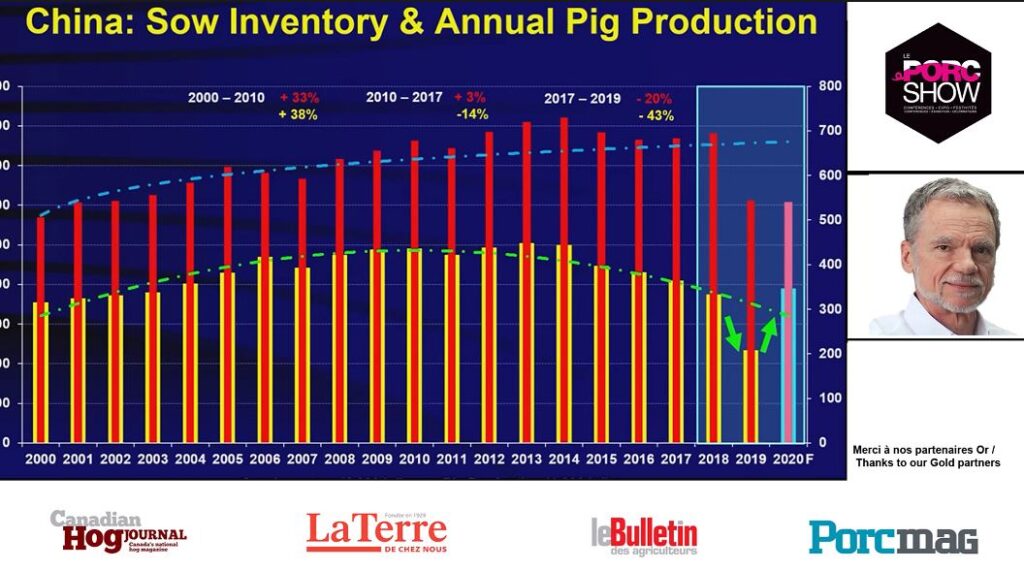
Ever since the African Swine Fever (ASF) outbreak that decimated half of its herd, China has transitioned more of its domestic production from backyard farms to American-style mega farms. Along with the ban on feeding human food scraps, there is now and will continue to be increased demand for feed grains.

Inclement weather experienced during China’s growing season did not boost supplies and has resulted in significant draws on world grain supplies. While China’s activity in the U.S. pork market has had a muted effect on U.S. prices, global events have exacerbated activity in grain markets. U.S. exports of soybean meal and corn continue to surpass previous highs and continue to drive grain shortages.

Locking-in could help producers prevent losses

Kerns recommends that producers use the economic tools available to hedge or lock-in some value. He highlighted that the pork cut-out futures contract provides either a one-to-one hedge if a producer’s current contract is based on the pork cut-out, or a basis hedge on the difference between cash and cut-out values.

Based on his economic projections, Kerns expects some cost-push inflationary pressure, and with it, higher interest rates. He recommends that producers who have the ability to lock-in at low interest rates or exercise an interest rate swap should do so now.

What does this all mean for Canada?
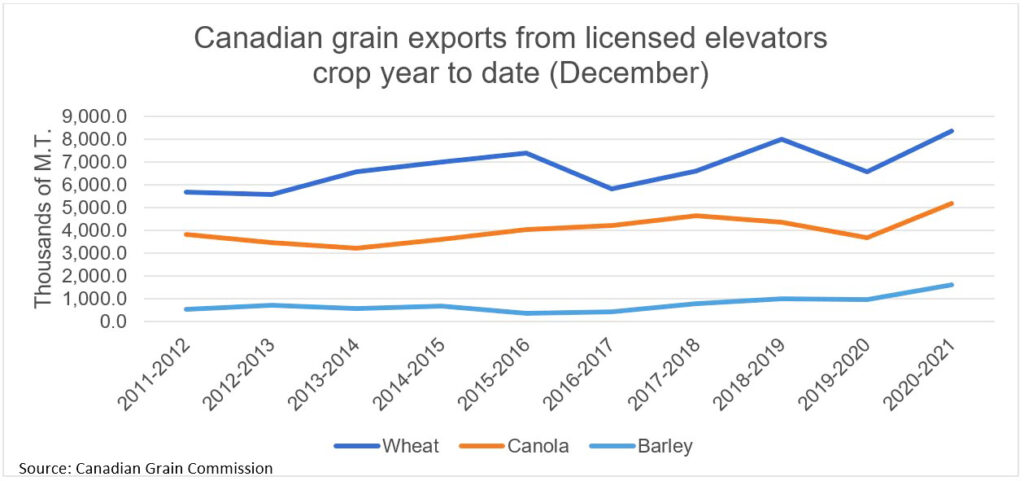
Increased wheat and barley exports from Canada to China have driven domestic feed prices upward.

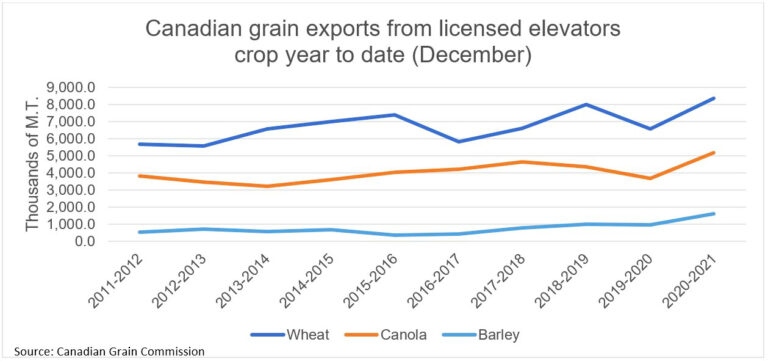
In Canada, there has been a similar trend with crop year-to-date exports for wheat, canola and barley at 10-year highs at the end of 2020. Barley exports to China have doubled, and wheat exports have jumped almost five-fold. These significant drawdowns have tightened supplies and lifted domestic grain prices. With U.S. supplies being tight, there is always the possibility of Canadian grain being pushed south of the border. Nevertheless, there was no significant movement in this regard based on the data for the crop year-to-date in December 2020.

If strong demand out of China persists and U.S. supplies continue to be tight, then this could mean grain prices remain elevated for the foreseeable future. Like U.S. hog producers, it is expected that Canadian hog producers’ revenues could be eroded by the higher cost of feed, despite the possibility of higher hog prices.

While publicly available hog and pork pricing data from Canadian packers is limited, Canadian pork export data indicates that revenues have jumped by almost 18 per cent. While, historically, the U.S. was once the largest export market for Canadian pork, 2020 bucked the trend, as most Canadian pork was diverted to the meat-deprived Chinese market. In 2020, nearly 40 per cent of Canadian pork exports went to China, more than double the volume in 2019. The growth in 2020 resulted in marginal declines in exports to both the U.S. and Japan.

Overall, the previous two years of Canadian pork export values and volumes, along with projections for 2021, indicate significant boosts to packer revenues, while producers have struggled to recover cost, let alone earn a profit.


Lean Hog Prices Continue to Rise

Pork Commentary, March 1st, 2021
Jim Long, President-CEO, Genesus Inc.

Jim Long's Pork Commentary

Iowa\Southern Minnesota Lean Hog Price closed last Friday at 79.81₵ lb. It has risen from 63.97₵ lb. average in December. Last February Iowa\Southern Minnesota averaged 58.33₵ lb. The last time Iowa\Southern Minnesota was this high was in February 2014 during PED epidemic when it was 86.72₵ lb.

Obviously, supply-demand of pork is pushing prices higher. No one and certainly not packers pay more than they have to.

This is going to get more interesting. Packers have had the longest run of the best gross margins in history. They don’t want to give that up if they can help it. Who would?

Where we are at in our opinion is a point of reckoning. We all want to see our own story in data and reports. Packers one side, producers another.

We expect Packers are looking at USDA reports and Chicken Little Economist analysis that says there will be more U.S. Pork in 2021 than 2020. USDA this week projected 28,724 million pounds (2021) versus 28,314 in 2020. If we were a packer we would gravitate to this information. We all search for what we want to hear. This information is helping to maintain current large gross packer margins ($30+) Packers hope it’s right and their fun will continue.

Producers on the other hand can see U.S. Pork Cut-outs in the 90’s despite kills of 2.6 million a week plus. Producers see hog weights have declined 5 lbs. since the first part of January. Producers know there has been significantly more PRRS and PED this year compared to last. Official lab reports indicate 30% more positives this year compared to last.

40 lb. cash feeder pigs last week averaged $88 – $30 per head more than a year ago. Many stories of empty finishing spaces that add up in the millions. Every pig is in a barn. No one has barns to be empty. The $88 feeder pig price is the cost to get pigs for these empty spaces.

It defies logic that there would be more pigs in 2021 than 2020. The financial losses of 2020 were unprecedented. The average Iowa\Southern Minnesota price in 2020 was $61.05. This was lowest annual price since 2009. The U.S. 40 lb. feeder pig price average in 2021 was $36.98. We have data back to 2000 and no year was this low. No way have huge financial losses make more pigs.

There was sow liquidation, a combination of producers exiting, and also a lack of gilt retention in sow herds. The average sow mortality is at least 1% per month. If you don’t have constant schedule to bring in gilts the herd declines.

We sell Genetics. We observed individual farms lower gilt purchases. We expect many sow herds have fewer females in inventory today compared to a year ago. That leads to fewer pigs.

Year to date, 2 months in, U.S. slaughter is 3.8% lower. Hard to believe all of a sudden slaughter will exceed last year (other than we go into comparing to last year’s pandemic shortened weeks). We believe the reckoning is coming. Slaughter will be declining, cut-outs-hog prices will continue to move higher. We expect Gross Packer Margins will decline as they have to chase fewer hogs or lose market share to competitors. We expect lean hogs reaching a $1.00 plus this year.

China

China’s hog price has declined over the last few weeks, but still real high at 31.78 rmb\kg ($2.23 U.S. liveweight a lb.). We expect part of this is from liquidation of pigs due to ASF. During an ASF break, it’s common practice in China to dump inventory, slaughter sows, all weights of pigs.

Reports are 18-20% of all China slaughter pigs currently are below normal slaughter weight. That could be 1.5 to 2 million lighter pigs a week. This, short-term, puts more pork into market which will cut hog prices. It also probably slows down pork imports temporarily.

There are reports that 15% plus of China’s sows have been slaughtered in the last 3 months due to ASF issues. Could be 5 plus million sows (80 million-plus pigs annually). Heaven knows just how many pigs have died that won’t get to market.

If correct a big setback to China’s domestic supply recovery. It also could mean a temporary slowdown in pork imports but in future more and longer time of pork importation.

This import scenario would continue to support hog prices in Europe, Brazil, and North America throughout most of 2021 and into 2022.

Lean hog futures not over-bought!

0

Pork Commentary, February 22nd, 2021
Jim Long, President-CEO, Genesus Inc.

We read in several places where some speculate lean hog futures are over-bought. We disagree.
Our reason is that the U.S. Pork cut-out price is in the low 90’s. This despite weekly kills of at least 2.6 million-plus until this past weeks weather hindered slaughter.

When you look at summer month lean hog futures in the 90’s, it’s not hard to believe this is not over-bought when weekly marketings seasonally should decline below 2.4 million.

In our opinion, the dynamics of lower supply due to sow liquidation and disease coupled with good demand will push summer cash hogs over $1.00.

Bill Gates
I do think all rich countries should move to 100 percent Synthetic beef” 

Links below are articles about Bill Gates promoting the benefits of lab beef (meat).

Link 2 : All wealthy nations should switch to synthetic beef

Link 1 : Rich nations should shift entirely to synthetic beef

It is always interesting to see self-serving elitist billionaires using their platform for social engineering. We always love the elite flying around on private jets with multiple homes talking about carbon footprints and how everyone else should live and eat.

Does anyone ever say “Bill we don’t care what you think.” So you made big money on software, you are part of the elitist 1% – that doesn’t make you an expert on everything. We as farmers are feeding the world, not software makers, there is more than enough food and we can produce more.

The issue is distribution of that food and who can pay for it. High-priced one percenter food from labs will not have the price or volume as the answer for food security.

U.S.D.A. is projecting:

  • 2021 Corn crop year at 15.2 billion bushels compared to 14.18 billion bushels in 2020.
  • 2021 Corn acreage planted 92 million, 90.8 million acres 2020
  • 2021 Soybean crop year at 4.5 billion bushels compared to 4.14 billion in 2020.
  • 2021 Soybean acreage planted is projected up 6.9 million acres, at 90 million acres.

Goes to show what higher prices does. A projected USA increase of (corn-soybeans) of 8.1 million acres. We expect the increased acreage planted will be seen all over the Northern Hemisphere- USA-Canada-China- Europe-Russia. Higher prices will find acres.

USDA projects 2021-22 $11.25 bushel soybeans, $4.50 bushel corn.

China

We are continuing to hear reports of major ASF issues in China. The hog price is still high but has declined slightly to $2.35 U.S. liveweight a lb. We expect the price pressure is from light hogs sent to market when ASF breaks (up to 18% of total slaughter).

In Russia and other countries when ASF strikes, pigs are killed and buried. In China they are sent to slaughter. It’s one of the reasons it will be hard to get ASF under control in China. The movement of ASF-positive pigs and then factor the illegal ASF vaccines that have failed and further spread the disease.


$265 U.S. 35 lb feeder pigs in China tell us all we need to know about supply-demand. Reports of 1.7 million sows slaughtered in China last three months certainly pressures small pig supply.

An observation. All these dead pigs in China will not be eating corn or soybeans. We expect China pork imports to be strong throughout 2021, supporting lean hog prices.

U.S. Market Continues to Strengthen

0

Pork Commentary, February 15th, 2021
Jim Long, President-CEO, Genesus Inc.

U.S. Pork cut-outs closed Friday at 88.38 ¢ lb. A very strong price in our opinion considering a weekly slaughter of 2,664,000. What will cut-outs be when slaughter in summer months declines to 2.3-2.4 million a week? $1.10 -1.20?

Weights of Market Hogs are declining. We estimate the last four weeks a 5 lb. decline. This means to us packers have pulled hogs ahead to maintain current slaughter levels.

Sow liquidation continues. We understand the Chicken Little Economists spoke this past week and did not think PRRS was a factor this year any more than any other. At the same time was explaining there was little liquidation in the sow herd. We totally disagree. PRRS-PED ripping up production at a high level. There has been sow liquidation and it continues; currently 10s of thousands of empty finishing spaces. They were built to hold hogs. All hogs are in barns now. Empty barns mean less hogs.

Cash feeder pigs touching $80 each, highest price in many years. All of this in the face of $5 corn. A sign of supply versus demand.

Jan 1 to Feb 12 this year compared to last U.S. hog slaughter down 4.3% – some of this can be related to slaughter days year to date, but certainly a sign of lower production. Most months of Lean Hog Futures reached contract highs on Friday. June closed 91.90 up from 74.75 in mid-August. We expect further upside as hog supply plummets.

China

Genesus does business in China. We are paying attention to what goes on in that market. Below are highlights of some Chinese reports we have translated.

China Feeder Pigs prices have increased for 11 straight weeks.

  • 16 kg. (36 lb.) feeder pigs 1681 RMB. ($260 U.S. dollars each)
  • Considering corn is $11.00 U.S. a bushel – certainly indicates supply-demand.
  • Breakeven over $400 per head

The ASF (African Swine Fever) epidemic is getting worse.

  • The proportion of low weight pigs shipped is an increasing sign of fast pig liquidation when ASF strikes (18% of total slaughter – light weights).
  • The recovery of pig production has not gone as smoothly as expected.
  • The widespread inoculation of substandard (illegal) ASF vaccines has made inoculated pigs infectious with mutated African Swine Fever virus.

Reports of pregnant sows sent to slaughter from vaccine poison. 

  • Report estimates some provinces sow inventory have declined 50%.
  • Due to the rise of sow slaughter the inventory of sows is estimated nationally to have declined 1.76 million in the 3 months November 2020 to January 2021 (10%)
  • The Report indicates cumulative pig semen sales from October 2020 to December 2020 are calculated down 16%.
  • You do not use AI if you do not have sows to breed.

It is not only sows that are being eliminated.

  • Mortality of infectious pigs can reach 70% which obviously cuts hog supply.

China report

“What is even more frightening is that the modified African Swine Fever (ASF) virus can be transmitted through the air. If one pig is vaccinated the whole farm may be infected by African Swine Fever.”

As you can see from above perspective, of the potential major issues slowing China’s pork production recovery, this analysis is far different than some of the reports of rapid expansion in China.


A potential decline of 1.7 million sows in the last three months is far from expansion. We have seen the difficulties Russia has had to stop ASF in the last ten years.

Our observations:

Russia’s biosecurity and space between farms are as great as any in the world. Russia does not use illegal ASF vaccines. They liquidate all pigs and close farm for 6 months minimum.

China uses illegal vaccine, does not liquidate pigs or empty farms. There are also maybe ten to twenty times more pigs in China than Russia. To us, it tells us ASF will continue at a high level in China for the conceivable future.


The high hog price and profitability will continue to encourage Chinese producers to keep producing in the face of ASF. The challenge; continual ASF breaks. We expect ASF will eliminate single farm operations that cannot afford the risk.

Our perspective is that China will continue to import pork at higher levels for a longer time than many are expecting.

The growth in pork production in China will be slowed by the continual ASF issue. For pork exporting countries these factors should be supportive to their hog prices.

July Lean Hogs Reach 90!

Pork Commentary, February 8th, 2021
Jim Long, President-CEO, Genesus Inc.

Last Friday July Lean Hog Futures reached 90₵. This is a new high for July 2021 – a long way from mid-August last summer when July was 75₵. An increase of over $30 per head. Good progress and we expect summer hog prices still have upside.

Don’t forget about the Chicken Little Economists stating in August lean hog prices 2021 had next to no upside. Good they knew nothing.

High Feed Prices

We all know feed prices have increased dramatically. This will affect global meat production, Poultry, Beef, and Swine. The high prices will curtail production as it increases break-evens. Curtailed production we expect will be due to lower number of units produced and reduced weights of these units.

Some things to watch

  • Hog slaughter weights. Will they go below year over year in next few weeks? Cutting pork tonnage. We would not be surprised.
  • Current U.S. chicken productio. Weekly egg sets, chick placed, slaughter down 2%. Up to 5 million less chickens per week. Chicken prices now 83₵ lb, a year ago 86₵ lb with feed prices up 40% year over year.
  • January 1st – February 5th U.S. Beef and Pork. Meat production down 2.7%.
  • Sow Slaughter. Our calculation is that 60,500 sows to market a week is approximate U.S. herd equilibrium. First 3 weeks 2021, the number over equilibrium is plus 20,000. Appears to us this means sow herd is contracting still.
  • Other global swine and meat production countries. High feed prices and ASF issues have squeezed margins in EU. We expect to see lower production, with some predicting Germany; the world’s fourth hog producer to be down 10% in 2021.
  • China. High feed prices with high hog prices. (Corn $11.00 a bushel). Expansion is under way. No one knows what production will be in future. ASF still a factor. Current China hog price is over $2.40 U.S. liveweight a lb. Hog price is the truth in supply (and demand).

Genus-(PIC)

Many of you have read over the last few weeks the detailed cost analysis of recommended feed rations of PIC and Genesus. You have read the huge difference of a cost of a ton of feed Genesus compared to PIC (55 lb-290 lbs). A huge $17.35 Genesus competitive cost per ton advantage.

This tells us our dedication as a company to produce genetics that make our customers more profitable is getting to the market place. Making your customers more money should be the number 1 goal of any business.

We, like you, probably don’t follow the London Stock Exchange closely. Last week though, we were told how Genus – (PIC-ABS) stock has increased significantly on the London Stock Exchange.

DateShare Price
February 22, 20192,280 
March 20, 20202,694 
February 5, 20215,30

As you can see Genus (owners of PIC) stock value has increased by double in a year. It is in a stratified area with Stock Price to Earning (P.E.) ratio of 85.62. A market capitalization of 3.46 billion pounds (U.S. dollars- 4.74 billion). A gain of about 2 billion U.S. this past year. Phenomenal share value growth.

The stock price to earning ratio (P.E.) of 85.62 is huge. For example, Apple’s P.E ratio is currently 37.21. Obviously the market has great faith in the future of Genus-PIC, and indirectly what genetics- technology and the pork future value is in the world. One of Genus (PIC) largest investors is BlackRock; from what we understand, the world’s largest investment fund.

Genus (PIC) is by far the largest swine genetic company in the world, but the swine genetic industry is still fragmented with using PIC’s market share claim. We estimate if it is correct, somewhere less than 15% of the world’s genetic supply.

Have to say seeing Genus (PIC) current capitalization value is a real head-turner for the President-CEO-Shareholder of Genesus.

Genesus is not owned by big investors like BlackRock. Genesus is owned by Pig Guys who understand technology and work every day knowing the day to day challenges of the owners of pig barns and production.

Maybe that’s why we believe that when you look at the real tangibles – pig numbers, growth, mortality, feed costs, taste – we welcome head to head comparisons with PIC.

There was a legacy company – IBM. Then came the disrupter – APPLE. Better with a focused purpose is always a good plan to bring value to customers.

SIP celebrates decade milestone

0

By Geoff Geddes

Editor’s note: The following piece was written for Swine Innovation Porc. For more information, contact Leslie Walsh at lwalsh@swineinnovationporc.ca.

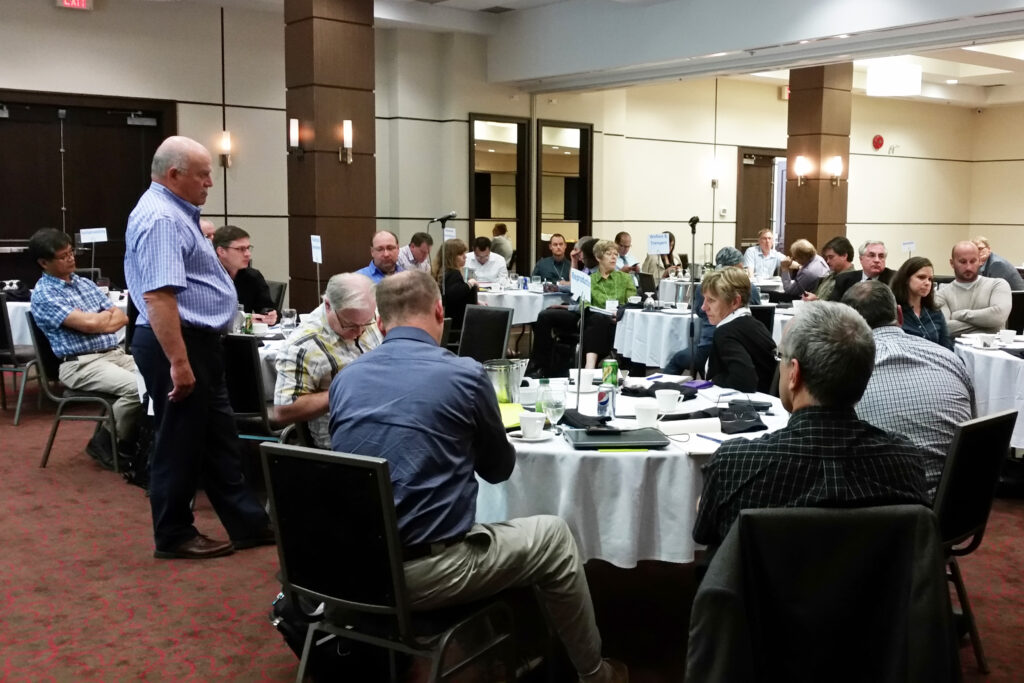
SIP brings together the brightest minds in swine research, as seen at this workshop, hosted in Winnipeg, in 2013.

Progress without research is like hiking without a compass: you may keep moving but likely in the wrong direction. In celebrating 10 years as Canada’s leading facilitator of pig research, Swine Innovation Porc (SIP) remains on the cutting edge of the ever-changing pork industry.

By supporting research to enhance profitability and sustainability, the non-profit entity – whose members include the Canadian Pork Council (CPC) and eight provincial pork producer organizations – acts as a guide to keep producers and industry on the path to success.

Since 2010, SIP has facilitated three national swine research and development programs that encompass more than 50 projects involving more than 100 researchers, injecting $51 million of investment into the swine sector. While many factors led to the formation of SIP, it was the power of collaboration that really drove its development.

SIP founded with a desire for collaboration

“Prior to SIP, the provinces had worked jointly on a national trucking project to evaluate pigs in transport,” said Stewart Cressman, Chair, SIP. “In doing so, we realized we had similar priorities, so how did it make sense that we each did research separately? It was clear that we could save money and get better results by combining our resources.”

As chair of Ontario Pork’s research committee at the time, Cressman was approached by the head of a Quebec research group who felt swine was not receiving research dollars from the federal government at the same rate as other commodities. Ontario Pork was asked to join them in approaching Agriculture and Agri-Food Canada (AAFC) about boosting funds for swine research. Also at this time, Cressman was invited to join the Canadian Swine Health Board (CSHB).

“The CSHB was the start of regular collaboration among swine industry representatives from around the country,” said Cressman. “One of our guiding principles was ‘national standards with regional implementation.’ We could look at national solutions, but implementation had to occur locally, considering significant regional differences across Canada. As an organization, we benefited from a diverse membership that included veterinarians, processors and representatives from AAFC, among others, so we had the full supply chain at the table.”

Amid greater activity in the swine research sphere, the federal government was working on a national research ‘cluster’ program for the agricultural sector, and SIP became one of those clusters for the swine industry.

“The government was looking at research as being demand-driven, where industry would determine their highest priorities and then cost-share with the government to carry out the research required,” said Cressman.

That cost-share arrangement was usually 25 per cent from industry and 75 per cent from government. In return for contributing the bulk of the funding, the government was quite prescriptive of what could and could not be done from a research standpoint.

“We would come to them with a Christmas list of the funding we wanted, and they decided how big the Christmas ‘gift’ would be,” said Cressman. “In preparation, we circulated a set of priorities to the research community every five years and asked for a three-page proposal or letter of intent. From there, after a stringent scientific review and industry input, we made recommendations to the government on which projects to support.”

Thus, SIP was initiated as a cluster management board that administers funds received from the federal government and matching dollars from industry. They have now embarked on a third cluster program and have developed considerable expertise in coordinating research programs and bringing researchers together with industry.

Early program wrinkles ironed out over time

“The current cluster program is working very smoothly compared to the first iteration, and I credit AAFC for listening to our feedback and making improvements to the cluster program,” said Cressman.

To continue with this spirit of collaboration, SIP introduced regular meetings among researchers from different institutions to discuss their findings and any modifications in analysis that might be helpful.

“We see senior researchers mentoring the rookies at these meetings, and new researchers bringing fresh ideas to the table,” said Cressman. “The result was a good exchange of ideas and an increased level of cooperation among swine researchers across Canada, which has been very valuable to the industry.”

Also of value to the pork sector is the aspect of knowledge transfer, something SIP has stressed from day one.

“We can’t assume that national research efforts meet every individual need of each province, but we hope we can provide results that our partners, researchers and provincial pork producer organizations will disseminate to their stakeholders for the benefit of all,” said Cressman.

To date, those benefits have flowed from a wide range of projects representing every aspect of the pork industry, including sow enrichment, phase feeding, truck washing, disease detection and more.

Sow enrichment equals healthier animals

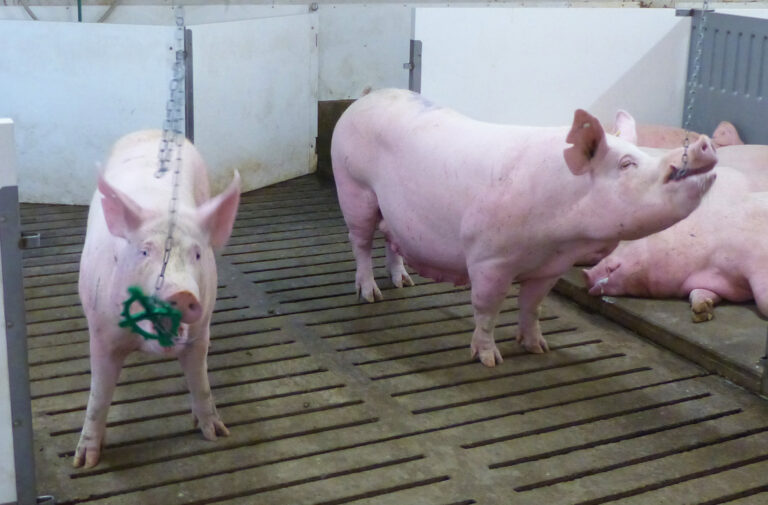
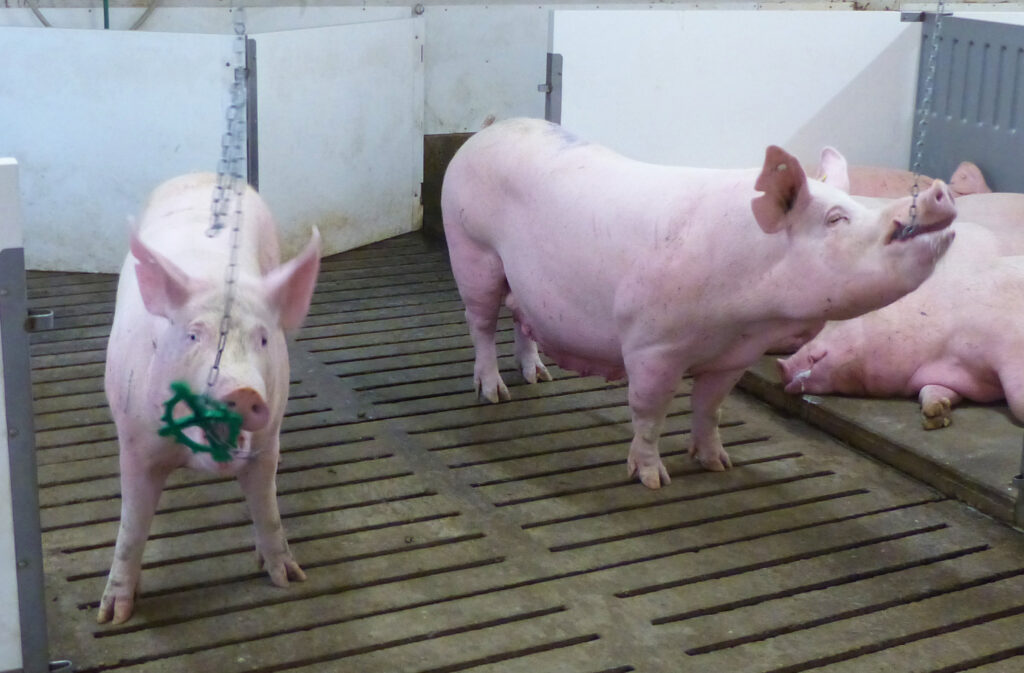
Studying enrichment, such as this trial, in 2017, has helped produce fitter sows.

Enrichment has been an increasing focus for the pork sector since the National Farm Animal Care Council’s (NFACC) Code of Practice for the Care and Handling of Pigs was released. Since most of the research focused on grow-finish pigs, however, sows were the subject of a study by Jennifer Brown, a research scientist with Prairie Swine Centre. The move to group housing and the restricted diet for sows can often lead to greater aggression, making enrichment more important than ever.

The study employed four forms of enrichment in a free-access feeding system: no enrichment; constant enrichment with three wood pieces on a chain; rotating enrichment every three to four days among rope, straw and wood on a chain; and the same rotation but with a sound stimulus added during each change that has been thought to increase the value of enrichment.

Sows were rotated through the four options, and just the presence of enrichment was found to increase their standing time, meaning they were more active. This was important, as more activity enhances bone strength and muscle tone, producing fitter sows at farrowing.

This study added value for producers by demonstrating the impact of enrichment on sows, the importance of rotating that enrichment to maintain engagement, and the fact that effective enrichment can take many forms.

Phase feeding saves money

Given that a good chunk of producer revenue is consumed by feed, SIP has made reducing feed costs a priority topic for its research efforts. In one project on parity-segregated phase feeding, the team looked at limiting overfeeding of gestating sows while still meeting their needs for amino acids and energy.

While the standard approach in the pork industry is to give gestating sows one diet to follow throughout gestation, this project offered them two separate diets in recognition that sows have different nutritional needs at various stages of gestation and parity.

The result was an annual saving of $5.69 per sow, with parity-segregated phase feeding over a conventional program. Since feed prices are prone to fluctuations, the project team used financial modelling to gauge the impact of changing corn and soybean meal prices over a five-year period. When the numbers were crunched, phase feeding again came out on top, with an annual saving of $1.66 to $10.06 per sow versus conventional feeding. For the producer feeding 10,000 sows every year, those numbers should offer much food for thought.

Truck washing is key to preventing disease

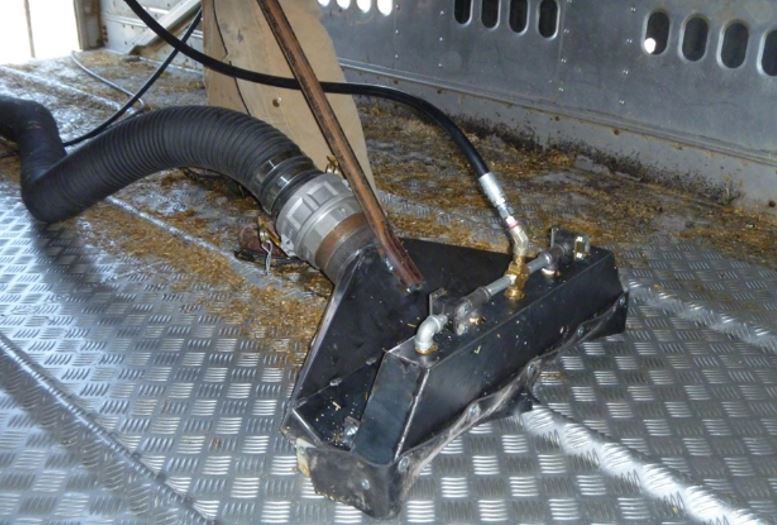
By studying techniques for truck washing, including this example, from 2016, the industry is working to better protect itself against the spread of disease.

As porcine epidemic diarrhea (PED) and other diseases spark a greater interest in biosecurity, a prime target for SIP research has been the trucking sector, where the risk of disease transfer is ever-present. To address this challenge, a comprehensive study was undertaken, led by Terry Fonstad, Associate Dean, Research and Partnerships, College of Engineering, University of Saskatchewan.

One of the study’s key findings was that while dry heating of pathogens for 15 minutes at 70 degrees Celsius could inactivate most of them, greater intensity was needed to address PED. As a result, researchers recommended heating trucks to 75 degrees Celsius for 20 minutes in every section of the trailer.

The project also worked on developing an automated cleaning system to prevent workers having to enter trailers to clean them, or at least limit their time in the trailer. The result was a manually operated system that allows cleaning of each level of a trailer by one person with 250 litres of water and a high-volume vacuum.

As well, Fonstad’s team conducted a trailer survey that led to recommendations for improving biosecurity and comfort. Work on the survey, trailer heating and the cleaning system is continuing. At a time when disease threats are top-of-mind, this project will mean fewer losses for producers and greater welfare for their animals – truly a win-win.

Detecting ASF is critical for the industry

As scary as PED is for producers, African Swine Fever (ASF) poses an even greater threat to the entire industry. In light of its highly contagious nature and near-complete mortality rate, ASF has been deemed a global animal health priority.

While ASF can seriously impact the pork sector on both a local and international level, there is currently no vaccine or effective treatment for the disease. This has made ASF a top priority for research, including a current study led by Aruna Ambagala, Research Scientist, National Centre for Foreign Animal Disease (NCFAD), Canadian Food Inspection Agency (CFIA).

Given the significant amount of pork that Canada produces, the arrival of ASF would cost billions of dollars and have a devasting impact on farmers and other workers affected by the trade restrictions that accompany the virus. To help minimize the damage, Canada would engage in zoning or compartmentalization, along with active surveillance, which, optimistically, could allow pork exports to continue from unaffected areas of the country.

Unfortunately, active surveillance based on individual pig sampling is labour-intensive and costly, making it impractical to apply on a large scale. In seeking a viable alternative, researchers are turning to pen-based oral fluid (rope) testing, which is non-invasive and much less expensive in terms of financial and human resources. Over the course of the study, they hope to determine the feasibility of using oral fluid samples for active surveillance to maintain ASF-free areas during zoning, as well as validating oral fluid field testing in an ASF-affected country.

Though a cure for ASF remains elusive, an affordable means to keep pork trade flowing may be the best thing the industry can hope for in the event the disease reaches North America.

Today’s research is tomorrow’s practice

While these projects represent important progress for the swine sector, SIP is committed to building on its foundation.

“We continue to develop as an organization, enhancing our communication and trying to expand the sources of funding we can tap to conduct swine research,” said Cressman. 

Adapting to the current financial climate also means making the best possible decisions when it comes to future research.

“You never arrive at a point where everything has been addressed, but hopefully we have an attitude of continuous improvement,” said Cressman. “Our ask for cluster three was $26 million, and our current program is worth about $18 million. For that money, we have letters of intent amounting to $80 million for prospective projects, so we must determine priorities and identify which projects will have the greatest impact on the industry.

“In some cases, you also have to do some ‘blue sky’ research. I would say we aim for 75 to 80 per cent of projects where the outcomes can be applied now, and about 20 to 25 per cent that may bear fruit farther down the road. We must do what is needed to develop and maintain capacity in certain areas, while recognizing that the ‘itch of the day’ might not be the itch 10 years from now.”

Through all the planning and prioritizing, the common thread may come down to a simple question: so what?

“We will always be guided by how a project can be implemented at the farm level and whether it will make a meaningful difference,” said Cressman. “It’s about ensuring that the money being spent will advance the science and contribute to answers. At the end of the day, we hope to have findings that can be shared for the benefit of all, while having the greatest possible impact on producers.”

E-commerce transforms food industry for better

By Mike von Massow

Editor’s note: Dr. Mike von Massow is an associate professor in food, agriculture and resource economics at the University of Guelph and is the Ontario Agriculture College chair in food system leadership. He can be contacted at mvonmass@uoguelph.ca.

COVID bends but does not break food system

The trend of ordering groceries online for pick-up or delivery has exploded during COVID-19.

Our food system has adapted remarkably well to the pressures of the COVID pandemic. While we have experienced some short-term food shortages, these were driven more by demand surges than by supply issues. We also did see some disruption for producers when problems arose in meat processing plants, but these appear to be largely behind us, and supply is flowing relatively normally again. 

The COVID experience so far has highlighted some vulnerabilities in the food supply chain but has also shown that the system is remarkably resilient. The challenges of the pandemic have also highlighted some opportunities within the system. One of those opportunities is for smaller food processors to access consumers directly through online channels.

Consumer, retailer behaviours adapt to circumstances

We have seen changes to food shopping behaviours arising from the pandemic. When the original shutdown occurred, we saw a combination of factors affect the food system. The food service channel closed completely and still has not opened back up to pre-COVID levels. Consumers were nervous about food availability, and overall demand at retail increased, because we were not eating out anymore. People shopped less frequently, and many tried online ordering (with or without delivery) for the first time. 

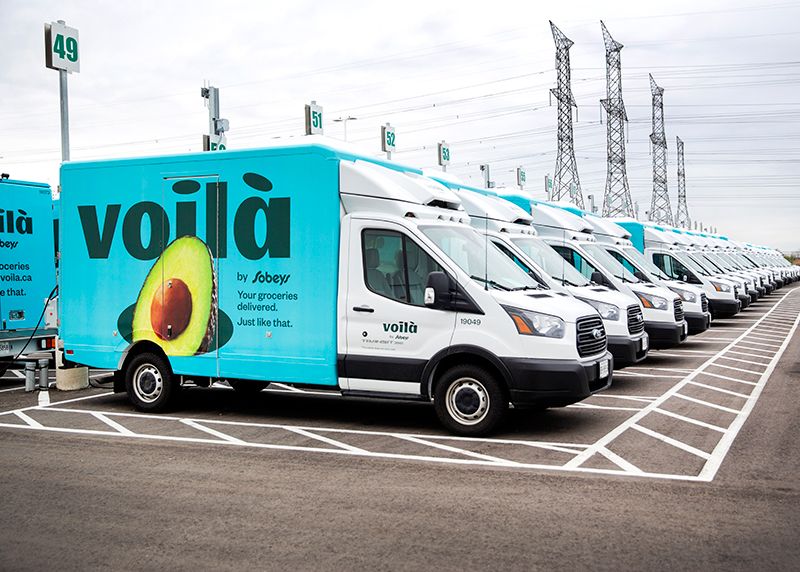
There were clearly challenges early in the process. Companies struggled to build the capacity to pick orders and coordinate delivery or pick-up. And there were different approaches to the market. Sobeys launched its ‘Voila’ project, which picks orders from a state-of-the-art robotic warehouse that can assemble a 50-item order in about five minutes, which then ships directly using an optimizing routing software. 

Other stores are picking orders from existing physical store inventory and offering pick-up or delivery through third-party partners. There has been an explosion in delivery, which has created the infrastructure to allow other smaller companies to piggyback on the opportunity. Small wineries and craft breweries, as an example, have seen a fundamental shift in their supply chain with a significant portion of the business moving to online ordering and direct delivery for as little as $5 an order. This is a huge opportunity for small food processors to access customers directly to maintain margin. 

There is an opportunity for smaller processors and farmers is to establish a web interface with delivery to allow them to deal directly with the consumer. There are many small food processors who have identified and begun to leverage this opportunity, which is expected to grow.

Several factors are driving this opportunity. First, as we have already outlined, more of us are buying things, including food, online for delivery to our homes or pick-up at a convenient point. While most of us will not ordinarily spend time going from physical store to store to find the product we want at the price we want, jumping from website to website requires little effort. It is easier to comparison-shop online, and once you find the website you like, repeating an order the next time is very simple. This is important. 

It is difficult for many smaller processors to get onto store shelves. It can be very expensive, and small processors may not be able to provide the volume that large retailers require before the retailer will even consider adding a new product. For many of these processors, they have no way to access a larger customer base but an online shopping platform, and enhanced delivery expands the potential market dramatically.

Once we remove the requirement for consumers to go to the store in-person, getting products home is also easier from a delivery perspective. The cost of direct-to-home delivery is going down. Leveraging the large volume of orders that delivery companies are carrying from a variety of sellers provides access to smaller-volume sellers. While the delivery cost needs to be small-ish relative to the total cost of what you are ordering, this burden has been lessened given the huge volume of delivery vehicles on the road, which lowers the cost per delivery.

It is also easier to receive products now that many of us are working from home. Coordinating multiple deliveries is much easier if you are at home regardless, and most deliveries can simply be dropped without signature. There does remain some threat of theft, but that is mitigated by those spending more days working from home. Meat processors have the additional cold chain requirement, but there are refrigerated options available, and the speed of delivery – especially within local markets – makes it less difficult.

It is also worth noting that large grocery companies are downloading some costs onto their suppliers. It is already difficult enough for small processors to get on the shelves of major retailers. Additional costs may make it even less profitable and provide further impetus to invest in the infrastructure to sell directly to consumers.

Challenges remain, but future is bright

‘Voila’ by Sobeys is a robust grocery delivery service currently offered in the Greater Toronto Area. Other services by national and regional retailers serve most major markets across Canada.

There are no doubt challenges associated with selling online and costs associated with both infrastructure and delivery. Companies require a new skill set to leverage the opportunity. There is some risk in making the investment in the case that the trend does not last beyond the pandemic. However, there is strong evidence to suggest the trend is here to stay. Sobeys’ investment in the ‘Voila’ system should provide some comfort to smaller processors in that regard.

Meat comes with some unique challenges beyond the obvious cold chain requirements. Customers are accustomed to selecting the size of package that they want. In some cases, particularly for specialty products, they are able to point to exactly the product they want. In the case of online orders, sizes and prices need to be standardized so that payment and shipping can be done expeditiously. There may be an opportunity to have customers provide a weight range and price per kilogram. The order would then be billed only when the specific product is picked and included in the order. These are unlikely to be significant issues for consumers and may require more of a shift to the mindset of sellers. 

There is a real opportunity for certain differentiated products to shorten the chain and deal directly with the end consumer. Small players will not compete on commodity products – shorter supply chains still have cost – but on specialty products, the opportunities are real. More and more companies are driving growth through this channel, and it is expected to become even more important as time goes on.

U.S. Pork in Cold Storage
Ten Year Low

Pork Commentary, February 1st, 2021
Jim Long, President-CEO, Genesus Inc.

At the end of December the USDA estimates U.S. Pork in cold storage was 408,361 (1,000 pounds) a year. A year ago it was 580,464. Down 30% and a ten year low.

In our opinion a sign of good pork demand, and bullish for the future lean hog prices.

U.S. Hog Slaughter (1,000 head)
January-December

 201920202019 to 2020 difference
Barrows and Gilts125,844.3127,149.2+1.305
Sows 3,0123,321-309
Boars354.3311.6-39.7
Total129,210.7130,781.9 

The U.S. January-December 2020 numbers tell the story – more barrows and gilts and more sows to slaughter. The sow number of 3,321,000 up 309,000 year over year can be seen in the December Quarterly Hogs and Pigs Report with the 2020 breeding herd down 195,000 for the year.

December Breeding Herd (1,000 head)

YearHerd
20176179
20186326
20196471
20206276

Some Farmer Arithmetic

  • The sow herd increased from Dec 1 2018 to 2019 by 145,000. The sow slaughter that year was 3.012 million sows.
  • In 2020 the Dec 1 breeding herd decreased year over year 195,000, with a 2020 sow slaughter of 3.321 million.
  • 3.012 (2019 sow slaughter) + 145 (2019 breeding herd increase) = 3.157 (total) ÷ 52 weeks = 60,711 (breeding herd equilibrium).
  • 3,321 (2020 sow slaughter) – 195 (2019 breeding herd increase) = 3.126 (total) ÷ 52 weeks = 60,115 (breeding herd equilibrium).

For what it’s worth analyzing the last 2 years of sow slaughter and breeding herd change we come with a sow slaughter on the 60,500 range per week average that would indicate a breeding herd staying about where it’s at. Above 60,500 it means liquidation. First 2 weeks of 2021 it has been 70,000 and 67,000.

Of note, last December-March the U.S.D.A. March 1 Hogs and Pigs Report indicated a Breeding Herd decline of 96,000 year over year. This year December was 18,000 higher sow slaughter than last year. All points to an indication of continued breeding herd liquidation.

It’s Farmer Arithmetic but it is what we figure.

The ASF Challenge

We have been doing business in Russia twelve years. Russia has been fighting ASF for over that length of time. Russia has massive land base and newer farms with good bio-security protocols. Still, they have not stopped ASF.

Recently, two large breaks – one near Moscow and other near Kursk, has led to a reported half a million pigs being killed including thousands of sows. To us this shows the challenge of stopping ASF. Russia’s structure should give it an advantage to do so.

When we compare Russia’s industry to China’s size and structure, the challenge to control ASF seems daunting. A person who works full time with China’s Swine Industry told us the other day “ASF is rampant still.” A big challenge.

When people look at China’s swine production increasing, we are not sure if the ASF equation is being factored in.

Currently in China, a commercial market hog is fetching over $600 U.S. a head. Certainly a sign of demand outstripping supply.

Other Observations

U.S. Pork Cut-outs closed Friday at 85.36₵ lb. Real strong price considering slaughter numbers of 2.658 million. Pork Cut-outs are 85.36₵ lb., Choice Beef Cut-outs $2.33 lb. Pork is a great deal cheaper relative to Beef. Maybe get better tasting Pork to compete with Beef might not be a bad idea? Why do people pay more for Beef? Taste! Doubt it’s because they want to just spend their money.

U.S. Chicken production continues to run lower than a year ago. About 1% lower egg sets, chicks placed, and slaughter. Chicken has for years had steady production increases. This slow down now means less meat available. Good for Pork price support.

U.S. cash early weans averaged $61.48 last week – 8 months ago they were $5.00. What a crazy business! All indications are there are lots of finishing spaces chasing less pigs available to fill them.

You can’t cut breeding herd and have major health breaks (PRRS) and not have fewer pigs. With sow herd liquidation continuing we expect even less supply in future. This is going to lead to even fewer market hogs.

We believe that current lean hog futures are underestimating supply-demand. We will not be surprised to see lean hogs over $1.00 a lb. this summer. With current feed prices we will all need it.

Lean Hog Futures
Set New Contract Highs

Pork Commentary, January 25th, 2021
Jim Long, President-CEO, Genesus Inc.

Summer month lean hog futures hit new contract highs last Friday at 87.20₵/lb. Significantly up from last June at 71₵ or mid-August at 74.50₵.

We remember mid-August as that was when a certain Ag-economist at NPIC projected no increase in lean hog futures because of future increased production. We disagreed vehemently at the time. The expert Ag-Economist said “CME average price for 2021 is currently 68.37₵. We believe the average price in 2021 will be 56-59₵. We recommend producers consider some hedging.” Current CME average for 2021 is 79.92₵.

Continued upside in future hog price

We expect continued upside in future hog price prospects.
Less hogs coming. Why? Lower sow herd- big disease issues cutting supply.

High feed prices

High feed prices will lead to further sow herd liquidation.
The latest weekly sow herd slaughter was 70,686.
Any number over 60,000 is definitely liquidation.

U.S. Pork Exports

U.S. Pork Exports latest week 40,800 metric tonnes.
An indication of continued strong demand.

This past week the U.S. slaughtered 2,738,000 market hogs. U.S. carcass cut-out closed Friday at $82.83. A very strong sign of demand in the face of maximum slaughter capacity.
Makes us very positive of where pork cut-outs can go when hog slaughter decreases 300,000 ± head a week in the June-July- August time frame. We will not be surprised if lean hogs reach $1.00

Europe

Europe’s hog market was quite profitable until March when the pandemic hit. It got a further hit in September when Germany got ASF and lost its market in Asia. Prices have dropped significantly while feed prices have increased.

Currently; German hog producers’ losses are in the $35 U.S. per head range. Liquidation has begun. Parts of Europe have many family farms in the 150-250 sow range. It is expected there will be significant numbers of these exit for multiple reasons – profitability, labor, family inheritance or lack of, high feed prices, more environmental and animal welfare regulations.

There conceivably could be 500,000 to one million sows exit. This will cut pork availability for both domestic and export markets.

Philippines

Philippines purchased a record 4540 metric tonnes of Pork a week ago from U.S.A. Philippines has been devastated by ASF losing a large percentage of production. Market hogs are over $500 U.S. per head. The price confirms to us the lack of domestic supply. 108 million people in the Country.

Genesus Genetics are in a 2500 sow nucleus-multiplier on top of a small mountain in Luzon. It’s stayed clean. Luzon could have lost 80% of 500,000 sows. No one knows for sure but $500 plus market hogs and record export sale from U.S.A. indicate severity of ASF.

We expect Philippines will be importing a large supply of pork ongoing while they work to rebuild herd.

China

The world grain market has been pushed by the expectation of China importing even larger amounts, but since October has only had small purchases from U.S.A. We would not be surprised if China has already jumped in and bought most of their needs earlier.

Might be a communist country, but they sure understand capitalism. Corn still expensive in China at $11.08 a bushel but remember, they are used to $9-10 corn.

We read this week about continued issues with ASF in China and possible new variants related to illegal ASF vaccine use. For sure ASF hasn’t gone away.

China’s hog price is about $2.40 U.S. liveweight a lb., indicating a continued lack of supply and also to no increase in hogs being fed.

Top 20 producers in China 2020 according to report published by the Swine Communication Forum produced 78 million hogs.

Top 5 Companies

Muyuan18.12 million
Zhengbang9.56 million
Wens9.55 million
New Hope8.29 million
Twins5.2 million

CFAP “Top-Up” Payments for Swine

~below from USDA website~

“USDA is providing an additional CFAP 1 inventory payment for swine to help producers who face continuing market disruptions from changes in U.S. meat consumption due to the pandemic. Swine with approved CFAP 1 applications will soon receive a “top up” payment of $17 per head, increasing the total CFAP 1 inventory payments to $34 per head”.

Expanded Eligibility for CFAP 2

Contract producers of swine, broilers, laying hens, chicken eggs and turkeys who suffered a drop in revenue in 2020 as compared to their 2019 revenue because of the pandemic, now are eligible for assistance. Producers could receive up to 80% of their revenue loss, subject to availability of funds.

For U.S. producers; good news. The $17 top-up could mean up to $750,000 for some. The Government assistance is a true reflection of the crisis the Swine Industry has suffered. It’s not a subsidy for pig producers but an investment by the Government to ensure a continual food supply.

No food – hungry and unhappy people

Porc Show prevails despite global crisis

0

By Andrew Heck

Quebec City’s Rue des Remparts military installment successfully defended the settlement in 1775 against the invading American Revolutionary Army. Like those early Canadians, the Porc Show’s organizers have strategically managed challenges to modify the Porc Show in 2020, on account of COVID-19.

The seventh, annual Porc Show was presented in digital format on Nov. 25 and Dec. 3 & 9, 2020, featuring presentations, speeches and an introduction to the Quebec agri-food industry. Guests were invited to network with conference partners, including the Canadian Hog Journal, by visiting an online exhibitor area.

For the past six years, Canada’s largest pork conference has been hosted in-person at the Quebec City Convention Centre, just across from the province’s National Assembly (provincial legislature), down the road from La Citadelle and the 400-year-old Petit Champlain district – typically an attractive location for the conference’s more than 1,000 guests.

“We are very pleased with the outcome of this year’s format,” said Sébastien Lacroix, CEO, Quebec Association of Animal and Cereal Feed Industries (AQINAC), one of the Porc Show’s host organizations. “While we would have loved to welcome guests to our province, the global pandemic has prompted us to adapt, which parallels the work being done in our industry to innovate and overcome barriers to success.”

Each day of the conference was opened by Vincent Cloutier, Senior Advisor, National Bank. Special dignitaries, including Andre Lamontagne, Minister, Quebec Agriculture, Fisheries and Food (MAPAQ); David Duval, President, Éleveurs de porcs du Québec (Quebec Pork); and Marie-Claude Bibeau, Minister, Agriculture and Agri-Food Canada (AAFC) also delivered remarks.

“The pork sector has been courageous and resilient through COVID-19, soldiering on to maintain the food supply and stimulate the Canadian economy,” said Bibeau. “We must maintain solidarity with processors as they continue to operate at a reduced capacity, and we must support producers as they look for alternate solutions to sell their animals.”

Presentation topics for all three days ranged from the impacts of human and swine disease on the global pork trade, pork industry issues management and animal handling. With more than a dozen industry experts on-hand, guests were treated to a diverse and comprehensive array of subject matter.

COVID-19, ASF and global pork trade

ASF hammered China’s pig herd in 2018 and 2019, but in 2020, a rapid rebound has put the country on a path to greater self-sufficiency.

In the past two and a half years, African Swine Fever (ASF) has largely shaped pork demand and sourcing, while in the past 10 months, COVID-19 has impacted the industry in more localized ways. Complications related to ASF and COVID have promoted differing industry responses, tailored to the situations faced regionally. Experts joined the Porc Show this year from Canada, the U.S., the U.K., China, Brazil, Spain and Germany – all keen to explore their national industries’ activities in response to market challenges.

Among all presenters on the topic of trade, not one failed to mention China’s impact on production and profits. For Gary Stoner, Vice Chair, C.P. Group China – a global top-three producer of pork, poultry and other commodities in southeast Asia – China’s ASF recovery has been swift, from banning human food scraps as feed to the construction of multi-storey ‘pig condominiums’ for efficient land use. The domestic price of pork for the country’s consumers varies but remains inflated, as no combination of domestic production and imports has yet been able to fill the growing demand.

In Germany, opportunities in Asia quickly vanished following the discovery of ASF in the country’s wild boar population in September 2020. Albert Hortmann-Scholten, Market Analyst, Chamber of Agriculture, Lower Saxony indicated that German pork is currently banned in 14 countries globally, as a result. Taken together with processing shutdowns related to COVID-19, pig prices in 2020 have dropped by nearly 15 per cent for German producers. In Germany, 80 per cent of all pork is processed by just 10 packers, leading the European Union (E.U.) in pork production volume and trailing only Spain in pig production volume.

In contrast to the German industry’s more recent woes, in Spain, an unusual phenomenon is taking place compared to most other pork-producing countries around the world, according to Miguel Higuera, Executive Director, Spanish National Association of Swine Producers (ANPROGAPOR): the number of farms is increasing. Starting in 2014, the Spanish government capped the size of all livestock farms, but a desire to continue expanding the industry has driven growth. Sixty-five per cent of all Spanish hog farms are integrated with processors, with the remaining 35 per cent equally split between producer cooperatives and independent operations. Spain first started exporting pork only in 1995, and in the quarter-century since then, has actually surpassed Germany when it comes to breeding pigs, exemplifying just how different the conditions are from one E.U. nation-state to the next.

Meanwhile in North America, where ASF has spared the industry so far, COVID restrictions have disrupted the supply chain. According to Steven Weiss, President, NutriQuest of Iowa, plant shutdowns encouraged curtailment of U.S. pig production in the second quarter of the year, but by the fourth quarter, production had returned to near pre-COVID levels. The production response this spring included slowing down diets and euthanizing millions of pigs – an unfortunate yet effective course of action. John Ross, President, Canadian Pork Council (CPC) pointed to a similar albeit much smaller-scale COVID response in Canada, which has included reducing breeding and, when necessary, shipping eastern Canadian hogs to western Canadian plants as a way to back-fill western demand when eastern plants were faced with interruptions.

No matter where in the world pigs and pork are found, biosecurity remains top-of-mind. Proper protocols remain important as ever – from farms and trucks to processing facilities and airports, where the potential for disease transmission is ever-present. Martin Bonneau of Demeter Veterinary Services, based in Lévis, Quebec, spoke about a new national partnership in Australia that aims to address biosecurity challenges across all livestock sectors, particularly focusing on international passenger travel and cargo shipping. The partnership is backed by a decade-long plan that is designed to buff up the country’s biosecurity significantly approaching 2030. Like Australia, the Canada Border Services Agency (CBSA) has identified flights from ASF-positive countries as having heightened risk.

Pork industry issues management

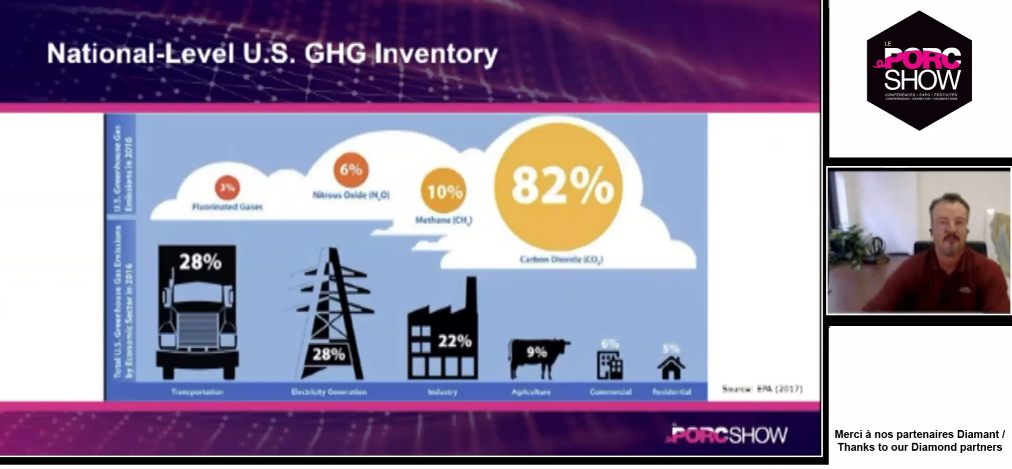
Frank Mitloehner compares greenhouse gas emission types and sources in the U.S. Agriculture altogether contributes only nine per cent of the total.

When it comes to climate change, Frank Mitloehner, Air Quality Extension Specialist, University of California believes the pork sector has many opportunities to become better by continuing to reduce methane output through manure management strategies, such as generating renewable products like biogas.

Incentivizing change and sharing knowledge, rather than punishing behaviour, is key to transforming the industry positively. While pig production has a much smaller carbon footprint compared to ruminants like cattle and sheep, feeding a growing global population means raising more livestock. Despite this, Mitloehner points out that comparing greenhouse gases directly – carbon dioxide, nitrous oxide and methane – is like comparing apples and oranges, which is where critics of animal agriculture fail when it comes to arguing the sector’s negative climate impacts.

Mitloehner also suggests that food waste, not livestock production, is the true menace that the agriculture industry as a whole needs to address, as 40 per cent of all food produced globally – or one out of every three calories – is never consumed by either humans or animals. He points out that food waste in the developing world occurs more often at the farm level, since barriers to harvesting crops and transporting commodities are more common than in North America, where much more of the waste occurs at the level of retail and home consumption.

If everyone on Earth switched from an omnivorous diet to a vegan diet, would that save the planet? Mitloehner believes that such a dramatic hypothetical change would result in an overall greenhouse gas reduction of less than one per cent. Despite that reality, vegans and animal activists continue to push this narrative.

And while Canada is no stranger to the harmful actions of animal activists, in Europe, highly organized networks have infiltrated the industry for even longer and with greater influence. Groups like L214 Ethics & Animals recruit mostly young and impressionable individuals through social media as foot soldiers for threatening pork producers and processors, while instilling fear in public figures and politicians who sympathize with the livestock industry.

According to Jacques Crolais of Brittany, France’s Meat Producers Union, the European anti-meat movement is led primarily by urban millennials who use online fundraising to support campaigns of misinformation, along with criminal trespassing and espionage.

Whether by distorting the pork sector’s impact on the environment or by targeting meat production and consumption itself, critics continue to take pot shots at the industry, which has been forced over time to cushion such reputational blows.

Animal handling, health and welfare

While the Porc Show has an undeniably business-oriented character, no pork conference would be complete without a little testimony from those who study pigs the hardest: veterinarians.

Jean Brochu, a swine vet with Sollio Agriculture, provided an overview of behavioural problems that emerge with uterine and rectal prolapses in sows. The condition often goes unaddressed without constant monitoring, and it has a mortality rate of anywhere between less than one per cent and upwards of 10 per cent. It is difficult to pinpoint commonalities between herds, as few concrete conclusions have been drawn to connect indicators from one farm to the next.

Georg Dusel, Professor of Animal Nutrition and Health, University of Applied Sciences in Bingen, Germany spoke to the role of fibre in sow management. He pointed to the fact that not all carbohydrate sources are created equal when it comes to digestible fibre, and sows at different stages of gestation and farrowing have unique dietary needs, even as it relates to using crates versus group housing.

François Cardinal with Triple V Emergency Veterinary Services of Vale, Quebec presented on the challenges and eradication strategies related to Porcine Reproductive and Respiratory Syndrome (PRRS). On an average litter of piglets, the cost of managing PRRS can be anywhere between $50 and $60. The most effective strategy, according to Cardinal, is a herd closure until negative tests come back in four consecutive litters, lasting for a period of six to nine months, at which point the herd can be carefully reopened with close attention paid to biosecurity protocols. For farrow-to-finish operations, increasing the marketed weight of hogs can also create better pig flow and optimize productivity while managing the disease.

Meeting disappointment with triumph

The scaled-down physical hub for this year’s Porc Show, where behind-the-scenes technicians were the unsung heroes of production.

Over the noon hour during the third and final day of the Porc Show, guests were treated to a culinary student competition, a tribute to Quebec’s agri-food retailers and an introduction to The Chef’s Boxmeal delivery kits with renowned Montreal-based chef Jérôme Ferrer.

After lunch, Alexandre Cusson, General Manager, Quebec Pork and Richard Davies, Executive Vice President, Sales & Marketing, Olymel took part in a brief discussion on industry issues, while Christian Bourque, Executive Vice President, Léger Marketing presented on food consumer trends.

Organizers are cautiously optimistic that next year’s event can once again be hosted in-person, but if not, the lessons learned in 2020 will be invaluable to delivering an even higher-quality experience in 2021.

While the Porc Show normally brings the world to Quebec, this year’s edition brought Quebec and Canada to the world. Extraordinary times call for extraordinary solutions, and while the virtual format is not likely the preference for most participants, it does offer certain benefits on the side of cost and accessibility. While there is no perfect substitute for the rich professional and cultural experience afforded by the Porc Show’s legendary location, the event has prevailed despite the COVID-19 crisis.