
Monday, March 9, 2026

USDA December 1 Hogs and Pigs Report

0

Pork Commentary, December 28th, 2020
Jim Long, President-CEO, Genesus Inc.

Jim Long's Pork Commentary

(1,000 head) 

December 1201920202020 as percent of 2019
Kept for Breeding6,4716,27697
Market71,75771,22699
Market Hogs and Pigs by weight groups
Under 50 pounds22,04821,73999
50-119 pounds20,64820,26098
120-179 pounds15,25615,246100
180 pounds and over13,81613,980101
Fig Crop71,82971,03099

Dec 2019-Nov2020 (12-Months)

(1,000 head)

Sows FarrowingPigs per litterPig Crop
201920202019202020192020
12,70112,64110.9811.03139,449139,418

Observations

Breeding Herd Declining 

The December 1st USDA report indicates the U.S. breeding herd has declined 195,000 in the past year. The report indicates reduction the last three months was 57,000. There is no doubt the U.S. breeding herd has been declining. We believe the trend will continue for some time yet.
The latest weekly sow slaughter was over 69,000 – a liquidation level.

Market Hogs Number 

Market hog numbers in the December 1st report indicate 1% less than a year ago. So much for the predictions of more hogs in 2021 than 2020?

The USDA Report on September 1 indicated 10% more hogs over 180 pounds. They have now gone back and revised it to 1% as the reality of what was actually marketed in that weight group the last three months was far different than indicated September 1.

It is fair to question the accuracy of USDA numbers. They have overestimated production to the detriment of producer pricing for the last 2 reports. How much of the December 1 report is accurate? It’s a fair question.


We expect hog slaughter will continue the next few months lower than the USDA inventory would indicate.

21.54 Pigs per Breeding Animal

If we divide the Pig Crop Dec 1st-Nov 30th (12 Months) 139.418 million by the Dec 1st, 2019 breeding herd of 6.471 million = 21.54 pigs per breeding animal. 

21.54 is a far cry from numbers that get talked about per productivity. It is a real number and this is the pig crop – many pigs die after they are born/weaned. Nothing like the grim reality of farmer arithmetic.

The USDA Dec 1st Report indicates 2% more sows farrowing 2021. This with 3% fewer sows in inventory? Some data doesn’t make any sense. There will be fewer sows farrowing in our reality.

Other News

Lean Hog Future market took Dec 1st USDA report in stride last Thursday. First 2 months down, the next 6 up.

Small pig cash prices continue to increase. Early weans up $2.00 – Feeder pigs up $4.00. Last week Avg. Cash Early weans – $50.54 and 40 lb. Feeder pigs – $59.70. These prices are a real indication of demand. Lots of empty barns- Many integrators buying pigs to fill barns empty due to seasonal supply, PRRS, and PED. Cash pigs go to highest bidders and it has become a sellers’ market. Not that long ago some 40 lb. feeders sold for $10. Surest cure to low prices is low prices.

There will be fewer hogs in 2021 than 2020. We believe current lean hog futures are underestimating 2021 prices.

2020 is coming to an end. Good riddance. Much happened that was unpredictable and mostly bad for hog producers. Let’s hope 2021 treats us better.

“Learn from yesterday, live for today, hope for tomorrow. The important thing is not to stop questioning”.
-Albert Einstein-

GENESUS WISHES EVERYONE A HAPPY AND BETTER NEW YEAR

Holidays always hard on Hog Producers Pricing

0

Pork Commentary, December 21st, 2020
Jim Long, President-CEO, Genesus Inc.

Coming up to the holidays is usually never a good time for hog producers. Shortened work weeks at slaughter plants always give more leverage to packers. The best part of holidays for swine producers? They come then go!

Appears to us that U.S. Pork Exports to China, Japan and South Korea have all increased since Germany was banned from exporting to these countries due to ASF. Our Farmers Arithmetic has a gain of 5,000-10,000 tonnes a week in the three countries since end of September. This is about 100,000 – 200,000 head a week. Probably the major reason the U.S. hog price is higher than last year and significantly higher than lean hog futures indicated in August. This boost in exports should continue into 2021.

U.S. Hog Weights had jumped up but last week daily hog slaughter weights declined 2 lb. carcass from the week before. Good sign- means packers pulling down the hog inventory

There is always disease in our industry. It appears to us there is more than usual. Both PRRS and PED appear to be hitting hard. We heard of several sow units with PED and PRRS. This is cutting supply. There hasn’t been much PED in sows the last couple years. This development will cut hog supply further in the summer months.

This past week as an indicator of supply-demand we heard of a sow producer rejecting cash $60 early wean bids as not high enough. 5 months ago they were $5. Not a business for the faint-hearted. As the saying goes “The surest cure for low prices, is low prices”.

There is a myth in our industry that it is more expensive to produce dark red, high marbled pork.
We all know that consumers pay more for pork with marbling. We only need to look at the wholesale pork cut-outs, where Bellies and Ribs are the most expensive- both products with more levels of fat. They have taste and people pay for it.

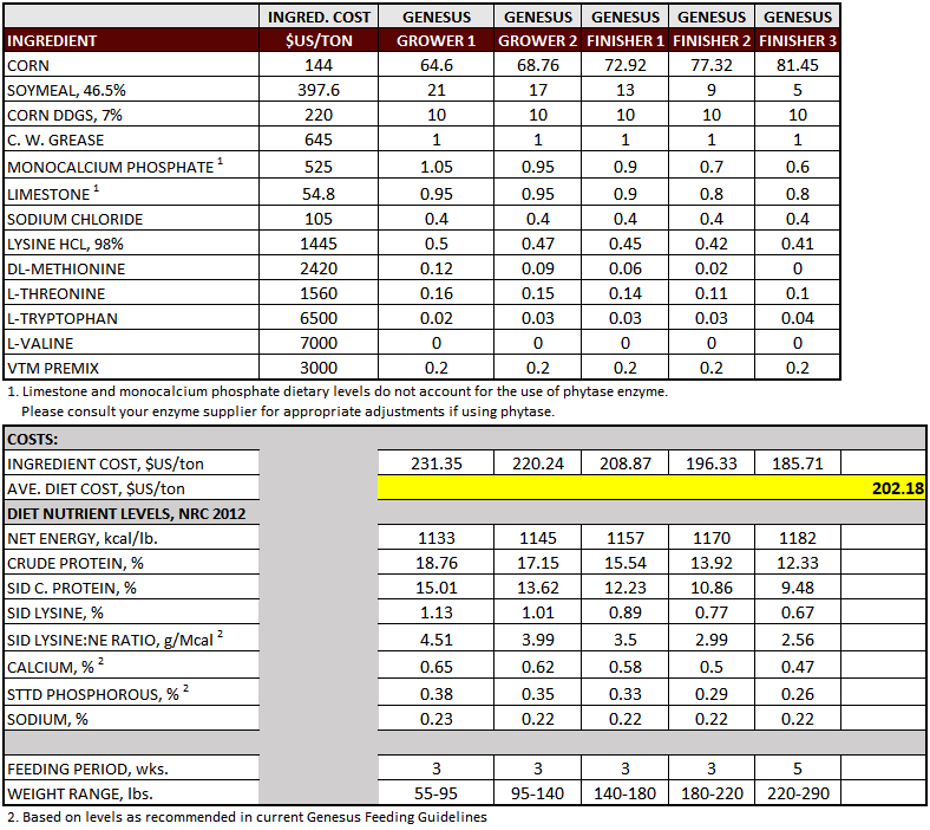
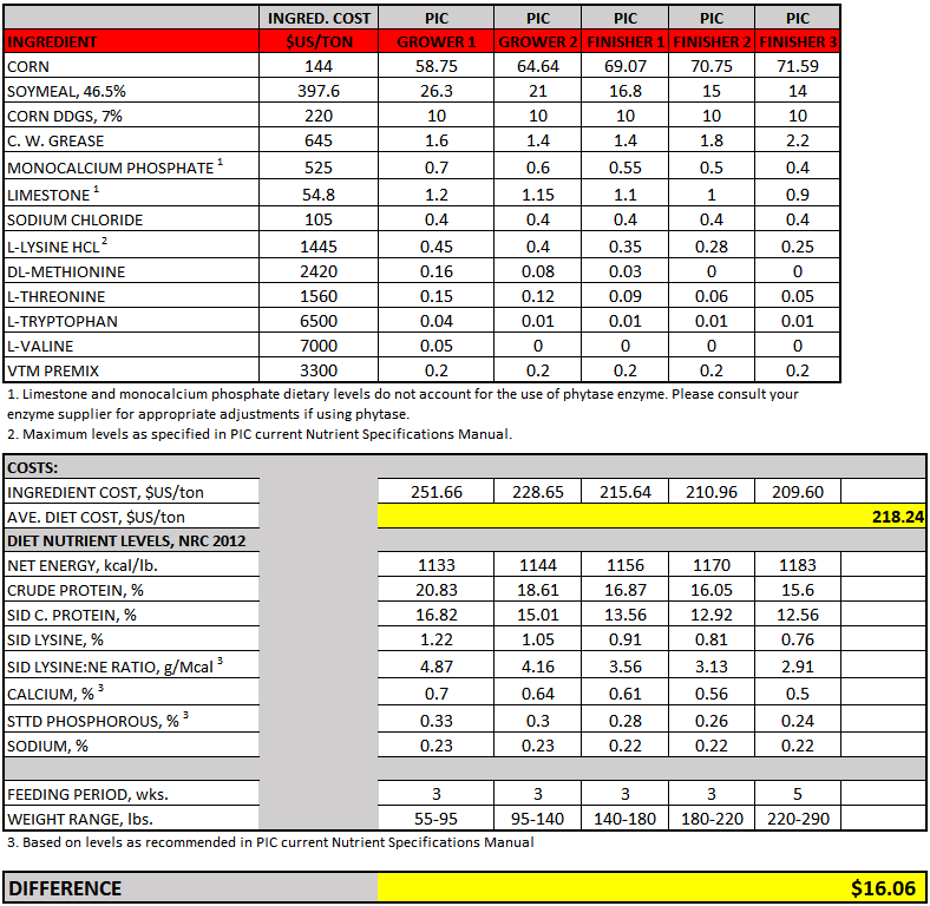
As corn-soybean prices have increased rapidly over the last while so has the cost of producing hogs. Made us look at Genesus customers cost of feed versus our competitors. We thought it reasonable to compare our rations to PIC guidelines- the world’s largest Genetic Company. What we discovered was that Genesus recommended finisher rations at current ingredient prices are $16.06 per ton less expensive then PIC’s current guidelines.

So much for it’s more expensive to produce more redder-marbled pork. $16.06 per ton is a lot of money in an industry that chases dollar bills to cut costs. We all can multiple our finisher tonnage by $16.06. It’s a lot of money.

We show our calculations below- compare and decide.

Assumptions: Corn – $144/ton ($4.03 bushel); Soymeal 46.5% – $397.60/ton; Corn DDGS 7% – $220/ton; C.W. Grease – $645/ton. See tables below for diet details and costs.

Genesus Sample Diets (Mixed Sex)
PIC Sample Diets (Mixed Sex)
Genesus – lower feed costs. As a Genesus Asian customer says “More pigs. Grows fast, tasty meat, don’t die.”

Have a Merry Christmas – 2021 will be better than 2020- (no Kidding)

U.S. Slaughter Numbers Continue Strong

0
Jim Long's Pork Commentary

Pork Commentary, December 14th, 2020
Jim Long, President-CEO, Genesus Inc.

The U.S. market continues to maintain weekly hog marketings similar to a year ago with last week at 2,776,000, a year ago 2,772,000.

These current slaughter numbers appear to be at capacity with the current limitations due to coronavirus issues. Packers have a good incentive to maintain rapid slaughter rates with U.S. pork cut-outs averaging $79.71 lb. last Friday while the average 53-54% hog price was 65.45₵ lb.

Unfortunately, it appears we have backed up some hogs relative to a year ago. Our estimate looking at current slaughter weights is about 500,000 – 800,000 head. We expect to catch up over the coming weeks.

Other Observations

The U.S.D.A released its December Crop Production and World Agriculture Supply and Demand Report.

World ending stocks
2020-2021
(Million metric tonnes)

Corn289.011,137 billion bushels
Soybeans85.63.144 billion bushels
Wheat316.5

World ending stocks 11.137 billion bushels of corn, 3.144 billion bushels of soybeans. No wonder most analysts called it neutral.

Interesting observation by a commentary reader who has traveled Western, Midwest for a number of years says “never saw so much corn piled up”. U.S.D.A estimates corn to average $4.00 a bushel until next crop.

Robert Hunsberger with Wallenstein Feeds in Canada does a report weekly, calculating profitability using current lean hog futures and future corn-soybean prices plus other logical costs. Last week the next twelve months has zero total profit. Not exactly a scenario to create bullishness.

The depreciation of the U.S. dollar to the Euro is supportive to U.S. pork exports. March 2020, Euro was 1.07 to the U.S. Dollar. This past week 1.21 Euros to the U.S. Dollar. A 13% change, making U.S. products more competitive globally.

U.S. Pork cut-outs last Friday $79.71 lb. with almost 2.8 million hogs slaughtered. When we look at normal summer marketings, they usually are 300-400,000 less per week. Assuming similar current demand seems to us lots of upside to cut-outs to jump pulling lean hogs higher.

Mexico

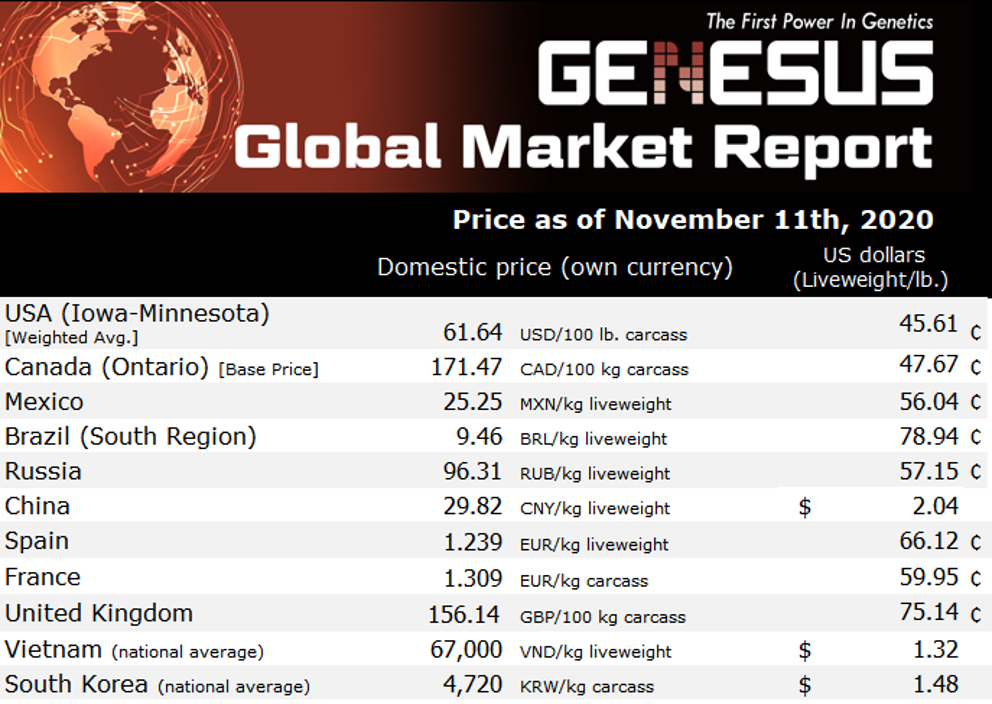
Mexico is the U.S. largest pork importer in volume terms. The hog prices currently in Mexico is around 70₵ U.S. lb. liveweight. We expect the current price will continue strong U.S. export sales.

China

China hog Price has jumped higher to 31.34 RMB/kg. ($2.15 U.S. lb). Back up from 29.55 RMB/kg.
This tells us China continues to be short of pork and recovery of supply won’t happen anytime soon. Price of hogs is the one truth in the worlds hog market.

Germany

ASF in Germany continues in wild boars. A week ago 55 were found positive in one day. Currently, 254 have been identified as of December 4.

The loss of Germany’s Asian market due to ASF (China, South Korea and Japan) has impacted Germany and Europe prices. For example: Spain prices have dropped from 1.30 Euro/kilogram at the time of German ASF break to 1.10 Euros/kilogram last week.

United States 

The U.S.D.A feeder pig price jumped $2.00 to $55.83 last week. Current price is the same as a year ago. A reflection of the recovery from the disaster of prices from the 4 months of April to August, when the average 40 lb. feeder pig was under $20 per head. When we look at feeder pig pricing over the last twenty years nothing comes close to the debacle of this year.

Reports tell us lots of empty finishing barns looking for pigs. With PRRS and PED a factor, we believe current lean hog futures and the U.S.D.A. overestimating the supply of hogs coming in 2021. As we commented last week, “cash feeder pig prices are the Canary in the Coal Mine of what’s coming”.

Europe

In Europe, feeder pig prices are following the opposite trajectory. The last 52 week average for same quality 30 kg feeder pigs from Denmark 412 Danish Krone ($66 U.S.); last week 140 Danish Krone ($22.40 U.S.). A reflection of the collapse of demand as ASF backs up hogs and drops demand, coupled with higher feed prices, decreasing margin.

Summary

  • Lots of market hogs coming to market.
  • As we head into 2021 we expect fewer.
  • In our opinion; lean hog futures for 2021 are undervalued.

Why So Many Empty Finishers?

Jim Long's Pork Commentary

Pork Commentary, December 7th, 2020
Jim Long, President-CEO, Genesus Inc.

One thing there seems to be an agreement on with people we talk to is the number of empty finishers in the U.S. Of course, there are no real statistics on this but it seems that it is a common observation.

Our thoughts

Continual decline in hog numbers

  • The sow herd liquidation that started last December is ongoing. We have been selling hogs currently bred last February. We expect to see a continual decline in hog numbers as we go forward.
  • There appears to be enough PRRS and PED to go around. This is leading to fewer pigs.
  • Integrators are in feeder pig market to fill holes. This is leading to cash feeder pig prices above the DTN Breakeven. The DTN calculation Breakeven was $42 last Friday, USDA cash feeder pig avg. was $54.00

To us, the feeder pig cash price is like the Canary in the Coal Mine. It’s early warning that something is happening. One thing we have learned over time- people won’t pay more than they have to. We believe that the lack of pigs to fill finishers is leading to strong feeder pig prices. We believe this fore-telling what’s coming.

Current Lean Hog Futures are underestimating the supply coming forward. 

  • Last week the U.S. slaughtered almost 2.8 million hogs. Currently Lean 53-54% hogs are 67.30 (last year 58.73).
  • Pork in storage is low. Exports are steady.
  • When summer comes, slaughter will drop 400,000 plus a week seasonally and from liquidation.
  • We expect 90₵ plus lean hogs.
  • The empty barns and demand for feeder pigs is the foretelling of what’s coming.

Russia

Last week we spoke at the Russia Pig Federation Conference. The Federation members include most of Russia’s commercial pig producers. The federation has done an excellent job over the last ten years looking after the interests of Russia Pig Producers.

Genesus does business in Russia. 

  • We currently work with 21,000 sows in Nucleus and multiplication in Russia producing Genesus Genetics for integrators and the general market.
  • Over the last twelve years we have done business in Russia, we have seen a massive interest in new swine facilities.
  • We have seen results on farms as good as any in the world.

Over the last decade, we believe that Russia has been the most profitable place in the world to produce swine. There have been probably in that time, fewer weeks than there are fingers on my hand when the Russian market has been below breakeven.

Ten years ago Russia was a large importer of pork. Now, Russia is self-sufficient at current consumption levels. Russians are big meat eaters, spending over 5% of their GDP per capita on meat – USA (1/2 of 1%)

We believe as Russia’s economy improves per capita consumption of pork will also increase. Russia has the capacity to produce massive levels of feed. Available acres for grain growing is larger than USA.

Russia would like to grow export market for pork. Their challenge is the ASF in their country which eliminates all the major pork importing countries as an option. One of the things we said in our talk last week was “Be careful what you wish for”. The desire to export has its downside.

Russia’s domestic hog price is 101.49 rubles a kg (61.25₵ U.S. liveweight a lb.). The U.S. hog price is less than 50₵ lb. liveweight. When you export you have competitors and become a price taker. Exporting is not as good as a strong domestic market.

There are many big opportunities with 145 million people in Russia to grow domestic consumption. Better tasting Pork is one of the major drivers to encourage repeat buying consumers.

Genesus Team at Conference Moscow

China Update (current)

  • Corn = 2,529 RMB Tonne = $9.73 U.S. bushel
  • Soybean meal = 3157 Rmb Tonne = $478 U.S. Tonne
  • Breakeven Pig Production = $1.00 U.S. lb. liveweight
  • Hog Price = 29.55 rmb/kg = $2.04 U.S. lb. liveweight

U.S. Pork in Cold Storage
Huge Decline

Jim Long's Pork Commentary

Pork Commentary, November 30th, 2020
Jim Long, President-CEO, Genesus Inc.

Last week the USDA released the inventory of Pork in Cold Storage at the end of October. A year ago 611 million pounds in cold storage, this year, 448 million pounds. A drop of 27%. A bullish sign for future pricing as the market has no burdensome inventory to sell as hog slaughter numbers decline into 2021.

An interesting detail in the report included only 19 million pounds of bellies this year compared to last year’s 45 million pounds. A 57% decline. Could we see a belly price explosion driving pork cut-outs?

Other Observations

Slaughter Weight 

Weekly U.S. slaughter and weight seem to continue running similar to year over year and since the first of September. The USDA Sept 1 Hogs and Pigs Report indicated 10% more heavy hogs year over year. It is 90 days since Sept 1st. Obviously, it was a wrong number.

Going forward this type of gross misinformation will put the trustworthiness of Quarterly Reports into question. The reports that have indicated in both USDA June and September that there were more than has been the slaughter reality have led to lower hog prices and cost producers 100’s of millions of dollars.

Breeding inventory

The latest U.S. weekly sow slaughter was 66,102. Anything above 60,000 a week is a liquidation number in our opinion.

Maxwell Foods 55,000 sows announced in August they were liquidating their herd. From what we understand they stopped breeding the first part of August, the last pigs to be weaned will be in December.

The USDA December 1st, 2019 breeding inventory was 6.471 million; on September 1st, 2020 breeding inventory was 6.333 million. We believe the 6.333 million is overestimating the actual, but just subtract Maxwell’s 55,000 from 6.333, you would get 6.278 million on Dec 1st this year – down 193,000 year over year. About 6 million fewer hogs per year.

Last week we published our reader survey if new sow barns built and under construction and that the sow barns have a 40-year life cycle (need 150,000 sow spaces a year). Below an email from a VP of a major leading institution responsible for swine:

“Thanks for taking this survey Jim. Your numbers match up right on what we use for replacement necessary in the industry as well assuming a 40 year life. It is good to see this industry put the brakes on for a while. Hopefully we will build back some profitability into operations and not just from hedge gains.”

Early Weans and Feeder Pigs 

Last week U.S. Small Pig Price- cash prices averaged $40.88 for early weans and 40 lb. feeder pigs $50. Similar to where prices are at this time on the last 3-year average.

We are told to expect rapidly increasing prices in the next few weeks. Why? Seasonal (summer market), lots of empty barns, holes to fill from PRRS and PED breaks.

The lots of empty barns tells us fewer hogs coming as every pig is in a barn somewhere.

Impossible “Pork”? 


text and image below sourced from:
Time magazine Nov 30 edition “The 100 Best Inventions of 2020″.

Food & drink
A sustainable substitute
Impossible Pork

The world’s most- consumed animal protein is pork—and its farming results in a slew of environmental issues, including pollution due to swine waste. Impossible Foods, which wowed the world with its rendition of a burger in 2015, aims to tackle these issues with a plant-based pork substitute, Impossible Pork. Previewed at CES 2020, Impossible Pork is made from soy and said to taste uncannily like the real deal. While the favorable environmental impacts of a pork alternative are clear, plans for a commercial rollout of Impossible Pork are still in the works.

– Nadia Suleman –


Isn’t it strange how the elitist agenda of some sell appointed experts on what’s best for society are given an unvarnished platform in what was once a thoughtful magazine?

The real shame is that they are allowed to call this crap they put together “pork“. Wouldn’t it be wise as an industry to challenge the name “Pork” being used? It’s not pork -it’s crap- they should call it such.

The NPPC-NPB could be focused on protecting our truly only real brand – Real Pork. Maybe work to make it illegal to call crap “Pork”?

Finally

Last week inadvertently we sent out the Pork Commentary in Chinese. Some of the replies sent back after our apology were quite funny.

Every week the Pork Commentary is sent by email, we-chat and is on numerous websites in English, Chinese, French, Spanish and Russian. We are thankful thousands read weekly in so many languages. The Pork Commentary is the most read weekly Swine Report in the world.

Some comments from readers re: Chinese apology

“I read every word…. That I know.”
– “Not to worry, I as well have made an error once or twice- this week or maybe even today.”
– “U need to find a good proof reader. Lots of typos!”
– “NO WORRIES WE NEED TO LEARN A LITTLE BIT OF CHINES TOO.”
– “Ok were wondering cause we don’t speak Mandarin at all!”
– “In the “not to distant future”, knowing the Chinese language will be an asset.”

U.S. Sow Herd Expansion Feedback

0

Pork Commentary, November 23rd, 2020
Jim Long, President-CEO, Genesus Inc.

Pork Commentary

In last week’s commentary we wrote:

“We will send out a challenge. If you know of a new sow unit in USA stocked this summer or under construction now, let us know. Send where and size. We will put list next week in commentary. Our premise if you are not adding your just subtracting. info@genesus.com

The following is each and every reply to the challenge.

  1. 6,000 sows Missouri – in construction.
  2. 3,000 sows Minnesota – completed expansion from 1,500 to 3,000.
  3. There is a 1,600 sow expansion going on line the first of the year in Southwest Minnesota.
  4. 2500 sows – new construction stocked in July- North Central Missouri
  5. We just completed a 5,000 sow farrow to wean with the first round of gilts completing a 20 week cycle at thanksgiving.
  6. 2400 – Missouri 
  7. I know of a new sow farm near Salem South Dakota under construction that will be 2,400 and a new one in Missouri populated summer 2020 and is also 2,400 head.
  8. A 32,000 sow operation is currently under construction on an additional 3,000 sow production facility in South East Nebraska, set to start in January 2021. Please keep my name anonymous.

Thank you for our readers that participated!

To summarize, our list from readers is 25,800 sows either stocked this summer-fall or under construction. We believe we could have some duplicates in the Missouri numbers so the total might be overestimated. There is also a good likelihood that we don’t have all new units just stocked or under construction.

Observations

The U.S. breeding inventory is around 6.3 million. 1% of that is 63,000. New sow herd construction of 26,000 is less than ½ of the 1% of the breeding herd.

How long does a sow herd facility last? 40 years? At 40 years we need to build 150,000 sow places annually to maintain herd spaces. We expect sow herd construction might be at as low a level currently in the U.S. than anytime in the last twenty years.

There was a run for a couple years of vet clinics-management companies finding outside investors to build new sow units. We believe that has come to an end or at least slow downed when early weans got to $5 a head for too long.

Our industry has been less than stellar for making profits the last while, so why would people have confidence to invest in new sow facilities. You need capital and courage to forge ahead.

We still see weekly sow slaughter running at levels above a year ago. The latest week about 8,000 over the last year average. Higher feed prices have increased break-evens in the U.S. and everywhere in the world. We expect continued year over year increased in sow slaughter numbers to continue.

The U.S. sow herd in our opinion continues to contract.

Europe

The ASF and Coronavirus issues are affecting the European Pig Prices.

Plants slowdown due to Coronavirus and the loss of Asian markets for Germany due to ASF is pushing German pork to other European countries.

On September 2, prior to ASF the Germany Slaughter Price was 1.47 Euro kg carcass (80₵ U.S. lb.), last week German slaughter price was 1.19 Euro kg. (64₵ U.S. lb.).

Other countries in Europe have seen a similar decline since the first of September in combination with higher feed prices.

The difficulties of the Euro slaughter market can be seen in Danish feeder pig prices. PRRS Positive 60 lb. feeder pigs averaged 436 Dkk the last 52 weeks ($70 U.S.), last week they were 144 Dkk ($22 U.S.).

We in North America have seen cheap feeder pigs. It will devastate the sow base. We expect liquidation in the European sow herd over coming months, as Coronavirus, German-Asia export market closure and higher feed prices lead producers to quit as the pig price goes below cost of production.

OPEN HOUSE – Canada

Last Friday we attended an Open House of Jem Farms- owned by Jesse Buis.

It’s a brand new farrow to finish sow unit in Ontario Canada that will be a Genesus F-1 multiplier to produce 20,000 F-1 pigs a year.

Jesse had been a Genesus commercial pig customer for a number of years when he decided to build a new farrow to finish facility. We appreciate the opportunity to work with him in Genetic production.

It’s great to see young independent producers with the capital and courage to invest in the future.
For our industry to thrive we need the enthusiasm and energy of a new generation to carry the torch forward.

Pork is still the most consumed meat in the world. To maintain our leadership we need to continue to adapt to new technologies, whether it be housing, genetics, nutrition and health to expand and grow our market.

Congratulations to Jesse and his family for having the confidence to forge a future path forward with Genesus.

Pictured from left to right: Jim Long,Genesus Inc; Jesse Buis, Jem Farms and Ryan Long, Genesus Inc.

Future not as shiny as it should be?

0
Jim Long's Pork Commentary

With the decrease in U.S. lean hog futures this past week and increased feed costs projected profits using lean hog futures and grain costs show near a breakeven farrow to finish for the next year.

We believe lean hog futures are underestimating prices in the coming months. Why? (The only thing we know about the future is that it will be different – Peter Drucker.)

We expect supply of hogs to drop below previous year’s numbers in the coming weeks with the gap widening as we go further into 2021.

We are now marketing hogs born in April-May. Sow slaughter last year averaged 57,500 a week. Since the first of 2020 the sow slaughter has run over 8,000 head more a week. The latest weeks data was 67,166. Less sows mean fewer hogs and less pork.

We will send out a challenge. If you know of a new sow unit in USA stocked in summer or under construction now let us know. Send where and size. We will put list next week in commentary. Our premise if you are not adding your just subtracting: info@genesus.com

With ASF in Germany continuing to grow in discoveries (150) the likelihood of Germany staying more than a year out of Asia export markets grows. This will lead to export opportunities for other countries: Spain, USA, Canada, Brazil, etc.

U.S. pork export sales last week were 42,500 metric tonnes. We believe that’s a good number, probably equivalent to near 500,000 hogs. China sales were over 21,000 metric tonnes. The lean hog future market analysts called these numbers negative?

U.S. chicken egg sets, chick placements and slaughter are now below year ago levels by up to 3%. At the first of 2020 they were running year over year higher. It appears that lower chicken prices year over year and higher feed prices have cut production. Some year over weeks have been 8 million plus chickens lower. Less chicken means less protein on market and that’s supportive to pork prices.

China is expanding, high hog prices will do that. China’s hog price will contract in 2021 but when it does China’s lower pork price will be increasing per capita consumption of 1.4 billion Chinese. This will slow price decline and in turn, keep Chinese pork imports up through 2021.

The one thing we continue to struggle with is the lack of industry strategy to increase U.S. domestic consumption. Our industry continues to produce pork that is too lean and doesn’t deliver maximum taste and flavor. Bellies, Ribs, Shoulders all more marbled products continue to lead the cut-out prices. Leaner Loins and Hams languish. It’s obvious marbling adds flavor, consumers pay for flavor-taste (Bellies, Ribs, Shoulders). It’s so obvious it’s sad we can’t see the forest for the trees. Some Packers see Durocs as answer. It’s a fallacy. Some so-called Durocs have no more marbling then synthetic breeds that produced Pork like Chicken. It’s not the process (Duroc) it’s the results that meet the consumer desire. The consumers are voting with their money. Loins and Hams used to lead cut-outs (and are 50% of carcass).

The folly of the “other white meat” program was we made pork more like chicken – taking away taste-flavor consumers took notice. Time to respond. It’s how to drive real demand in a domestic market that is dependable and is here.

Genesus Global Market Report, China, November 2020

0

Lyle L. Jones, Director of Sales China, Genesus Inc.

Live Pig and Pork Prices

According to the National Bureau of Statistics, the number of live pigs in the China market is increasing. At the same time, live pig prices have been decreasing over the past 12 weeks. The current average live pig price was 29.82 yuan / kg (($2.05/lb.), which was 23.0% lower than that in the same period last year. 


The average price of pork in China is 47.66 yuan / kg ($3.25/lb.), down 18.6% year on year. By end of October, 361.86 million pigs were put on the market, down 11.7% year on year; and the pork output was 28.38 million tons, down 10.8%. 


Pork Imports

China imported 6.58 million tons of meat from January to August, exceeding the 6.18 million tons imported in the whole of last year of which pork accounted for the largest proportion. The share of pork imports rose, while the proportion such as beef declined. China suspended meat imports from Germany and Poland after Europe’s largest pork producer reported its first case of ASF. China’s meat imports are expected to hit a record high by the end of the year.

Plans for Rebuilding Domestic Production

The Ministry of Agriculture and Rural Affairs (MARA) recently organized a group experts to evaluate the recovery of live pig production, pork imports and consumer demand. It is estimated that the pork supply will increase by about 30% year on year by the time of Spring Festival 2021.

MARA announced that 12,500 new pig farms were put into production in the first three quarters of this year, and 13,400 empty pig farms were back into production. By the end of September, China’s pig inventory had reached 370 million, returning to 84 percent of that at the end of 2017. The inventory of breeding sows reached 38.22 million, returning to 86% at the end of 2017.

It has been reported that there are 2.6 million producers in China with 355,000 pig production related enterprises. Of those, 71% have registered capital less than 1 million each, which indicates most pig farms are small and medium size enterprises. 


China recently announced the Plan for National Economic and Social Development and its long-term goals. Swine production is included in the national security strategy. Those larger and more established companies are expected to receive the most government support and play a vital role in organizing production involving family farms.


New Trends in the Industry

Today the family farm is a new concept in Chinese industry competing with backyard small farmers. Backyard farms produce for self-sufficiency, while family farms are commercially driven farming businesses owned and operated by family members within a larger production system.


Another trend that seems to be growing in popularity are multilevel pig barns. Those enterprises building these have included Muyuan, Wens, New Hope, Tianzow, Lihua and other pig production giants. The tallest is to be 26 floors with the advantage of requiring less land to build, but more expensive to construct. It remains to be seem how popular these will become, but the popular trend cannot be ignored in China.


Observations

High pork prices have no doubt had an effect upon demand, but pork is still the No.1 meat of choice by the Chinese people. Consumption is actually projected to increase as result of the continued urbanization trend in China. Over 100 million people from the rural areas are expected to move to the cities by end of 2020. 

At present, the per capita pork consumption of rural households in China is less than 70% of urban households. According to the current consumption level of the urban population, it is estimated that pork consumption can be increased by about 700,000 tons as result of this migration. 

According to the National Health and Family Planning Commission, the total population of China will reach 1.43 billion by end of 2020. Based upon a population growth of 60 million people and the current consumption level (per capita consumption of 41.5 kg), the newly added population will increase pork consumption by about 2.5 million tons. 

The pandemic obviously has impacted pork consumption per capita given the reduced dinning out and travels. However, it seems life is returning to normal in China and market forces are expected to keep the demand for pork strong. This is good news for pork producers and exporters of pork.

U.S. Pork Prices Remain Strong

0

The U.S. hog slaughter last week was over 2.7 million head, about the same as a year ago. Despite this big number U.S. pork cut-outs stayed in the mid 80’s (84.06¢ Friday). We find this a powerfully positive sign that the pork cut-outs are so strong despite the large amount of pork available.

U.S. pork exports continue strong at 37,700 metric tonnes in the latest week. With the last week the largest since May to China at 14,560 metric tonnes. US-China pork exports will be pushed now by the ban of pork from Germany due to ASF. Year to date total U.S. pork exports are 1,595,609 mt compared to 1,278,834 mt last year. Plus 25%. The increase is almost all attributed to China’s enhanced exports.

China is expanding the pig production despite continuous ASF events. The $200 plus U.S. per head profits are all the stimulus needed to fuel the production increase. We expect good exports to China through 2021 from US-Canada helped by the German ASF ban but by 2022 we expect less pork will be needed in China and their hog prices will decline from their historically high levels back to normal type prices. The one wild card as China pork prices decline what does it do to per capita consumption. Every 1 lb. increase of 1.4 billion people is a lot of pork.

ASF in Germany

There now have been 123 ASF cases identified in Germany. Up to last week, all were found in the Brandenburg region but now one has been identified in Saxony. The combination of loss of Asian markets and issues with slowdown of German slaughter plants due to Covid-19 issues is impacting the market. Last week Danish 30 kg (64 lb.) feeder pig price for export quoted as low as $28 U.S. while the 52-week average is about $75 U.S. When coupled with rising feed prices lots of money will be lost at their feeder pig price levels. The European sow cull price average is now $80 U.S. per head. The two German Black Swan events are hitting the markets hard with no solution for either in the near term.

GMO Pork 

We understand one of the major U.S. packers shareholders-management has made it a policy to never slaughter GMO (Gene-Edited) hogs. They don’t want to risk their brand with a consumer backlash against GMO pork. We expect a U.S. Democratic administration will keep all oversight-approvals of GMO (Gene-Edited) swine with the Food and Drug Administration. The chances of legal approval will remain next to zero for GMO (Gene-Edited) in our opinion. The Swine Genetic company that has promoted the idea that they would sell producers GMO (Gene-Edited) Swine breeding stock in the future might need another story.

“He who works the land will have abundant food, but he who chases fantasies lacks judgment.”
– The Bible Proverbs 12:11 –

Pork News Round Up

Pork Commentary

Pork Commentary, November 2nd, 2020
Jim Long, President-CEO, Genesus Inc.

African Swine Fever in Germany

African Swine Fever continues to be found in Germany. Over 100 cases now. The loss of Asian markets and Covid plant closures are backing up hogs but the hog market price holds at 1.27 Euro/kg. It’s hard to believe that the hog price will not decrease in the face of these two realities.

U.S. pork and pork products to China stand at $1.5 billion from January to August. As of October 8, 2020 U.S. pork sales are 8 times greater than the same time in 2017.

China’s production is recovering

It’s not surprising profits of over $200 per head stimulating production! ASF still exists but better biosecurity is helping.

China reports an increase of pig inventory of 370 million head at the end of September up 21% from a year ago but still 16% lower than in 2017. The sow herd at the end of September is reported to be 38.22 million after month on month sow herd increase from the low 12 months ago. The current sow inventory is 14% lower than at the end of 2017 or still down about 6 million sows (same as total U.S. sow herd).

With greater hog supply China’s price has begun to decline from 37.02 RMB/kg at the first of September to 30.94 RMB/kg last week. Still very strong at $2.09 U.S. liveweight a lb. We only wish to have prices like that in North America. As China production increases, we expect China will require less imported pork.

Ways to increase domestic consumption

Now more than ever the US-Canada need to look at ways to increase domestic consumption and market share. We believe this can be done by producing better tasting pork to enhance demand. Higher marbled pork is the answer, not the other white meat genetic program that has destroyed taste in our pork.

“The meek shall inherit the earth, but they’ll never increase market share.”
William McGowan – entrepreneur

U.S. Sow Slaughter

U.S. sow slaughter the last two weeks has shown a decline from where it has been. The week of October 17 registered 58,923, maybe the lowest on a non-holiday week this year. It appears to us the sow herd liquidation is slowing or over. This would be a reflection of more positive attitude towards future. We believe that the sow herd had already declined by 250-300,000 sows since last December.

A reflection of fewer sows to slaughter can be seen in cull sow pricing. All weight categories have seen about a 10¢ increase over the last few weeks.

Fewer Hogs Year Over Year?

The September 1st Hogs and Pigs Report indicated 10% more hogs in the 180 plus weight category than the year before. It’s 60 days since September 1. We calculate that almost all the 180 lb. plus hogs should have gone to market. Slaughter since September 1st is almost the same as a year ago. Slaughter weights are the same or maybe lower. It’s obvious there wasn’t 10% more.

We are now slaughtering hogs born in April-May. It was a time of the major euthanisation of small pigs and sow herd liquidation. We expect no more or fewer hogs year over year in the coming weeks.

U.S. Pork cut-outs took a big hit last week dropping from mid 90’s to mid 80’s. Hopefully this can hold as we will continue to have high hog slaughter the next couple months. In our mind mid 80’s is still very strong in the face of weekly hog slaughter approaching 2.7 million.

Last week the National Pork Board newsletter pointed out the USDA is projecting 2021 Quarter 1 hog production will be down 2.1% from 2020. This is interesting to see since the Chicken Little Economists were projecting more pork production in 2021 then 2020. A point we adamantly disagreed with. There was no way an industry that was losing $100 million a week plus was expanding and the only way to have more hogs is expansion. The reality of the Chicken Little Economists in our industry. Never owned pigs, never will own pigs, never lived with $50 per head losses, never had to make a payroll. The grim reality of the marketplace is a real truth maker it is not an economic exercise from a chair in a cubicle.

There is no doubt there will be fewer hogs in 2021 than 2020. This will be price supportive.

“In all recorded history there has not been one economist who has had to worry about where the next meal would come from.”
Peter Drucker, management writer