Monday, March 9, 2026

Fed up with high feed costs? Chew on this

By Geoff Geddes, for Swine Innovation Porc

Producers view feed costs as most Canadians view winter – something to complain about that never goes away. While we do get a short break from winter each year, feed costs are a constant, which explains the abundance of research on how to reduce that expense. What makes a recent study unique is that it looked at feed in relation to other factors on farm, with some surprising results.

“We have previously shown that feeding low, constant net energy (NE) diets to growout hogs resulted in greater revenue than feeding higher NE levels,” said Dr. Miranda Smit, technical writer/research assistant in the livestock research section at Alberta Agriculture and Forestry.

Feed fights

The catch is that pigs must be able to increase feed intake to compensate for the lower dietary energy density. That can be easier said than done in a setting where they may face crowded pens and/or less feeder access that could affect feed intake. Is there a relationship among dietary NE level, stocking density, feeder space and sex? If so, what is it? The only thing researchers love more than questions are answers, so they went seeking some with a study of 960 barrows and 960 gilts. 

“Pigs were housed in 96 pens by sex – 18 or 22 pigs per pen – and fed either a low NE (2.2 Mcal) diet based on wheat/barley or a high NE (2.35 Mcal) diet based on wheat and field peas with some canola oil. Half the pens had two feeder spaces and the other half had three. Pen body weight and feed disappearance were measured for each growth phase.”

Though the results confirmed previous findings on some fronts, they also offered new insights of interest to producers. 

Eat more, grow the same?

“Once again, we found pigs on the low NE diet consumed more feed than those on the high NE regimen, without really changing growth rate. For stocking density, the 18 pigs per pen ate a bit more than those with 22 per pen and also had better growth rates, as overcrowding means pigs have fewer chances to eat and generally don’t grow as well.”

Adding an extra feeder in a pen did result in pigs eating more, yet the difference in average daily gain was negligible. 

“My best guess is that the added feeder raised the chance of feed being spilled. When you look at feed efficiency, it went down a bit with the third feeder as there were now three places where feed could be spilled. Pigs in those pens probably ate a bit more but spilled more feed as well.”

For Dr. Smit, the biggest surprise in their findings was what didn’t happen.

“I expected to see interactions for feed intake among three different things – stocking density, feeders and diet. In actuality, we saw no relationship between those parameters. What was neat to see is that regardless of whether you overcrowd your pigs or give them an extra feeder, you can use low NE diets and the pigs will do quite well with it. That was an interesting take away, as when we saw in previous trials that low NE diets worked and lowered feed costs, we assumed all the other factors had to be right for that to happen; but this study suggests otherwise.”

Though this project is further confirmation that diets based on low net energy value can save on feed costs, it’s important that the ratio of amino acids to energy isn’t substantially altered or results will not meet producer expectations. For those considering such a diet, Dr. Smit urges them to consult a nutritionist before taking the plunge.

As we add to our knowledge of feed and how to lower the expense, we might soon find that we don’t have high feed costs to complain about anymore. But don’t worry; we’ll always have the weather.

For more information on this research, please contact:

Dr. Miranda Smit
Email: miranda.smit@gov.ab.ca
Phone: 780 427-8409

Your Daily Bacon

Kitty Bacon
Always follow your dreams.
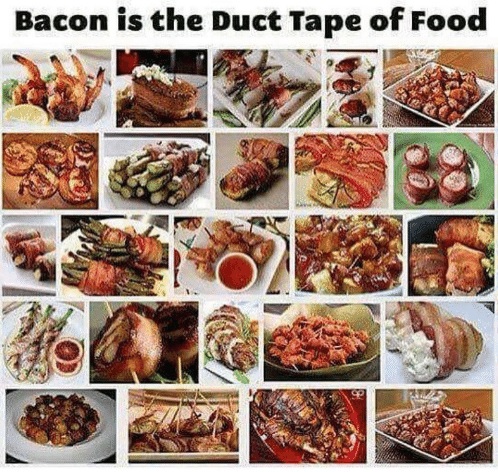
Bacon is the Duct Tape of Food
Could there be a more versatile meat?
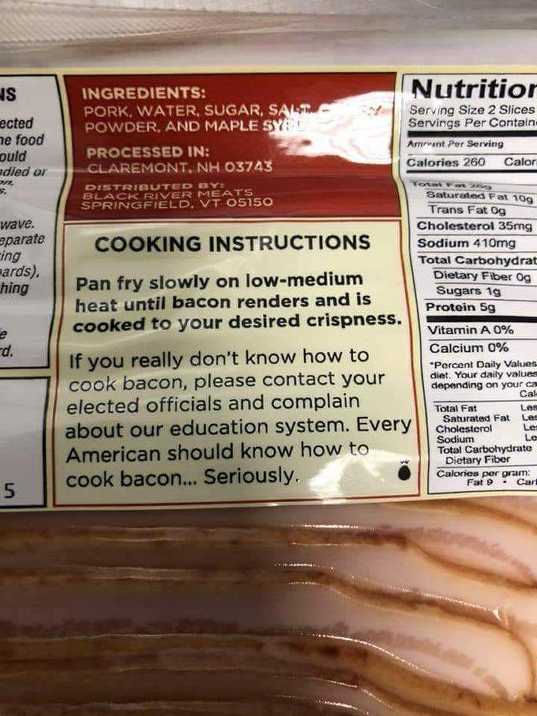
This is real. We checked.
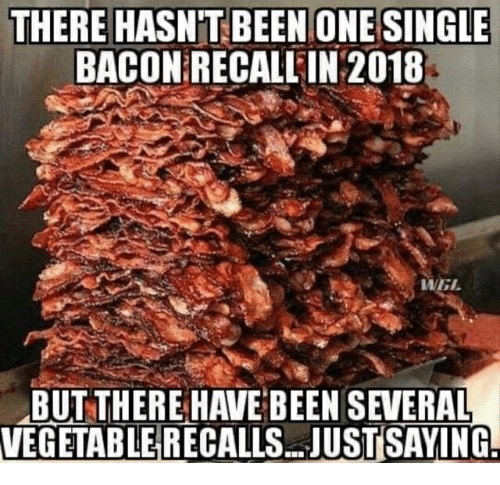
Bacon Recall
Think about that, vegetarians!
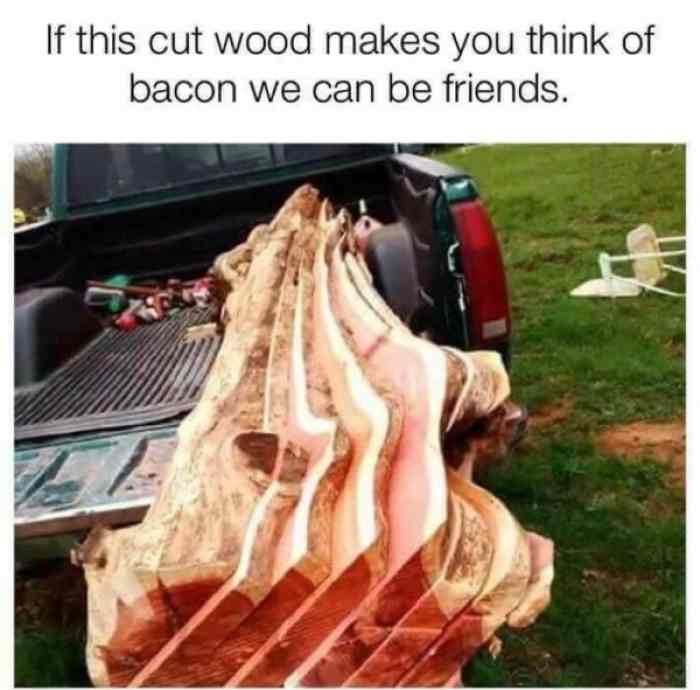
If we had to choose between wood for heat or bacon and freezing, you know what we’d choose. As long as we had other wood to cook the bacon over.
Just a Dog Eating a Bacon Strip
Okay, it isn’t his tongue, but if it were, he could lick our faces all he wanted.
If you receive this from a suitor, it means they're a keeper.
If you receive this from a suitor, it means they’re a keeper.

True Crime!

By Buddy Simmons 
We here at Your Daily Bacon are pretty diligent about scouring the internet for interesting pig tails, er, we mean pig tales, but for this edition, we found the pickings to be a bit slim. But fear not, we did discover a few stories of interest from days past that slipped beneath our radar, so we are happy (relieved) to be able to pass them on to you.

This first one is actually pretty recent. A report published on November 14thof this year revealed the story of assault and bacon battery. It seems that an unnamed woman who worked in the kitchen at a McDonald’s in Bluffton South Carolina, decided to snack a bit on the bacon that was presumably awaiting to be served. Her manager spotted her helping herself to some free tasty pork-product, and instructed her to just cut it out, after which the hungry worker acknowledged the reprimand…and then helped herself again to another couple crispy strips.
Now, we know what you are thinking, the same thing as we did. “Who could blame her?”

While bacon is extremely tempting, in a civilized society we wait for somebody to offer it to us, not steal it. The bacon-snatcher apparently was not a follower of this code.  And as a result, the manager told the woman’s boss. (That bit is a little confusing, at McDonald’s wouldn’t the manager BE the boss?)
Anyway, in retaliation, the bacon thief, upon learning she had been ratted out, backed the manager into a corner and proceeded to attempt to shove hot crispy bacon into the manager’s face. Again you are probably thinking as we did, “Um, what’s the crime in that? Bacon is great, who cares about the delivery method?” But there is a difference between somebody shoving bacon into your mouth and into your face, after-all. The former is a tasty, if perhaps a bit forced, favour, the latter is a ticket to a burn-treatment center.
Naturally the manager fought the bacon-crazed employee who then responded by slapping the manager. With the bacon still in her hands. As the report noted, if the manager had just eaten the bacon coming at her, the unruly employee would have been pretty much disarmed. It is unknown if she also shrieked, “Do you want fries with that?”

The police were called, and a warrant for the bacon barbarian was issued. When apprehended, she will face charges of assault and battery.
The story did not contain a resolution, so for all we know she may still be at large. Who knows, she may have headed for the Canadian border to escape prosecution. So just in case, if you see a wild-eyed woman eating a BLT on the streets, play it safe and avoid her! Or at least do not ask her for a bite of her sandwich, tempting as it may be to do so.

That is not the only case of meat mayhem. In Goldsboro, North Carolina, during an argument, a man’s girlfriend slapped him upside the head with an entire package of bacon. The boyfriend did not press charges, probably because hey – free bacon! Apparently, the further south you go, the nuttier people get. The tale is insane. After all, who would waste perfectly good bacon by using it as a weapon?

And in where we deduced may have been in the city of Madison, Wisconsin (forgive us for the sketchy details, we just dig this stuff up, we can’t always figure out the whereabouts unless it is explicitly stated and bacon crime is often a deeply shrouded mystery), a man – are you ready for this – named Thomas Bacon was arrested for allegedly assaulting another man for eating the last piece of breakfast sausage.

We also learned that back in 2014, a man in Staten Island, New York was arrested for attempting to steal 48(!) packages of bacon from a grocery store, hiding the merchandise beneath his clothes. Along with some beer and dog food. We can imagine one store clerk commenting to another, “Hey did that guy weigh 300 pounds when he came in here?!?” At least the thief thought of his dogas well, we guess. So he can’t be ALL bad. 

Next, in 2013, a woman was arrested in Athens, Georgia at a Piggily Wiggily grocery store for swiping five packs of bacon and two packages of chicken wings. When observant employees attempted to confront her, she sprayed them with pepper spray. She had to be insane. After-all, she could have gotten two extra packs of bacon if she had left the chicken wings behind. She ended up receiving five years in the pig-penitentiary for her misdeeds.

Finally, in 2010, in Surrey, England, a crook broke into a home and stole a pack of bacon from the refrigerator. He left a single uncooked slice hanging from the doorknob of the house, indicating that he was not entirely heartless.

And that concludes out forensic time-travel into the world of purloined pork crimes. We’ll leave you with this bit of advice: keep your bacon locked up!

2018 Saskatchewan Pork Industry Awards of Distinction

Submitted by Sask Pork

Sask Pork was pleased to present the awards this year to two Saskatchewan individuals well-known in the pork industry. Nearly 300 people were on hand November 14that the annual Pork Industry Symposium banquet.  

The first award of the evening, was given to Dr. Mark Jacobson of Warman Veterinary Services in Saskatoon. Jay McGrath of Sinnett Pork Farms presented the award, noting that Mark was nominated by the many producers, clients, industry supplier and colleagues who have appreciated and benefited from nearly 25 years of valued service, counsel, dedication and friendship over the many years he has served Saskatchewan hog producers. He added that Mark’s contributions have had a positive impact on the success of many of the individual hog operations that supported the award.

Pictured left to right:  Jay McGrath, Marilyn Jacobson, Dr. Mark Jacobson, DVM

Mark was born and raised on a mixed farm in north central Saskatchewan and attended the University of Saskatchewan College of Agriculture and the Western College of Veterinary Medicine, graduating with distinction from the WCVM in 1975.

Moving to Brandon, Manitoba in 1978, Mark joined Brandon Hills Veterinary Clinic as a veterinarian and partner, working there for 11 years. It was during this time he developed an interest in swine practice, monitoring the health and production of pigs. In 1989, he moved back to Saskatchewan accepting a position with the Canadian Food Inspection Agency in Regina and Saskatoon where he remained for four years. 

Mark missed the challenges of private practice and the relationships he developed working closely with livestock producers. As a result, he joined Dr. Neil Shantz at Warman Veterinary Services in 1994, later becoming a partner in 1996 and has worked closely with his swine clients providing health, biosecurity and production advice. He also brought his passion for the pork industry to his role.

A special presentation was made to Dr. Jacobson by Mark Wipf of Sovereign Colony, on behalf of the pork-producing Colonies, industry suppliers, and independent pork producers Dr. Jacobson served over the years. He was acknowledged by farms and individuals not only for his veterinary service, but also his friendship and genuine compassion for the people who work in the pork industry. He was presented with a hand-made commemorative clock crafted by Kyle Colony with the engraving by Goldenview Colony.

The second award of the evening was presented to Lee Whittington, past CEO of the Prairie Swine Centre (PSC). The award was co-presented by Dr. Harold Fast, Fast Genetics and Dr. John Patience, Iowa State University. Lee was nominated for his visionary leadership and contributions to the Saskatchewan Pork Industry.  

Pictured left to right:  Dr. John Patience, Lee Whittington, Grace Whittington, Harold Fast

Lee retired earlier this year after a 25-year career with the Prairie Swine Centre. Dr. Fast reflected on the many years he’s known Lee and spoke of the excellent qualities he possesses that contributed to his successful and rewarding career with the Prairie Swine Centre.

Lee joined the Centre in 1992 as director of technology transfer. His reach was local, national and international and he was driven by a passion to help producers be profitable. Above all, Lee always did his homework on new initiatives and research opportunities and was always prepared. This is in large part why he was so successful in gaining national support for PSC. 

He became president/CEO of the Prairie Swine Centre 2008, managing the operations, and maintaining an international brand for applied research in pork production. He has been an untiring spokesperson for the pork industry, the University of Saskatchewan, and the world.  He followed the standard set by Dr. John Patience that a leader needs to be present, listen and be relevant and that brand recognition begins with, and is synonymous with, the institution’s name.

Photo courtesy of Sask Pork

Lee also helped to create a culture at PSC that focused on measurable results and the $/pig impact making changes had on net income. This was an objective that brought credibility and accountability to the organization. The Centre has started a new research project every 10 days while still achieving 30+ PSY. They have also achieved in most years to maintain a positive cash flow despite some of the most challenging times in the last 50 years.

His imagination, personal credibility and tenacity resulted in the recent establishment of the NSERC research chair on Swine Welfare at the WCVM and the selection of Yolande Seddon who appointed Chair earlier this year. He was also responsible for the design, development and management of the Pork Interpretive Gallery at Elstow which for many years offered the general public, students and stakeholders a birds-eye view of modern pork production.

He has contributed as a member of Prairie Diagnostics Services board of directors, Sask Pork’s Research Committee, AgWest Bio and others. He has also received numerous industry leadership, stewardship and marketing awards throughout his career. In the local community, he has been part of the Raj Manek Business Mentorship Program and has mentored 12 small business owners since 2008.

Pictured:  Keynote opening speaker Trent Loos, of Loos Tales from the Farm in Nebraska
Photo courtesy of Sask Pork