By Jette Christensen
Editor’s note: Jette Christensen is Manager, Canada West Swine Health Intelligence Network (CWSHIN). She can be contacted at ‘manager@cwshin.ca.’
Maintaining strong animal health is fundamental to the long-term success and competitiveness of the Canadian pork industry. Diseases can influence production, market access and profitability in many ways, which is why minimizing their impact depends on coordinated action across the sector. Effective collaboration among producers, herd veterinarians, laboratories, provincial pork organizations and governments is essential to monitor and prevent disease threats.
Even a small number of cases of certain foreign animal diseases can trigger severe trade restrictions and disrupt the movement of animals and pork products across international borders. In addition to these high-impact diseases, a range of other conditions can reduce productivity and increase costs, often with less immediate but still significant consequences.
Understanding the full spectrum of disease risks – from export-threatening outbreaks to everyday production challenges – is critical for everyone in the value chain. By working together, the industry can protect herd health and maintain market access.
Animal movement disruptions cause challenges

Some diseases have the ability to disrupt the movement of animals through the production system, even when their direct impact on animal health is less concerning. A recent example is Senecavirus A (SVA). To date, SVA cases in Canada have typically been mild, with animals showing blisters on the snout that resolve within a few days. In some cases, diarrhea and sudden death in piglets under 10-days-old have also been observed.
SVA produces blisters that are indistinguishable from those caused by Foot-and-Mouth Disease (FMD). Because of this similarity, any appearance of blisters must be investigated, triggering precautionary responses that can slow or halt animal movements. This becomes particularly important in the cull sow market.
Most cull sows from Canada are shipped through assembly yards in Ontario and Manitoba before being exported to U.S. processing plants. If sows arrive at the border or at a U.S. plant showing blisters – or even healed lesions that could have been blisters – they may be rejected and returned to Canada. Repeated occurrences from a specific assembly yard can result in export restrictions until enhanced surveillance and corrective measures are implemented.
Such restrictions have occurred in both Ontario and Manitoba, sometimes lasting weeks or months. These disruptions can have cascading effects across the system, including reduced market access, backlog of animals and overcrowding in sow herds.
Disease management strategies can also influence production flow. For example, during efforts to eliminate Porcine Epidemic Diarrhea (PED), pig movements may be redirected based on disease status, limiting contact between infected and non-infected sites. While effective for disease control, these adjustments can add complexity to production flow.
Although diseases that disrupt animal movements may not be clinically severe, their potential impact should not be underestimated.
Production-limiting diseases are costly
Most diseases encountered in commercial barns reduce productivity in some way, making them a constant challenge for producers. These production-limiting diseases can cause both direct losses, such as mortality, poor growth, abortions and reproductive failure, along with indirect costs, including treatment, labour and enhanced biosecurity measures.
Porcine Epidemic Diarrhea (PED) is a clear example of a disease that significantly affects production efficiency. Because of its impact, the industry in western Canada has made a coordinated effort to control and eliminate PED. During major outbreaks in Manitoba and Alberta over the past decade, collaboration has been essential reducing its spread.
The virus can persist in the environment both inside and outside barns, making it difficult to eliminate completely. While individual farms may successfully eradicate PED, they remain at risk of reintroduction if the disease is still present in nearby operations or within their production network.
Porcine Reproductive and Respiratory Syndrome (PRRS) is another major production-limiting disease. It can cause reproductive failures such as abortions and respiratory disease in growing pigs. This virus can spread over short distances through the air. Although PED and PRRS can be managed or eliminated at the farm level, regional coordination is often more effective, particularly in areas with high farm density.
Finally, we have production-limiting diseases that currently are tackled farm-by-farm. One that stands out is the condition ‘diarrhea in young pigs’ because the cause is complex and could be a combination of E coli, Rotavirus, Salmonella, Sapovirus, feed and management.
Addressing these complex conditions requires detailed investigation, including laboratory diagnostics and analysis of on-farm practices. Effective solutions must be tailored to each operation, relying on close cooperation between producers, veterinarians and laboratories to identify causes and develop targeted control strategies.
Exports threatened by foreign diseases
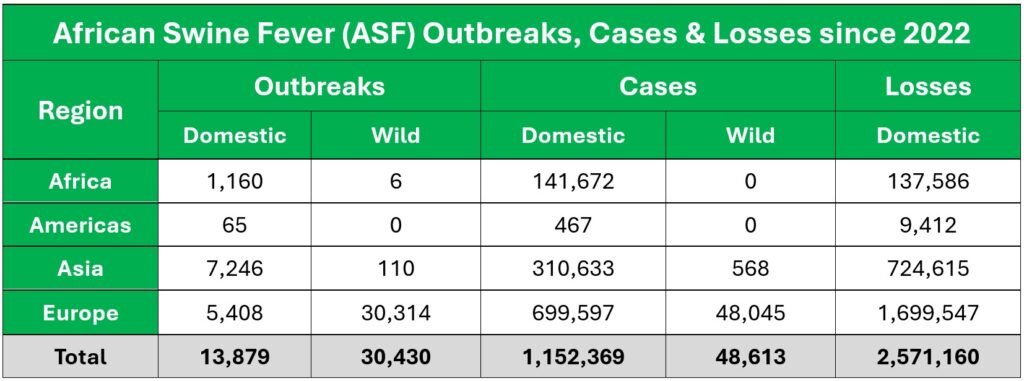
The Canadian pork industry pays careful attention to diseases that threaten international market access. Certain foreign animal diseases are considered high-risk because even a single case can lead to immediate trade restrictions.
African Swine Fever (ASF) is one of the most widely recognized threats. Since its spread in China in 2018, ASF has affected many regions across Europe, Asia and parts of the Americas. Although it has never been detected in Canada, its global impact highlights the importance of prevention and preparedness.
Foot-and-Mouth Disease (FMD) is another major concern. While it affects multiple livestock species –including cattle and sheep – it would have severe consequences for the entire Canadian livestock sector if introduced. In recent years, FMD has spread across regions of North Africa, Europe and Asia.
Both ASF and FMD have the potential to shut down export markets almost immediately, disrupting not only international trade but also the internal movement of animals and products within Canada. Movement restrictions would likely be imposed around infected areas, affecting farms based on their proximity to outbreaks and disease status.
In addition to trade impacts, these diseases can also severely affect production at the farm level. ASF, for example, can cause extremely high mortality rates. In its acute form, it can kill nearly all infected animals, often following rapid onset of symptoms such as fever, loss of appetite and sudden death.
Less severe, chronic forms of ASF can still cause significant production losses, including abortions, weight loss, respiratory issues and lameness. While mortality rates may be lower – around 20 per cent—the overall economic impact remains substantial.
Given these risks, preventing the introduction of foreign animal diseases is a top priority for the industry.
Swine disease surveillance provides useful data
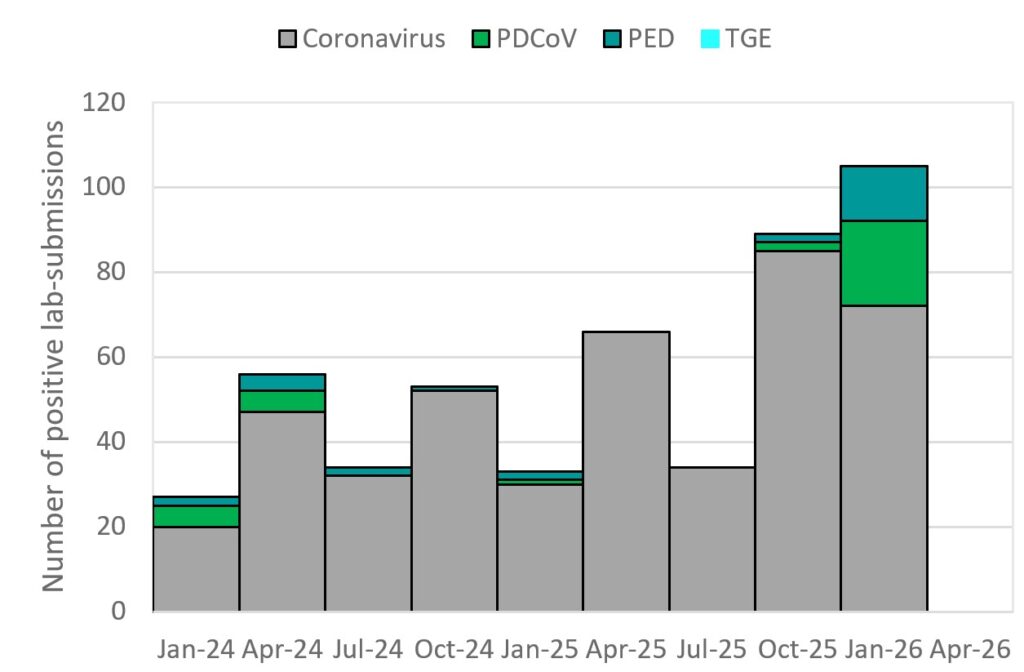
Ongoing surveillance is essential to understanding and managing animal health risks across regions. The Canada West Swine Health Intelligence Network (CWSHIN) plays a key role in monitoring disease trends and supporting decision-making.
CWSHIN operates with four main objectives: detecting emerging health issues, identifying unusual presentations of known diseases, providing information on endemic diseases, and supporting evidence of disease freedom – particularly for ASF and FMD.
Through its network, herd veterinarians share knowledge and observations, contributing to a broader understanding of disease patterns across the four western provinces. Laboratory data complements this information, helping confirm diagnoses and track disease presence.
Surveillance data show that ASF and FMD have not been detected in the region. Models and testing results are used to support evidence of disease freedom, which is critical for maintaining trade relationships. Other findings include the presence of Senecavirus A at assembly yards over several years. Data shows that PRRS is generally well-managed, though occasional outbreaks or instability still occur.
CWSHIN has also been effective in identifying new and emerging diseases. For example, Streptococcus equi zooepidemicus was first reported in 2019 and caused significant losses for the affected farms due to high sow mortality. More recently, SVA was detected at a sow site, with early information shared through the network before laboratory confirmation. For both diseases, the road to elimination was shared with the CWSHIN network for the benefit of other swine health experts.
A key feature of CWSHIN is its use of anonymous data sharing. Information that could identify farms is not collected, which encourages early reporting and builds trust among participants. While this approach limits geographic specificity, it enhances participation and improves overall knowledge sharing, supporting the network’s surveillance goals.
Producer efforts can limit disease impact

Reducing the impact of swine diseases requires a proactive and coordinated approach built on prevention, early detection and effective response. Each of these strategies depends on shared responsibility across the industry.
For foreign animal diseases, current prevention efforts include strict import controls, border biosecurity, on-farm biosecurity, and early detection through CanSpotASF. This enhanced surveillance program, established in response to the rapid spread of ASF in 2019, has received much voluntary support across Canada. Preparedness planning – a natural next step to prevention – is also an area of focus.
For production-limiting diseases, collaboration is equally important. PED elimination programs include biosecurity at farms (prevention) and surveillance at high traffic sites, which supports detection in herds and plans for effective response to an outbreak.
For production-limiting diseases in general, producers, supported by veterinarians and laboratories, are responsible for:
- Maintaining strong biosecurity practices within and around barns
- Monitoring animal health daily and responding quickly to changes
- Seeking timely veterinary advice when unusual signs appear
- Using accurate diagnostic tools, including laboratory testing
- Implementing effective treatment and herd management strategies
These measures are essential for controlling both common and complex diseases and minimizing their impact on production.
Disease control is in our hands
Diseases pose ongoing risks to the Canadian pork industry. They can reduce productivity, increase costs and disrupt market access, ultimately hurting the sector.
To address these challenges, the industry must consistently apply three key strategies: prevention, detection and treatment. Success depends on strong collaboration among producers, herd veterinarians, laboratories, provincial pork organizations and governments
By working together, the Canadian pork sector can better protect animal health, maintain trade opportunities and ensure a resilient and competitive future.