Pork Commentary Jim Long President – CEO Genesus Inc. Sept 12, 2022
This past week saw continued pressure on U.S. hog markets as Lean Hogs continue their drop from summer highs.
Some Observations
Last week’s slaughter was 2,243,000, almost the same as last year’s same week of 2,248,000. Year-to-date slaughter is down 3.3%.
Iowa – S. Minnesota slaughter weights a week ago 277.7 lbs. the year before 278.9 lbs. Hog inventory is certainly not backed up.
Average Lean Hog Futures on Friday average from September 2022 – August 2023 – 92.73. What’s the over/under on that?
We have been writing about Europe’s sow liquidation ongoing for months. Last week the United Kingdom released its sow inventory for June. Compared to a year before down 18%. A real reflection of the financial challenge in the UK and much of Europe have faced. The current carcass price in the UK is 198.40 British pounds/kg ($1.05 U.S. lb.) (what we understand is a record price). In February it was 138.1 (85¢ U.S. lb.). The price increase to date is from about 3% less hogs year over year. What happens when it is 18%? At the current prices, producers in the UK are losing money due to high energy costs.
In our opinion, Europe will be seeing less pork production per month year over year for the foreseeable future. This will push hog prices ever higher.
Avian Flu seems to be acting up again. Reports in the U.S. and France are indicating renewed activity. It seems to hit mostly Turkey and Egg flocks in the U.S. Broilers in France. A 3 million commercial Table Egg Layer flock broke in Ohio a week ago. In the last couple of weeks, 600,000 Turkeys in California and Minnesota hit. Turkeys a big item for Thanksgiving are hitting record prices around $1.50/lb. up about 24% from the prior year. Higher Turkey prices are probably supportive of Ham prices, especially during the holiday season.
The USDA is projecting Beef production to fall by almost 2 billion lbs. (-7%) in 2023 compared to 2022. The U.S. – Canada inventory report for July 1st was just released.
(1,000 head)
2020
2021
2022
Cattle and Calves
114,875
113,445
111,090
Almost 4 million less cattle from 2 years ago with the ongoing drought in the U.S. west there’s a good chance liquidation continues. Less Beef is price supportive for Pork. Beef cut-outs are $2.65 U.S./lb. Pork is $1.03 U.S./lb. Consumers are willing to pay more for Beef. Why? Is it our industry’s failure to deliver a better-tasting product?
Current weekly Beef Production is about 500 million lbs. a week. The USDA estimate of almost 2 billion less lbs. of Beef in 2023 would equal to 4 weeks of production disappearing. That’s a lot of meat not available.
USDA is projecting Latin American pork production to increase slightly in 2023 (0.4%). They expect less exports and more imports. Consumption they believe will have a significant jump of 3.3%.
Mexico the U.S. largest pork export market is projected by the USDA to increase imports by 8.2% compared to 2022 from 1.155 – 1.250 million tons.
China
According to public data, 17 publicly listed pig companies lost a total of 21.819 billion RMB ($3.50 billion U.S.) in the first half of 2022.
Losses Include
Muyuan
-6.871 billion RMB (-$991 million U.S.)
Zhengbang
-4.009 billion RMB (-$578 million U.S.)
Wens
-3.864 billion RMB (-$557 million U.S.)
Lots of money lost. These enterprises all with over a million sows at the beginning of 2022 are a reflection of the situation that China’s industry was in the first half of the year and the last half of 2021. The losses have cut China’s sow herd significantly and like Europe will see continued year-over declines in production for the foreseeable future.
Pork Commentary Jim Long President-CEO Genesus Inc.
September 6, 2022
We have been writing for several months about the reality of Europe’s challenge of profitability in the swine sector and that has been leading to sow herd liquidation.
InterPIG, is an international group of economists that gather together physical and financial data to a standard methodology so that the cost of production can be compared across a select group of countries. Below is a chart that showed the 2021 cost of production and selling price in different countries. U.S. dollars/kilogram liveweight.
Using a 120 kg liveweight basis we calculate the returns or lack of per country.
2021 – Full Year
Country
Profit/Loss per head
Netherlands
-$38.40 Loss per head
Germany
-$34.20 Loss per head
InterPIG Includes: Austria, Belgium, Czech Republic, Finland, France, Great Britain, Ireland, Italy, Sweden (Over 2.5 million sows)
-$14.40 Loss per head
Spain
$3.60 Profit per head
Canada
$15.60 Profit per head
Denmark
$3.60 Profit per head
U.S.
$39.60 Profit per head
Brazil Mt.
$0 Profit per head
Brazil SC.
$9.60 Profit per head
It doesn’t take an ag-economist to see that producing pigs in Europe in 2021 wasn’t a profitable experience. The Netherlands, Germany, and many other countries are quite dismal. We expect in the first six months of 2022 the financial picture didn’t change much as higher hog prices in 2022 have been negated by higher feed prices. Last week the U.S. national corn price was estimated to be $7.25 a bushel. Corn in Spain last week was $9.50 a bushel.
InterPIG estimates would put Denmark at a $3.60 per head profit in 2021. Denmark data indicates the Danish sow herd is down 8% year over year this July. Imagine what has happened in the countries that lost big money?
We expect the EU sow herd declined significantly from the end of 2021 through up to at least July this year. Lower slaughter numbers year over year is being seen. We are now marketing pigs that these mothers were bred last October-November, in our opinion, the sow herd has gotten continually smaller from then. Less Pigs to market in the coming months and less Pork to sell. We wrote last October after our visit to Europe that we expected the EU sow herd would decline up to 1 million sows due to the losses the industry was seeing. Looks like our opinion might have been correct.
One point on InterPIG data we have a hard time believing is the average U.S. market hog in 2021 led to a profit of $39.60 per head. If that much money was being made the U.S. sow herd wouldn’t have got smaller.
Pork Commentary Jim Long President-CEO Genesus Inc.
This past week Lean Hog futures, pork cut-outs, and hog prices declined while corn and soybeans jumped higher. There is certainly not a week for joy in Hogville. Our observations:
We aren’t smart enough to understand the sudden decline in hog pricing factors. The pork cut-outs and hog prices dropped but there were no more hogs to slaughter than the week before. Beef cut-outs didn’t move.
Corn and soybean prices jumped on reports of an expected smaller U.S. crop. Keep in mind Brazil, Russia, and Western Canada all have or expect excellent crop production, and all are major exporters of grains and oilseeds. The strong U.S. dollar will encourage global buyers to look at these countries as sources.
Ukraine, a major global exporter appears to be back in the game. After no ships moving for 6 months. As of last week, over 44-grain ships have left, 70 pending. More grain into world markets.
China has relisted approval of several of Canada’s hog packing plants. They did this on their own accord. We speculate China realizes they will need to import pork and want as many options as possible to source pork for competitive reasons. Pork moving to China is supportive for all Global Pork Exporters.
The Canadian government estimates that total Grain and Oilseed production will increase this year to 87,297 (K+) from 65,039 (K+) last year. A huge increase and recovery from the drought of last year.
Germany’s hog slaughter has been running between 700 – 750,000 a week in the last while. A couple of years ago it was around 1 million. No wonder Europe’s hog prices are near record levels as the massive liquidation of sows is being felt in lower supply.
European hog prices are at record levels – China’s hog price has almost doubled since the first of April. We are currently marketing hogs bred in October – November last year. Our observation is the sow herds of Europe – China both saw major liquidation since October. They both had huge financial losses until late spring. In our opinion the supply of hogs in both areas is going to see even greater year-over-year production declines in the coming months. Year over year global pork supply is declining. How do you ration less supply? Higher prices.
U.S. hog supply. Farmer Arithmetic – Smithfield Foods has announced the decrease of their sow herd in Utah tied to the closing of the Los Angeles slaughter plant. Our opinion is the Utah decline means the net U.S. sow herd is not expanding.
U.S. sow slaughter in July this year was 237,000 a year ago 246,000. There was one less workday in July this year. Year to date U.S. sow slaughter 2.5% of total slaughter the same as a year ago less sows have been slaughtered but the sow herd is smaller. In July though less sows were slaughtered than a year ago the percentage of slaughter was 2.6% higher than last year’s 2.5%. This tells us net U.S. sow herd not moving much one way or another.
It’s been really uplifting for us to see the reaction in the marketplace with the Genesus – Jersey Red Duroc. We continue to win taste tests domestically and globally. For more than two decades we have believed that taste trumps all with consumers. As my father used to say, “It’s like pushing a chain uphill” and that’s how it has felt. Genesus has been the lone and lonely genetic company that has believed the key to increasing per capita consumption is a better eating experience. Don’t we sell pork to compete with beef? Beef gets more money because consumers will pay more, they vote with their money. Those who say consumers won’t pay more miss the point. They will but they want to get a good predictable eating experience, not disappointment from too many marble-devoid loins.
Genesus is the Number #1 genetics imported to South Korea and has been for several years. It’s a market where consumers demand high marbling to get a better taste but producers need feed costs and disease challenge resistance at a competitive cost of production. Our Korean dealer summed up why Genesus is Number #1:
Compared to commercial hog producers, small-scale farmers raise just a fraction of pigs in Canada, but their need and desire for industry information continues to increase.
In the last two decades or longer, a predictable phenomenon has swept almost all regions where commercial pork production exists on a significant level: a trend toward larger, fewer farms with increased herd sizes. In most provinces, that means fewer than half of all producers – commercial operations – raise nearly all of the hogs accounted for, while the balance of producers run small-scale farms, not to be overlooked.
There is room in the Canadian pork industry for both commercial and small-scale production, as they typically serve different end-users. Many small-scale producers are responsible for supplying hogs to local provincially inspected abattoirs, while some perform on-farm slaughter for farmgate sales or personal consumption. In any case, the presence of small-scale producers represents an increasingly greater and more important challenge as time goes on: effective communication.
Regardless of size, all producers have a role to play in responsible pig stewardship, which helps protect our $24-billion annual industry when it comes to animal care, health and traceability. And it is incumbent upon producer organizations and the broader industry to invest more heavily in this area, as foreign animal diseases and public trust concerns continue to emerge.
Surveying small-scale producers across Canada
Most small-scale producers raise pigs outdoors, with optional shelter provided.
Last year, Prairie Swine Centre launched a survey of small-scale producers across Canada’s main pork-producing regions.
The survey sought information in four main areas: operational features, herd composition, pig health and disease awareness. The survey was completed by nearly 600 producers, of whom, nearly nine of 10 own fewer than 25 pigs total. A similar number of those producers reside in Alberta, Saskatchewan, Manitoba, Ontario and Quebec, with the occasional British Columbian or Maritime producer included for good measure. More than half of all surveyed own pigs for only part of the year, with fewer than one-fifth housing pigs entirely inside a barn, favouring mixed indoor-outdoor production.
“It confirmed what we thought in certain areas,” said Murray Pettitt, CEO, Prairie Swine Centre. “While most of the results weren’t too surprising, it is a bit concerning how many respondents indicated that they feed food scraps to their pigs and were unaware of certain diseases, like African Swine Fever.”
As a follow-up to the survey, Prairie Swine Centre is looking at options to improve small-scale producer engagement, including the potential development of fact sheets and videos as resources. Recently, a new website (‘www.smallscalepigfarming.com’) was launched to support knowledge transfer.
As Pettitt sees it, part of the challenge could be the widespread availability of misinformation on social media, especially for someone new to raising pigs.
“Many farmers prefer to get their information from diverse sources, such as other producers, veterinarians, websites and social media,” said Pettitt. “This new website will be identified as a source of accurate information, allowing small-scale farms to have confidence in the content they choose to seek out.”
Recognizing the challenge at hand, Pettitt has posed some pointed questions.
“Are the knowledge gaps related to new people coming into pigs, or is it something else?” asked Pettit. “Can we communicate most effectively by understanding farmers’ goals and objectives, which can be different from the needs of large-scale production? What resonates with them?”
At least one possible answer could be the use of interactive sessions to strike down some of the myths around small-scale farming, to bring those individuals into the circle of trust that the commercial industry is hoping to widen.
“The whole effort is really about education,” said Pettitt. “It can be difficult for small farms to find useful, factual information applicable to the way they raise their pigs. Key information on topics like feed and biosecurity are important to all producers in Canada, no matter the size. By making this information easier to access, collectively, we will better protect the health and welfare of Canadian pigs.”
Webinars link small-scale producers to experts
Kelsey Gray of Prairie Livestock Veterinarians led a series of Alberta-based webinars for small-scale producers last year.
Alberta Pork supported a three-part webinar series last year with Alberta Farm Animal Care (AFAC) and Prairie Livestock Veterinarians. The series invited dozens of small-scale producers to attend hour-long broadcasts, free-of-charge, for anyone who owns a small number of pigs or may wish to do so in the future, covering everything from legislative concerns around pig ownership to proper handling. Funding from Alberta Pork made the webinars possible.
“Producers can often be set in their ways,” said Charlotte Shipp, Industry Programs Manager, Alberta Pork. “You would be hard-pressed to find a producer who does not take raising pigs seriously, but the ‘right way’ of doing things can mean something different to everyone.”
Certain production practices that are more prevalent with small herds include things like raising pigs on pasture, which increases the animals’ risk of stress due to weather, interactions with wildlife and potential disease incursions. While these practices hearken back to the traditional way of doing things, the industry has evolved considerably in recent decades. For small-scale producers who are not as up-to-speed with the modern industry, there is still progress to be made when it comes to registering their farms with provincial pork organizations and entering their pig movements into Canada’s national traceability database, PigTrace.
Producer registration captures important information
Producer and premise registration through the appropriate provincial pork organization is a legally required first step to moving pigs, which are tracked in PigTrace.
Few small-scale pig producers rely on their hog operations as a sole source of income, and some of those producers are caught off-guard when it comes to registering with provincial organizations, which is legislated for anyone who owns even a single pig.
This is most easily observed in late summer, when, every year, requests come into the provinces for last-minute registrations. What often happens is that a producer arrives at his or her intended abattoir with a hog and is then informed by the processor of the registration requirement. Because abattoirs are responsible for collecting and submitting producer levies to the appropriate provincial organizations, to collect that levy, producers must be registered in advance. This process can sometimes be expedited on-the-spot, assuming traceability officials are available to assist at any given time, but the situation is not ideal for anyone.
“We get panicked calls from producers who are waiting at the abattoir with a pig, but they can’t get it in, because they haven’t gone through the registration process yet,” said Christina Quinn, Traceability Coordinator, Alberta Pork. “It’s a pain for them, and while we’re happy to help producers in a bind, it is easiest for everyone if initiative is taken prior to the moment when these things need to be in place.”
The situation described by Quinn is evidence of why communication is vital to the process. If we can actively campaign to register new and prospective producers, it makes the job of traceability much more thorough. In the unfortunate instance of a disease outbreak, which could affect anything from product recalls at retail to the industry’s ability to conduct international trade, traceability is a crucial component of incident investigation. Lessons learned help the industry prepare for the future and improve upon any mistakes.
Strengthening relationships equals better business
Education matters. Feeding food scraps to pigs is not recommended, but some small-scale producers are simply unaware of the risks.
Every pig owner – from the pet lover and conservation breeder to the on-farm consumer or commercial farrow-to-finish operator – factors into the bigger picture. As the global marketplace for pork continues to expand, the commercial industry will certainly need to focus more often on small-scale production, not just because these producers outnumber commercial producers, but more specifically because they have the potential to make or break certain promises the industry has worked hard to keep with its many respected, valued overseas partners.
Editor’s note: Bijon Brown, Production Economist, Alberta Pork recently interviewed Trevor Wallace, Nutrient Management Specialist, Alberta Agriculture, Forestry and Rural Economic Development. Brown can be contacted at bijon.brown@albertapork.com. Wallace can be contacted at trevor.wallace@gov.ab.ca.
High fertilizer prices have created a renewed sense of interest in using hog manure to nourish crops. Knowledge is the key to putting manure to best use.
Brown: Since mid-2020, we’ve seen a significant rise in fertilizer prices. More recently, we’ve seen how transportation bottlenecks and China’s restriction of fertilizer exports have caused prices to soar. Do you think there is value in using hog manure as fertilizer for crops?
Wallace: Yes, definitely. Basically, all the nutrients that a crop needs can be found in manure to varying degrees. It’s not a perfect fertilizer, and there’s going to be shortfalls of nitrogen within the manure, but as a nutrient source, it’s a very good option for producers – especially the operations that have manure there. They’ve got to put it on the land somewhere, so it can be really targeted both on the landscape and towards the crop, to provide a very good value for that cost of application.
Brown: Is it expensive to test or sample manure?
Wallace: No. The sampling is relatively easy, and sometimes manure applicators can do it for you, but this can sometimes be a pain. Manure composition is variable, so that’s always a problem. On a drag line system with a pump, there’s often a spigot that we can open and take some manure out or use the transfer hose that we’re pumping. We take several samples and then try to keep it cool and get it to the lab, so that’s the bigger challenge than the cost.
Brown: What’s the best way to start this, and how can we value this manure? Is there a tool that can estimate the value of the manure?
Contrary to what some might think, it is possible to put a dollar value on manure through testing and analysis.
Wallace: Yes. There are a couple of different ways to do it, and we do have the ‘manure transportation calculator.’ The calculator allows you to put in the crops you want to grow, and it’s going to give you book values automatically, but you can put in your own values if you’ve had the analysis done.
When you put in your numbers, it spits out the economic benefit and the cost of using it. The calculator evaluates the cost over five years, so over that rotation, we’re going to account for nutrients that are released with time. Value comes in two ways: one of them is from the nutrients in the manure, and the other one’s from the nutrient needs in the crop.
Brown: What’s the best approach for getting consistent nutrient application?
Wallace: The traditional way is really good agitation – starting two to four hours before application. It costs money, but we’ve improved agitation with either multiple agitation pads in the lagoon or new technology, like a remote-controlled agitator that moves around and sucks up the content at the bottom. That’s one approach.
Another way is to take multiple samples from the lagoon at different times. The early material is mostly water, and the later material is going to be a higher percentage of solids. Another way yet uses a newer technology to sample the nitrogen content as the manure’s flowing from the tanker.
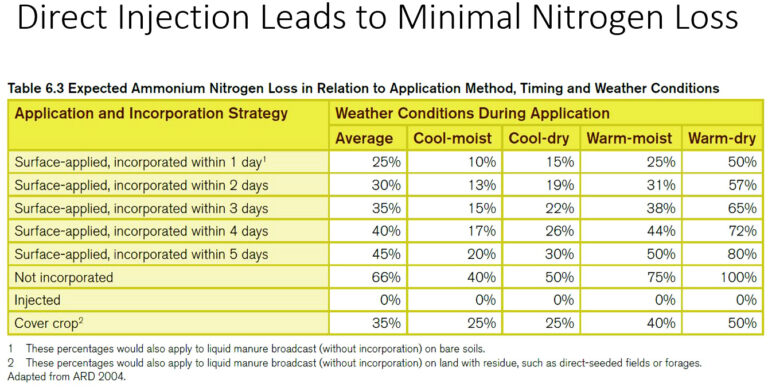
Brown: What are the benefits of applying the manure via direct injection versus surface application?
Wallace: Surface application is fast. You can do a large area quickly to reduce soil compaction, but the problem with surface application is the loss of that available nitrogen with solid manure, which has a lot more of the organic nitrogen and a smaller amount of the available nitrogen. With liquid manure, it’s fine. There’s a lot of nitrogen that can be lost depending how we handle it.
Injecting manure, rather than surface application, remains the preferred method. Among other reasons, less nitrogen is lost.
Brown: Should application be directly to the soil, to make the best use of nitrogen?
Wallace: Yes. It can still be broadcast, but the quicker we work it in, especially the liquid, the more nutrients or nitrogen being captured. The guys that are changing their system so they can spread during the season – into growing crop – are not spreading it when there’s a risk of loss, since most of our runoff’s in the spring. If we can get it in the ground in the fall, the organic stuff will start breaking down a bit, but crops use it better. A low broadcast or a pure injection helps with odour, and maybe the most important thing, it gets some of the equipment off the road, for safety reasons.
Brown: Are there any other benefits we can get out of manure when it comes to soil quality?
Wallace: Yes. Part of it comes from that organic portion, like the manure itself. We’re adding a food source for microbes. Solid manure can have a greater impact than the liquid. It’s adding the carbon and organic matter to the soil, which makes the ground more pliable and easier for crop growth. It granulates really nicely and helps with water infiltration, resists soil compaction and helps the plant roots.
Brown: Is there value to using manure for renewable energy?
Wallace: I’m torn on it. For this technology to work, it needs to be scalable and fit the size of the operation. The difficulty with this is that it is complex technology – it’s going to require expertise or extra labour. Many manures are not really high-energy producers. We can use the manure as a base in the mixture for something like an anaerobic digester, but the hog manure we did some research on was producing about 156 megajoules of energy per tonne. In the same quantity, poultry manure produces 3,200 megajoules, and coal is 22 to 32 gigajoules [22,000 to 32,000 megajoules].
Brown: Are there benefits to having knowledge in terms of how manure affects the environment?
Wallace: Yes. When we often talk about manure, we look at it as an economic benefit for the crop. It is a cost to get it out there, but whatever we can do to maximize the use of the nutrients that are in it helps offset that cost. When we start talking about losses due to gases in the air or runoff, the loss of value is either a loss in yield or just a pure loss of cost, because you paid to put it there, but now it’s gone.
Those nutrients do the exact same thing in water as they do on land. A very small amount of them have a huge impact in water, so when we start to lose nutrients because of runoff, we’re not capturing them in the field. That nitrogen or phosphorus can have a significant effect on the growth of algae, for example, which has a negative impact on water quality.
Brown: Do you have any best management tips that can help a farmer manage his use of manure?
Wallace: Knowing what’s in the manure is a great first step. It doesn’t matter if you start with book values, but knowing what you’re applying is important.
I’ve worked with a lot of producers who have figured out their application rate not because they know what’s in it, but they’ve done it so long and they’ve come up with a number that produces the crop they’re targeting, so they’ve figured it out that way, but getting to know the nutrient content through soil sampling is fundamental.
Knowing that nutrient profile really helps with taking advantage of all the nutrients that you’re applying or the nutrients that are in the field, because if they’re accumulating there, you’re not getting value from them.
Producers in Alberta are encouraged to contact Wallace if they are interested in learning more about how to best use their manure. Producers outside of Alberta are encouraged to contact their local agronomist.
August 22nd, 2022 Jim Long President-CEO Genesus Inc.
Last week saw lean hog futures plummet with the near-term months of October and December declining over $6.00. We have to say not sure why the big decline. Our observations:
Lean hog prices are strong, the National Lean hog price averaged $1.17 lb. last Friday. October futures closed 93¢ lb. The future traders are projecting that hogs will decline 24¢ lb. over the next few weeks. Seems like a huge drop to us.
A few weeks ago, Iowa – S. Minnesota average hog weights continued low at 275.7 lbs. compared to a year ago at 277.6 lbs. Reflecting to us a current inventory.
U.S. hog slaughter last week continued the trend of less hogs. 2,395,000 compared to 2,432,000 a year ago. Year to date U.S. hog harvest is down 3.5%. All indications are that hog supply will continue lower than a year ago.
USDA pork cut-out calculation was $1.17 lb. last Friday. Choice Beef cut-outs $2.64 lb. Pork a real value option compared to Beef should be demand supportive.
Whole Chicken prices continue to decline last week at $1.29 lb. a few weeks ago in the $1.60 lb. range. Chicken slaughter running 1-2% over a year ago. A year ago, the price was $1.04 lb.
We are not sure what lean hog futures will do in the near term. We wonder sometimes if futures price discovery is about as relevant to commercial pig production as show pigs. Time will tell but we expect October hogs will be selling stronger than Friday’s lean hog futures would indicate.
Europe
Spain the largest hog producer in Europe set a new record price for hogs last week at 1.71 Euros/kg (liveweight). Since January 20, when the national price was set at 1.02 Euros/kg the Spanish market has not had a week of decline. It’s been a steady rise.
Germany the second largest producer has also seen a jump in hog prices to 2 Euros/kg (carcass). At the end of January Germany was 1.2 Euros/kg. Germany’s prices suffered from pork export issues caused by ASF. Some believe the combination of hogs selling under the cost of production and new environmental – animal welfare regulations could have made Germany’s sow herd decline by 500,000 – 600,000 sows.
Denmark is also seeing a decline in pig inventory. The July 1st compared to last year inventory of slaughter pigs was down 991,000 (-8.2%) and the sow herd was down by 84,000 (-6.5%). At the end of February, the Danish slaughter price was 7.90 DKK/kg (46.6¢ U.S./lb.), last week it was 11.80 DKK/kg (70¢ U.S./lb.)
A factor that affects both European and U.S. competitiveness is the U.S. dollar to Euro exchange rate. Currently, they are at par 1 to 1. Not so long ago the Euro was 1.1 to 1.15 to the U.S. dollar. The current exchange rate of 1 to 1 helps European pork be more competitive in global markets but on the flip side has made feedstuffs mostly priced in U.S. dollars globally more expensive.
North America’s largest competitor in global pork exports is Europe. As Europe’s supply of pork continues to decline and prices continue to rise both Europe and North America will benefit from less pork driving prices.
Dead Sows
We have written several times about the continued increase in sow mortality reflected in USA sow data. Now at 14% plus average many systems are approaching 20% and beyond in the farms using the prolapse generating genetics of you all know who.
Recently we heard a producer make the comment “Why as an industry do we accept sow mortality greater than pre-weaning mortality?” SMS – MetaFarms data systems calculated a dead sow is a lost opportunity of $1,000 each. Do the arithmetic on your own farm, what is each 1% worth? As Albert Einstein in a well-used quote said, “Insanity is doing the same thing over and over again and expecting a different result.”
Einstein wasn’t in swine production but we would expect he would have realized buying the same genetics over and over and continuing to have the same results of huge sow attrition would lead to a change.
Pork Commentary – Jim Long President-CEO Genesus Inc. August 15, 2022
U.S. Hog Weights Reflect Current Hog Inventory
The latest Iowa – Southern Minnesota weights are reflecting quite a current hog inventory. In the first part of May, the weights were averaging 289 lbs. Last year same time they averaged 284 lbs. In May we were 5 lbs. heavier year over year. The first week of August this year 275.6 lbs., a year ago 278.4 lbs. Now almost 3 lbs. lighter year over year. Since the first part of May an 8 lb. swing. A significant shift may be somewhat attributable to heat but we don’t believe that can be the whole answer. Hog prices have gone up on the National Price from just over $1.00 lb. in the first part of May to now being in the mid $1.20’s. This tells us Packers have chased hogs with higher prices to keep lines fuller. This aggressive purchasing has pulled hogs forward as producers take the benefit of higher prices. Despite the lower hog weights U.S. hog slaughter year to date is down 3.6%. Last week the U.S. slaughtered 70,000 head less than a year ago. The National hog price current average in the mid $1.20’s lb. compares to $1.05 lb. a year ago same time. A reflection of more demand and less supply. This bodes well going into the future.
Other Observations
Last week CNN breathlessly told a story that Beef demand was declining while consumers were driving up Chicken prices due to inflation pressures. We wonder where they get their information?
We observe Choice Beef carcasses are $2.63 lb. range. We haven’t seen the Beef carcass price move more than a few cents either way for weeks.
If consumers are driving up demand for Chicken as the CNN story goes, wouldn’t Chicken prices be going up? What we observe is the opposite. Since the end of June, the National Whole Chicken price has declined steadily from $1.65 lb. to a week ago averaging $1.32 lb. Not exactly a resounding sign of increased demand and higher prices as CNN was reporting. Some would call this Fake News.
If CNN was doing a complete story on consumer demand maybe they should point out U.S. Pork cut-outs have gone from $1.05 to $1.25 lb. in a few short weeks. Obviously, as consumers are being squeezed by inflation, they are not cutting back on Pork purchasing if the price has gone higher. Maybe less stories on fake meat and more on an industry that consumers actually buy from i.e., Pork. Might better reflect the reality of real American consumers, not the ones the vegan woke’s in media fantasize about. American meat and poultry consumption is projected at near 220 lb. per capita this year. Americans love meat protein.
China Price Update
Market Hogs liveweight
35 lb. feeder pigs
April 4
12.54 RMB
89¢ U.S. lb.
413 RMB
$65.04
August 8
21.6 RMB
$1.44 U.S. lb.
775 RMB
$115.16
It doesn’t take an ag economist to observe the big price increase in market hogs and feeder pigs in China. Producers have gone from losing gobs of money to making good margins. All because of the massive sow herd liquidation caused by industry losses of over $60 billion U.S. We continue to believe China will be back in the Pork import market over the coming months. Giving continued price support in U.S. and European markets.
We are all aware of how strong Beef prices are currently. The question in our mind is how high will Beef prices go in 2023 if the USDA projection of 1.7 billion to 1.9 billion lbs. less is produced than in the last couple of years. About a 7% decline. In our opinion, the significantly higher Beef price will be tremendously supportive to hog and Pork prices as we note Americans pay for and like consuming meat.
Spain, the largest hog-producing country in Europe set a new record hog price last week of 1.70 Euro/kg. The hog price has gone up almost weekly since the end of January when it was 1.02 Euro/kg. In Spain, slaughter numbers are down significantly and weights are lower year over year. The specter of lower number of hogs in Europe as a whole continues. The liquidation of sows started mid-last year has not totally come home to roost.
Summary
China higher prices from fewer hogs.
Spain record hog prices. Europe even fewer hogs coming.
U.S. less Hogs – less Beef.
Global high feed prices will discourage any expansion near term.
China, Europe, USA less hogs now and into the next year. A scenario that should lead to very strong hog prices.
Pork Commentary – Jim Long President-CEO Genesus Inc. August 8, 2022
U.S. lean hog prices continue very strong with the National lean hog prices averaging $124.43 lb. last Friday.
U.S. pork carcass cut-outs also are strong last Friday at $1.25 lb.
Cut-out
Price
Belly
$2.17 lb.
Rib
$1.46 lb.
Butt
$1.29 lb.
Ham
$1.17 lb.
Loin
$1.05 lb.
As usual, the cuts with the most marbling (flavor) lead the way in value, consumers vote with their money. The legacy of pigs too lean can be seen in the Hams and Loins languishing in value. Half the carcass is in Hams and Loins, never a bad idea to improve their taste and subsequent value, this can only be done by increasing marbling. Cardboard tasting Loins-Hams are a cancer to our industry, stopping our ability to grow demand and consumption.
Beyond Meat (NASDAQ: BYND) is reported to have burned $1 billion in cash over the last twelve months. Not exactly going forward. Many of the plant-based fake meat products have poor taste or repugnant taste which is why they are failing. Taste matters. Of note U.S. per capita, red meat and poultry consumption are at historical highs. Vegans be damned.
Interest rates are climbing, putting up costs for all producers higher. It’s also affecting breakeven costs for existing and proposed new operations. Higher interest rates are affecting producers everywhere and will slow production.
We have been writing since last fall about the massive financial losses the China industry was encountering. We predicted a huge decrease in production. Hog prices have doubled in China since March lower hog numbers come through. Some in China are saying the breeding herd has decreased by 20% (-8 million sows). According to data from the China feed industry pig feed output in June of 9.45 million tons was down 12.4% from last June (over 1 million tonnes less meaning less corn-soybean needed).
We also have been expecting as pork supply drops in China pork imports will increase. A week ago, for that week U.S. sales to China were 16,770 tonnes (farmer arithmetic equivalent to 160,000 hogs). Year to date 116,706 mt. No one buys pork if there isn’t a market or demand. We expect to see increased sales of pork from North America and Europe. Every pound of pork that goes to China isn’t available for domestic use or other export markets. This will sustain and enhance hog prices.
Summary
U.S. lean hog prices and pork cut-outs are strong reflecting strong demand.
European prices such as in Spain at record levels.
China hog price $1.45 U.S. lb. liveweight – large U.S. sale for pork (16,000 mt) – both reflection of cut pork supply and stronger prices.
Our premise has been and continues that lower supplies in USA-Europe-China will lead to strong global hog prices.
At Genesus we believe that we are producing Genetics of pork that the consumer craves. It’s a better eating experience. Genesus – Jersey Red Duroc is the name of our World Leading Duroc. Attached is an interview of Spencer Long of Genesus and Jim Eadie of Swineweb discussing the Jersey Red Duroc.
Editor’s note: Lexie Reed is a food animal veterinarian based in Lethbridge, Alberta. She can be contacted at lexiereedvm@gmail.com.
Animal transport is one of the most prominent public-facing aspects of the livestock industry. Ensuring welfare has many benefits. But how much of a difference does distance make when it comes to weaner pigs?
The impact of transportation on animal health and welfare remains a hot-button issue for the livestock industry. All livestock systems require live animal transport at some point in the system. Further, transportation is the event in which the public is most likely to see and interact with animals in the food system.
The health and welfare effects of this commonplace event are not well understood in many food animal systems, including the practice of transporting weaner pigs. Federal transport regulations in Canada limit the transport time of pigs to 28 hours. These regulations are based mainly on research on market hogs, not weaner pigs, which differ physiologically.
New research, led by animal behaviour expert Jennifer Brown of Prairie Swine Centre, supported by Swine Innovation Porc, aims to assess the response of weaner pigs under Canadian commercial transport conditions. Brown, in collaboration with animal scientists at the University of Saskatchewan and University of Guelph, investigated physical and behavioural responses of weaners after short- and long-distance transportation.
Brown found that weaners subjected to long-distance transportation lost more of their body weight, experienced more dehydration and spent more time feeding, drinking and sitting after the journey than weaners transported short distances. However, weaners transported shorter distances had more muscle injuries and higher indicators of physiological stress, as evidenced by blood cortisol- and blood neutrophil-to-lymphocyte ratios.
Prairie Swine Centre’s research report states: “In conclusion, this study represents the first research in Canada on the effects of transport on weaner pig health and welfare. Differences in long-distance and short-distance transport were found, but neither treatment was identified as being better than the other.”
Better adaptation takes longer
Immediately upon arrival, long-distance piglets weighed less than those travelling short distances, but three days later, the weight gap had narrowed.
In this study, short-distance transportation was defined as less than three hours of duration. The piglets transported short distance were weaned at the same time they were shipped. Long-distance transportation was defined as being greater than 30 hours of duration, and in contrast, the piglets in this group were weaned several days before transportation occurred.
While it might at first seem counter-intuitive that the weaners transported a shorter distance had higher indicators of physiological stress and muscle injury, Brown believes that the weaning time, as well as adaption to transport, contributed to this difference.
“Short-distance piglets were weaned and transported at the same time, so their response post-transportation reflects acute stress,” said Brown. “Because long-distance weaners had a much greater transport time, they habituated to transport conditions and showed reduced levels of stress biomarkers on arrival compared to short-distance weaners. It appears that the long-distance weaners adapted reasonably well to transport, as they did not clearly show signs of chronic stress.”
While it is difficult to pinpoint exactly where acute stress turns into chronic stress, or where habituation occurs, Brown’s findings suggest that weaners may be adapting to transportation conditions during the added time in long-distance transport.
All pig transportation in Canada is mandated by the Health of Animals Regulations under the Health of Animals Act. Transporters and producers are held legally responsible under this legislation. Pig transportation is also regulated by the National Farm Animal Care Council’s (NFACC) Code of Practice for the Care and Handling of Pigs. While the pig code is not law, on-farm and transport quality assurance programs closely align with this standard. For more than 99 per cent of pigs raised in Canada, entering into abattoirs inspected by the Canadian Food Inspection Agency (CFIA), quality assurance guarantees are required.
To pass the Animal Care Assessment (ACA) section of the Canadian Quality Assurance (CQA) or the PigCARE component of the Canadian Pork Excellence (CPE) program, producers must meet the requirements within the code. As such, updates to the code are introduced only following consultation with animal welfare experts. Research such as this project by Brown is designed to eventually find its way into industry standards, which are adopted with public trust and the confidence of international trading partners in mind.
Pre-weaning prior to shipping may have positive effects
Greater allowances for weaning time and space, and trailer improvements, can all contribute to better welfare.
While still in the early stages of weaner transport research, Brown thinks this work could impact the industry in three ways. The first potential impact could be the separation of weaning and transportation events at the farm level.
“Especially for long transport, so that pigs are recovered to some extent from weaning and consuming feed before they are transported,” said Brown. “This would require that sow barns have nursery space to wean into.”
The other impacts concern trailers.
“These results could influence the use climate-controlled trailers, with forced ventilation or insulation, especially in extreme hot or cold temperatures,” said Brown. “The provision of feed, water and rest on trailers is another consideration.”
However, Brown cautions that more research would be required in this area before any of those changes could be applied. By further enhancing the industry’s understanding of weaner transportation, changes to these practices are almost inevitable, thanks to the support of scientists, veterinarians, government and other stakeholders.
Marie-Claude Bibeau, Minister, Agriculture and Agri-Food Canada and Kerry Towle, Chair, Canadian Meat Council (CMC) together at CMC’s 2022 annual general meeting (AGM) and 100th anniversary banquet.
The Canadian Meat Council (CMC) held its annual general meeting (AGM) in Ottawa in mid-June, along with a banquet to mark 100 years since the organization’s founding.
“Our centennial celebration is testament to the longstanding efforts of the Canadian meat industry to grow and prosper,” said Chris White, President & CEO, CMC. “Canadian meat packers have proven time and time again that we are here to defy expectations for a country our size compared to some of our international contemporaries.”
CMC represents about 90 to 95 per cent of all pork and beef processed in Canada, in addition to other red meats. These fresh and processed products originate from more than 200 facilities across the country, shipping product to more than 120 countries worldwide. CMC works with its processor members and associate members – such as food ingredient suppliers, packaging material suppliers, equipment manufacturers and service providers – to advocate for international trade and regulatory policy frameworks that protect food safety and market access, while also helping the industry stay collectively competitive domestically and globally.
When it comes to political decisions and livestock disease challenges at home or abroad, producers and packers alike can be deeply impacted. For the hog industry, the continued, uninhibited flow of pork from the abattoir to end-users is fundamental to the financial success of the sector. While the composition of the industry has changed over time, what has remained unchanged is its devotion to expanding business opportunities and focusing on providing safe and wholesome meat for consumers.
Canadian meat goes global
Exports of Canadian pork and beef increased five-fold in terms of volume and value between 1988 and 2021.
In the aftermath of the First World War, more than a dozen meatpacking firms gathered in Toronto, in 1919, to discuss the formation of a voluntary trade association, which would eventually become the ‘Industrial and Development Council of Canadian Meat Packers,’ in 1922, officially changing to the ‘Meat Packers’ Council of Canada,’ in 1952.
The organization was renamed the ‘Canadian Meat Council,’ in 1980, at which time major changes were afoot in the industry, with a focus on diversifying from mostly domestic markets to international ones. Domestic red meat consumption per capita had begun to fall, as a result of increasing food consumer choice and a shift to proteins like chicken. As a result, packers began to seek new markets for their goods. It was around this time that the integration of hog production and pork processing became a smart business decision for packers who were eager to secure hog supply for reliable volumes of pork.
In 1991, the Canadian Pork Council (CPC) and CMC came together to form Canada Pork International (now known simply as ‘Canada Pork’) – the definitive link in the value chain that brought together producers and packers.
“The value proposition for Verified Canadian Pork hinges on collaboration between those who raise hogs and those who process them,” said Trevor Sears, President & CEO, Canada Pork. “Whether we market pork to Canadians or our overseas partners, strength across the value chain is what makes quality assurance guarantees possible.”
Today, about half of hogs on-farm in Canada belong to producer-packer integrated systems, while independent producers continue to play an important role for all federal plants. In 2020, Canada exported more than 70 per cent of all pork produced in the country, primarily to China, Japan, the U.S. and Mexico, with large emerging markets in Vietnam and the Philippines. Considering all global pork traders, Canada ranks first among export-dependent jurisdictions in the world, followed by Chile, which ships away just over 60 per cent of its pork. The U.S., meanwhile, moves approximately 30 per cent of its pork out-of-country.
Looking forward at issues affecting trade and regulatory policy frameworks, the global rise of African Swine Fever (ASF) has characterized the pork industry narrative in recent years, which intimately affects hog producers as much as packers and others in the value chain.
Continued trade requires disease control
Canada Pork’s handbook covers a wide range of topics related to the federal pork processing system, responsible for all exports. Canadian pork processing standards are recognized as the best in the world, in line with jurisdictions like Europe, the U.S., Australia and New Zealand.
CMC consults with the Government of Canada closely on international trade agreements to ensure meat remains front-and-centre in negotiations. Better access for Canadian meat abroad demands consistency in standards at home. This includes mandatory preventive control programs and enforced outcome-based regulations in meat plants, all the way back to on-farm programs. When Canadian production standards align with international expectations, trade barriers are much easier to overcome.
Starting in 2018, with the spread of ASF in China, the establishment of zoning agreements became a priority for the industry, and today, agreements are in place with the U.S., U.K., European Union (E.U.), Singapore and Vietnam. An agreement with Japan remains a high priority, as Japanese officials prepare to visit Canadian farms, plants and labs in the coming months to perform audits. Should an agreement be struck with Japan, taking into account the other existing agreements, more than 40 per cent of Canadian pork exports would be theoretically secure, if ASF were to strike.
“Zoning is Canada’s best chance at ensuring business continuity in the event of ASF,” said Rick Bergmann, Chair, CPC. “The importance of these political decisions cannot be overstated, even as producers focus on day-to-day farm operations.”
In alignment with other national stakeholders, CMC is concentrating on supporting ASF mitigation efforts, such as enhancing surveillance to avoid the entry of pork products from infected countries through various ports of entry, enhanced biosecurity at the farm and plant level, wild boar eradication, passive surveillance sampling at key sites, small-scale producer awareness and by examining cross-border transport vehicle traffic on industry biosecurity. As such, CMC is an active partner on Canada’s ASF Executive Management Board (EMB), which includes representation from industry stakeholders and government officials working to implement the Pan-Canadian Action Plan on ASF. To reinforce the organization’s commitment in this area, CMC has joined CPC and the Government of Canada to study how an ASF outbreak would impact the Canadian industry from an economic perspective.
In the event trade comes to a halt due to ASF, pork supplies already in cold storage, awaiting export, will need to stay put, with additional back-filled pork arriving until the supply of market hogs on-farm and in transport is finally siphoned off. This would quickly become a complicated situation, as the Canadian public is not equipped to absorb (consume) the surplus pork that will be left in the lurch. For the countries with which Canada has agreed on zoning, a necessary first step would be to wait until CFIA has successfully established primary control zones (areas where the virus is known to exist) before declaring the rest of the country free of ASF. At that point, trade may resume in areas outside of the primary control zones with partners who are confident in our industry’s efforts to stop the spread.
As CMC furthers its advocacy on cultivating new trade relationships and strengthening existing ones, it would seem to be the unanimous opinion that ASF prevention, rather than response, is the preferred course. But it does stand to reason that, the more zoning agreements we have with our valued trading partners, the less the damage might be if the inevitable occurs.
Labour shortage has a ripple effect
In 2020, three beef facilities in Alberta, representing more than three-quarters of Canadian beef slaughter capacity, were closed simultaneously due to COVID-19 outbreaks.
When COVID-19 struck Canada’s meatpacking plants, the beef and pork value chains were in for a shock. Several federally inspected pork and beef facilities experienced voluntary or mandatory shutdowns, due to COVID-19 cases among employees. CMC played a pivotal role – working with provincial and federal government officials and other stakeholders – to ensure plants were able to be up-and-running as soon as possible, with worker safety in mind.
On the whole, labour availability remains a major challenge for packers and producers. Last year, CMC reported more than 9,000 vacancies within Canadian packing plants, ultimately affecting livestock slaughter volume. Vacancies also reduce capacity for further processing, which limits packers’ ability to create value-added products, prompting them to sell primal cuts at a lower price than what more detailed cuts could fetch on the market. This is why CMC advocates very strongly for an enhanced Temporary Foreign Worker Program, in addition to extended opportunities for workers to become Canadian permanent residents or citizens, as newcomers are much likelier to stick with their jobs when opportunities for long-term employment are available.
As labour challenges continue to hamper all aspects of the industry, this reality affects domestic and global food security, which depend on stable food supply.
An industry hungry for excellence
Verified Canadian Pork ‘katarosu’ shoulder roast, specially made with the Japanese consumer in mind. When Costco Japan switched from U.S. to Canadian pork, in 2017, sales improved.
More than nine out of 10 Canadians still eat meat, and a growing affluent population in the developing world is seeking out meat more frequently as a dietary staple. This is great news for both producers and packers, so long as the industry can continue working toward the common goal of sustainability and progress.
Canada’s hog producers and pork packers, bolstered by the work of CMC, continue to prove to buyers that the Canadian red meat industry is poised to serve their needs for years to come, as it has done for the past century and even longer. The COVID-19 pandemic, political regime changes, economically protectionist ideologies and industry hurdles aside, much opportunity exists for Canadian red meat to thrive in spite of challenges.