
Wednesday, February 4, 2026

EU and Spanish Pork Markets

0

Mercedes Vega
General Director for Spain, Italy & Portugal

mvega@genesus.com

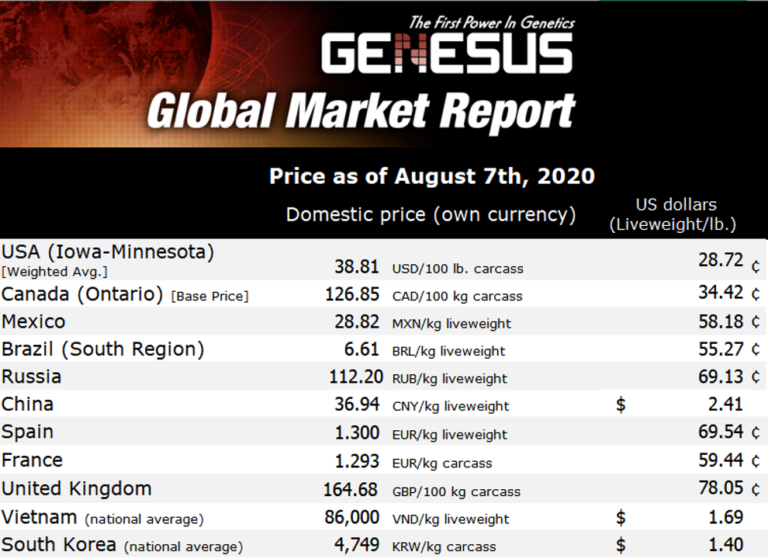
After eight weeks of same price, Spain is still at 1.3 € per kg live weight, the lowest value of the last five years, except for 2018. As we can see in the table below the average price until this week is much higher than previous years. This is because we started from a remarkably high value at the beginning of the year. During the summer months, as usual, the carcass weights are lower, but still the heaviest in the last five years.

20162017201820192020
MERCOLLEIDA PRICE
Average year 1.101321.151.291.38
Week 10.951.131.021.041.49
Week 361.321.411.251.471.30
LIVE WEIGHT
Average year 109.3108.2111.3110.5113.8
Week 1114.2113.2116.5115.1115.6
Week 36104.2105.5106.1106.6108.1
Source Mercolleida

Even though there is now more demand than supply and the usual summer lower weights, the price has not risen due to lower pig prices in other European countries like Germany, France and the Netherlands. 

The average year to date value difference between Spain and Germany is not significant, but at this moment this is visible 1,3€ in Spain vs 1.1€ in Germany (per kg live weight).

SPAINGERMANYFRANCENETHERLANDS
Average 20201.381.351.261.29
Week 361.31.141.221.06

Traditionally fall brings lower prices, but this year all the schemes are broken, and now prices are expected to go up given the market situation.

The major difference between Spain and rest of Europe, is that Spain did not had closure of packing plants by the Covid-19. There has been processing limitation due to sanitary measures implemented, offset by the processing capacity growth observed earlier in the year, great efficiency, and closure of plants in the north of the EU. 

From January to June 2020, despite the pandemic, processing of hogs has increased by 3.19% re number of hogs and 5.5% re weight.

 2020201920 vs 19 (%)
Hogs27,612,66526,758,873+3.19
Tons2,509,3582,378,484+5.50
Carcass weight (Kg)90.8888.89+2.24
Source MAPA

As far as exports are concerned, we can say that in the first six months of 2020, “Extra-Community Exports” of the Spanish pork sector continue to exceed “Intra-Community Exports” in volume and value (54.5% in volume and 51.4% in value).

More than 74% of exports (volume and value) are distributed among eight countries: China (first place), followed by France, Japan, Italy and Portugal. 

In 2019 – 663,892 tons were exported to China (27.2% of exports) with a value of 1,441,258 thousand euros (23%), while this year just during the first half of the year 539,627 tons were exported with a value of 1,192,379 euros

Tones 2019 January – June2020 January – June20 vs 19 Thousands
of Euros
 2019 January – June 2020 January – June20 vs 19
 China      260,652 22.1%539,62739.5%107.0%  China        442,464 16.2%     1,192,379 33.3%169.5%
 France      154,421 13.1%141,546104%-8.3%  France        407,521 14.9%        432,386 12.1%6.1%
 Italy        92,975 7.9%108,5568.0%16.8%  Japan         248,052 9.1%        279,673 7.8%12.7%
 Japan        71,556 6.1%66,2834.9%-7.4%  Italy        184,648 6.8%        237,382 6.6%28.6%
 Portugal        60,515 5.1%51,3743.8%-15.1%  Portugal        171,548 6.3%        166,725 4.7%-2.8%
 Poland        43,627 3.7%49,5023.6%13.5%  Germany        120,748 4.4%        126,713 3.5%4.9%
 Philippines        45,525 3.9%31,7962.3%-30.2%  UK        108,697 4.0%        118,082 3.3%8.6%
 South Korea        46,415 3.9%25,1311.8%-45.9%  South Korea        132,327 4.8%          90,815 2.5%-31.4%
Total   1,177,834 100%1,365,296100%15.9% Total     2,729,051 100%     3,582,367 100%31.3%
Source DATACOMEX

All this shows that 2020 is a good year for the Spanish pork sector, though there still is a lot of uncertainty because caused by ASF and the Coronavirus pandemic that is devastating the planet.

INTERPORC: The Spanish pork sector very committed to the environment

The Organization Interprofessional White Hog Agri-food (INTERPORC) stresses that the water footprint to produce a kilo of pork (meat or products) in Spain has dropped by 30% in recent years, with a total amount today of 5,950 liters, drinking water representing only 8%.

Spanish farmers are committed to reduce the water footprint by 50% over the next three decades within the goal of achieving a neutral climate impact by 2050.

Italian Market

In Italy, the market continues with sustained price increase. The certified pigs for Parma ham (176 kg average live weight) are at 1.468-1.498 euros/kg. Pigs out of Parma certification are priced at 1.286-1.316 € per kg. The 25kg feeder pig is priced at 64 euros.

There is a very dynamic demand, but supply is totally insufficient to cover it. The meat market is in a strong recovery, although the packing plants are still not making any money. That is why there is a lot of resistance to accept the maximum rise that producers are asking for.

ASF Germany – One Pig Turns Pig World Upside Down

0
Jim Long's Pork Commentary

Pork Commentary, September 14th, 2020
Jim Long, President-CEO, Genesus Inc.

Last week one wild boar was found in Germany with African Swine Fever. This one dead pig has now resulted in China, South Korea and Japan banning pork shipments from Germany. This in itself has turned the pork world upside down.

On Friday the news of the positive ASF dropped Germany’s hog price from 1.47 Euro/kg to 1.27 Euro/kg (-13.6%) or a decline of about $22 per head. 

In the USA Lean Hog Futures Thursday-Friday jumped as much as $13 per head higher.

Germany has exported $1.2 billion of pork to China in the last year it was China’s largest pork supplier. Korea and Japan were also significant markets. Now, these countries will need to find pork somewhere else or go without. The obvious countries to gain from the import ban will be USA, Canada, Brazil, and Spain as they are the only countries that have significant pork supply that can shift to their Asian countries.

Germany which is part of the European Union will be able to continue to move pork to other EU countries other than from ASF restrictive zone (not that big an area). This will probably depress hog prices in other areas of Europe as we doubt the other EU countries can increase non-EU exports to counterbalance the deluge of pork that Germany will put in the EU market.

In the U.S. a market that was already beginning to see the front end of lower hog supplier due to sow herd liquidation will now be getting the dynamics of the market supercharged with enhanced export demand.

It is unfortunate we are in an industry where it appears one’s adversity is another’s opportunity. This is our reality. Europe (Germany) has benefited from China-USA political issues that has restricted China pork imports from USA. EU (Germany) grew the Chinese business. Now it’s stopped cold. Now one China option is to buy more pork from USA or not. It’s also a reason why as an industry we need to be wary of export-driven business. One pig, market disappears?

More efforts should be put into growing domestic demand and consumption. Too many pork events we attend focus is on many things but little if ever talk on how to grow the domestic market. Exports are like a dangerous opiate.

We expect many German Pork farmers wished whoever found the one dead pig, just dug, buried, and shut up. This is a $1.2 billion pig.

We were at a conference a year and a half ago. We argued it was completely wrong that ASF should be a reportable disease. We also wrote this belief in our commentary. A reportable disease if it causes harm to humans and our financial losses. ASF has no human risk. The stupidity of the financial loss is the one dead pig will cost 1+ billion dollars. The worst financial part of ASF will be the closing of exports. It’s insane that an industry can be destroyed by stupid rules put together sixty years ago. With no consideration of the implications to current industry realities.

If ASF ever got to USA or Canada all exports would stop. It can be one pig? Billions would be lost and many producers go bankrupt. The world industry should look at stopping these insane rules on ASF. It should not be a reportable disease.

Market Update

On August 19 at the NPIC conference, it was suggested by one of our famous ag-economist that hog prices have little upside in the next 12 months. It was predicted we would have more hogs in 2021 than in 2020. They also suggested to hedge a percentage of your future marketing’s. We disagreed then and after.

Lean Hog Futures

 Aug. 19 Sept. 11 Difference
Oct.52.5566.57+14
Nov.53.5766.00+12.5
Dec.61.1569.47+8

Since August 19 the Lean Hog Futures have jumped significantly, already on the rise before the German ASF break. 


Disclaimer – As an owner of pigs we do have a vested interest in higher hog prices.

China 

Now that Germany is shut out of China. It’s important to look at some China market news. Hog prices are at a near-record level reflecting the reality of significantly lower production due to ASF. The Ministry of Agriculture of China’s latest sow inventory is 26.73 million. It was 44 million in 2017. China is a long way from having enough domestic pork without imports. The price of pigs in 2017 was 14 RMB/kg (88¢ lb.) last week 37 RMB/kg ($2.46 lb.). More USA pork will be going to China due to the German issue.

Summary 

  • U.S. hog market was gaining strength before German ASF break.
  • German ASF break means China, Japan, and South Korea market is closed for German imports until they can prove for a minimum 1 year no ASF breaks
  • We expect increased exports to China, Japan, and South Korea combined with lower hog slaughter year over year in 2021 this will be quite positive for North American prices.
  • A producer called on the weekend and asked if $70 early weans in four weeks? We don’t think so but this is just a reflection of a swing in market attitude.
  • Prices are driven by Demand, Supply, and Psychology. 
    • North American Supply is going down.
    • North American Demand is up.
    • North American Psychology is going up.
    • Europe is the opposite direction.

This is a tough business – fortunes can turn on a dime or one dead pig.

Yes, A Vested Interest!

0

Pork Commentary, September 8th, 2020
Jim Long, President-CEO, Genesus Inc.

For weeks we have strongly questioned the reported “3 million hogs backed up” opinion of Ag. Economists and futures traders. We just could not comprehend 3 million as a reality. We observed the ripping down of slaughter weights over the last several weeks. We were told we had a “vested interest”, we weren’t sure what that meant other than compared to know nothing chicken little ag economists, we own hogs and our interest in the business far exceeds a cubicle without a door.

Yes, all we have is in the hog business. We are all in as many if not all our customers and many of our readers. We are proud we are vested. Maybe some of the people who have trumpeted “3 million hogs backed up” had a vested interest to depress the hog prices? Only they know the truth.

Some Observations

Chasing Hogs to fill slaughter 

Some Packers are chasing hogs to fill slaughter. Why need to do that if hogs backed up?

National Daily Base Lean Hog Weights

In the first part of May this year National Daily Base Lean Hog Weights averaged 221 lbs. the same time a year ago they were 215.6 lbs. Last week the first 4 days the Weights averaged 206.4 lbs. a year ago same week 211.38 lbs. So, we have gone from about 5 lbs. heavier year over year to 5 lbs. lighter year over year. We don’t have a database to confirm this but we expect the 5 lb. year over year be as a large decline ever recorded. More importantly, anyone who owns hogs knows large levels of backed up hogs don’t lead to lower weights. It would be quite the opposite.

U.S. Cut-Outs

Last Friday U.S. Cut-Outs averaged 80.56¢ lb. This is real positive as a week ago were 72¢ lb. Pork Cut-Outs indicate strong demand.

Feeder Pigs 

Historically this time of year is the low price for feeder pigs. Reason is Sept. 1 – Dec. 31 is maximum annual slaughter and the barns are close to maximum capacity and this cuts feeder pig demands. What we are hearing from sales team and other industry people is right now there are numerous empty finisher barns which is not normal for this time of year. Also, hard to believe hogs backed up if numerous barns empty?

Some year over year 40 lb. feeder pig prices – USDA average.

 2019 2020 Difference
2020 to 2019 
Jan 7$70$68-$2
March 28 $78$47-$31
April 25$74$18-$56
July 18$45$10-$35
Sept. 8$30$27-$3

Its real obvious the collapse of feeder pig prices that occurred during pandemic. What’s interesting to us is the current narrowing of year over year prices in what is traditionally the low price for the year. No one pays more if they don’t have too, what we are seeing in our opinion is the beginning of the realisation of no pigs backed up and fewer pigs being born everyday year over year.

The DTN calculation of the breakeven you can pay for a 40 lb. feeder pig last Friday was $43.64, we expect week upon week appreciation of cash feeder pigs to continually increase. We expect to see $90 plus feeder pigs in 2021.

Empty Finishers

  • Since last December the U.S. sow inventory has been declining steadily. Sow slaughter year to date is about 9,000 more each and every week than a year ago.
  • Low Sow prices is leading to euthanization of poor sows – they don’t end up in current sow slaughter stats.
  • New Sow barn construction is next to non-existent.
  • Gilt retention has declined – we see it in gilt sales.
  • Industry record sow mortality – 12.5% per annum (1% a month). Don’t replace and you have less sows and pigs.
  • USDA Hogs and Pigs Report June 1 indicated 5% less farrowing’s for the balance of 2020.
  • Euthanization of small pigs in May – June is cutting need for barn space and obviously hogs for slaughter.
  • We don’t believe much ration formulation to slow hogs is ongoing.

Summary

  • Guilty – Yes, we have a vested interest in hog prices being profitable.
  • Guilty – We have believed hogs weren’t backed up to the degree “3 million hogs” level spoke about a week ago by the “industry experts”.
  • Guilty – Weeks ago we expressed opinion that Cut-Outs would be first indication of lower hog numbers – closed 80¢ lb. plus Friday.
  • Guilty – We believed liquidation of the sow herd is much greater than the “industry experts”.
  • Guilty – We say to the “industry experts” who claim there will be more hogs in 2021 then 2020 are absolutely wrong, wrong, wrong.
  • Guilty – We believe all lean hog futures are undervalued relative to collapsing hogs supply we expect in 2021.

U.S. Hog Slaughter Numbers
Remain Strong

0

Pork Commentary, August 31st, 2020
Jim Long, President-CEO, Genesus Inc.

The U.S. Packing Industry continues to ramp up slaughter numbers. Last week 2,664,000 up almost 200,000 head from the same week a year ago. We have to commend the Packers for adjusting to Coronavirus challenge and getting hog slaughter numbers up significantly.

One of the issues spoken more than once at National Pork Industry Conference (NPIC) was the pricing of market hogs in the future. Most if not all that spoke believed that current hog pricing programs need adjusting. Some touted the new plan to have pork cut-outs futures on the Chicago Board of Trade. This was mostly touted by the people selling futures.

Certainly, the push from NPIC speakers was that U.S. Pork cut-outs and a percentage of such would be a reasonable option for the future. One of the speakers said long term average of hog price to cut-outs was 88%. If we use that today and Friday’s cut-out-close of 71.39 the 88% hog price would be 62.82¢ lb. National 53-54% hogs 56.10¢ lb. Most of the time in the last months an 88% cut out to hog price spread has been lower and a detriment to producers.

For hog producers, whatever we are doing for hog pricing has not been working very well. From what we can see looking at hog prices throughout the world USA-Canada have the lowest global hog prices and worst financial situation. We as an industry must ask why? What needs to be changed? Is it just too many hogs? Coronavirus?

One Packer asked us in January “If the industry is hurting so bad, why is their expansion?” – good and fair question. Since then we believe expansion has stopped. There are next to no new sow units being built in the USA; there is liquidation of the sow herd – we believe at least 250,000 is gone and/or is ongoing. The marketplace is adjusting, but still, we ask why does USA-Canada have the lowest prices in the world?

NPIC

At NPIC Nick Giordano Vice President of the National Pork Producers Council (NPPC) spoke on current legislation for Gene-Editing (GMO).

As he explained current U.S. Gene-Editing (GMO) oversight is by the United States Food and Drug Administration (FDA). Mr. Giordano explained that currently Swine for Gene Editing is classified as “Living Animal Drug” and a Hog Farm using such would be considered a “drug manufacturing facility”. 

The European Union (EU) has classified Gene-Editing as Genetic Modified Organism (GMO) and have effectively made it illegal.

Mr. Giordano didn’t mention the EU part but he said Argentina, Brazil and China were working on Gene Editing. Not sure where Argentina comes in re Gene Editing (GMO) as they have very few hogs and no swine genetic companies. Brazil? China probably as PIC has signed a cooperation agreement with a company there, after the EU ruling.

PIC has invested millions of dollars in trying to get a GMO pig to market. They probably don’t appreciate Mr. Giordano explaining that today it’s classified as a “Living Animal Drug”. What we can figure when they tout to customers the opportunity to being first in line to get PIC’s GMO pig they aren’t mentioning “Living Animal Drug” or your farm becoming “a drug manufacturing facility”, sounds like fun.

Wonder which Retail Chain and or Foodservice will want to be first to sell Living Animal Drug – GMO Pork. Animal Welfare Groups would make a fortune fundraising on this. Sounds like suicide consumer marketing for all Pork producers. We appreciate Mr. Giordano’s frank and legal description (he’s a lawyer) of the reality of the Gene Editing (GMO) as he recognised the challenge to “Consumer Acceptance”. It’s good to see the money invested in NPPC is pointing out the perils of technology that could damage our industry and crush Pork consumption.

The best option for our industry could be to embrace new vaccine technology, not GMO. Will not be negative to consumers, retailers, foodservice, and exports. We need to do everything to increase Pork demand we don’t need impediments in place that encumber this quest. We need to use smart options.

In Feedstuffs a report that University of Connecticut assistant professor of animal science Young Tan and professor of pathology and veterinary science have now identified compounds that successfully use a vaccine to block the PRRS Virus. You can read the entire article here https://www.feedstuffs.com/nutrition-health/compound-blocks-prrs-virus-identified

Genesus News

Get acquainted with the Global Mega Producer 

A program of recognition led by National Hog Farmer and sponsored by Genesus Inc.

New Fashion Pork, USA

New Fashion Pork is once again part of the Global Mega Producers for 2020

From its beginning in 1998 a lot has changed for the company. Today operations extend from Wyoming to Indiana with International business diversity. Having a sustainable strategic plan, Land/Crops, Nutrient supply and Pigs, has always been a company goal.

Today 30% of the company needs are supplied within. Maintaining and achieving high health herds is also part of the plan. 

“Our employees are the reason we have been successful. I cannot imagine another group that has preformed at their very best with all of todays happenings”
– states Brad Freking, Owner NFP. 

Let us congratulate New Fashion Pork for being part of the Global Mega Producers.

Tom Stinson, Director of US Sales, Genesus Genetics (right) and Brad Freking, Owner NFP (left)

NPIC Observations

Pork Commentary, August 24th, 2020
Jim Long, President-CEO, Genesus Inc

NPIC Observations 

The National Pork Industry Conference (NPIC) was held last week as a virtual event. Not an ideal way to do conferences as the huge benefit of personal interaction is missed. Fortunately, the NPIC organisation did a good job executing the conference under the circumstances that today’s reality forced them too.

Thanks for many of you who watched my talk on NPIC site and YouTube. 

  • Appears from a couple of the speakers they believe hogs are still backed up in the millions. 
  • Steve Meyer with the Brokerage Firm Kerns and Associates projects an increase in hog slaughter in 2021 vs. 2020. (2020 = 130,646 vs 2021 = 131,739)
  • Steve Weiss one of the principles of NPIC (Century 21) and CEO Nutriquest indicates their data has breakeven top 25% producers 63-65¢ lb. lean (upper Midwest).
  • Steve Meyer said that the extra sow slaughter this year of 220,000 more year to date, does not indicate significant sow herd reduction.
  • Meyer’s spoke of Maxwell Foods 54,000 sows and Hitch Pork 15,000 sows being liquidated.
  • Meyer’s explained CME average price for 2021 is currently 68.37. Kerns and Associates believe the average price in 2021 will be 56-59. Meyer recommended producers consider some hedging. 

There were several other speakers with the NPIC conference. Next week we will discuss some of their thoughts.

Other Observations 

Sow Mortality Analysis 

We have looked at sow mortality and how it could affect the breeding herd inventory. We looked at Pig Champ data which is available on the Pig Champ website. Annual sow mean mortality in 2015 was 8.94%, in 2019 was 12.31% – an increase of 3.37%. If breeding herd is 6.3 million, the extra 3.37% equates to 212,310 sows a year or 4,000 extra dead sows a week. Kind of skews the analysis of historical sow liquidation to decide the current degree of herd liquidation. 

Hog Slaughter 

Hog slaughter this past week was 2,618,000 a year ago 2,531,000. Daily slaughter capacity is about 500,000 with some days now reaching 480,000 plus. Excellent Packer Gross Margin has been a great stimulus to get hogs killed. Now maybe with less lucrative unemployment benefits the labour force for all plants will move towards capacity helping production. 

National Daily Base Hog Carcass Weights first 4 days last week averaged 206.80 lbsthe week before 208.01 lbs.; year before 208.48 lbs. If hogs backed up in millions as some claim it will be first time in history backed up hogs have lower slaughter weights. 

Producing Better Pork 

As an industry we are obsessed with costs, not necessarily a bad thing. What we see very rarely, if any talk, on how to grow our business by increasing per capita consumption, where chicken industy has relentlessly increased consumption and stayed mostly profitable, the pork industry profit seems to come only when we cut cost production. Every consumer survey ever done shows taste, flavour, and eating experience are the main driver of consumer satisfaction and repeat purchasing. Instead, we focused on the stupid White Meat Program that drove us to produce Pork that tasted like cardboard. Is it any wonder bellies, ribs, and shoulders (most fat) now dominate the cut-outs while loins and hams lag in value.

The solution is not using a so-called Duroc; it is using Durocs or whatever breed that has marbling-colour–PH that will deliver the best eating experience. Some so-called Durocs will never deliver the eating experience as they themselves have been bred to be really lean and have no better eating attributes then the synthetic breeds the other White Meat Program spawned.

We need to stop being farmers and become marketers, we need to produce a better eating product that will drive price and demand. Playing only the cost game is why per capita consumption for pork has flatlined for 25 years while total meat consumption has increased. We have lost market share. There is a calculation that if every American ate pork one more time a month that is equivalent to 7 million hogs per year. We as an industry pine for more exports maybe the answer is producing a better tasting product and growing our domestic market.

More hogs in 2021? 

Projecting more hogs in 2021 than 2020 – interesting perspective. We don’t agree, liquidation is underway. Sow slaughter since first of year up 7,500 a week from a year ago. Sow herd on June 1st was down nearly 150,000 from Dec 1st. There has been continued liquidation since then, ie. Maxwell Foods and Hitch – they alone are 1% of the U.S. sow herd. We believe higher sow mortality due to the weaker genetics that has been introduced from Europe is also contributing to liquidation as gilt retention has declined. We believe without hesitation the U.S. will have fewer hogs in 2021 compared to 2020. How much less is too early to project as the sow herd continues to liquidate. Financial losses have been significant and continue.

Get acquainted with the Global Mega Producer 

A program of recognition led by National Hog Farmer and sponsored by Genesus Inc.

Christensen Farms, USA

Christensen Farms has again been recognized as a Global Mega Producer for 2020. One of the largest family-owned pork producers in the United States, Christensen Farms, relies on the dedication of employees, contract farmers and producing partners. 
 
Christensen has 142,500 sows in production in multiple states. The company will only add production if it fits into their integrated model. Dedicated to providing wholesome, safe, nutritious food around the world has made Christensen a world leader in pork production. 
 
Christensen is part of the Triumph Foods Group.  
 
The company continues to look for diversity that fits their goals and value system.

“I want to thank all our employees for their dedication to our industry” 
– states Greg Howard, VP of Strategic Planning, Christensen Farms. 

Let’s congratulate Christensen Farms for being a Global Mega Producer.

Greg Howard, VP of Strategic Planning, Christensen Farms (right) and Tom Stinson, Director of US Sales, Genesus Genetics (left) 

National Pork Industry Conference

Pork Commentary, August 17th, 2020
Jim Long, President-CEO, Genesus Inc.

Jim Long's Pork Commentary

This was to be the week of the National Pork Industry Conference (NPIC) at the Kalahari Resort Wisconsin. Instead due to Coronavirus, it has become a virtual conference.

Genesus has been a lead sponsor for twelve years. In that time, we came to appreciate the excellent organization and speakers of the NPIC. This year most importantly we will miss the interaction of the many people at the conference. At the NPIC and other like events we have come to meet and get to know many of the people in our industry. It has enriched us with the knowledge we have learned from these interactions.

As an industry, the pandemic has not only hit many financially, but it has prevented the events such as NPIC that binds us personally in relationships to our industry. We are all diminished by this reality.

As part of NPIC this year, we gave a 19-minute presentation on our feelings on the Global and U.S. markets. Please find below our presentation. 

Available in English language only

Genesus Global Market Report Canada, August 2020

Genesus Global Market Report

Bob Fraser – Sales & Service, Genesus Ontario
bfraser@genesus.com  

In my last two commentaries I’ve suggested the industry was a mess, maybe even a hot mess. What can I say now other than we’ve either got used to it or have become numb?

Carrying on from my table last commentary of Ontario Pork’s weekly reporting of the average, low and high total return to producers per 100 kilograms dressed weight.

DateAverage Price per ckg DW Total ValueLow Price per ckg DW Total ValueHigh Price per ckg DW Total Value
July 19, 2020$174 $131$240 

You can see the spread now extends to over $100 per hog. Resulting in some producers maybe thinking they should expand to producers bleeding to death by a thousand pin pricks, across the road from each other. I would question whether the spread has ever been this wide. All this as shown above with 25% of the global sow herd gone, primarily from ASF causing prices pretty much everywhere other than North American to be at historical highs.

So, if this isn’t broken, I don’t know what is. Andrew Heck, Editor of Canadian Hog Journal does an excellent job in their Summer 2020 magazine of highlighting some of the issues in his article “Producer-packer tensions threaten viability.”

In mid-May the pork producer organizations in B.C. Alberta, Saskatchewan and Manitoba issued a joint invitation to executives from Maple leaf Foods, Olymel and Donald’s Fine Foods to have an open frank discussion on the state of the industry, and work to solutions that generate shared value for producers and processors. Part of the written invitation reads:

“As a result of our flawed value sharing system, pig producers in Canada have needed to rely on the goodwill of the federal and provincial governments and taxpayer dollars to support producers’ very survival.” It continues, “For too long, the producer and packer have been at odds with each other, and it has created an unmanageable and antagonistic relationship that is weakening the industry and the brand in the global marketplace. This approach must come to an end.”  

source: “Producer-packer tensions threaten viability”, Canadian Hog Journal

I think most producers would agree with the synopsis if taking exception to the extent of government goodwill helping them. However, although a commendable effort, in a capitalist system with packers making previously unimaginable margins it will be challenging for them to see a lot wrong with this present picture. Even when some in their midst understand killing your supplier is ultimately bad for business. Similarly, as many producers are fighting for survival difficult to take “the long view”. I believe the saying is “when you’re up to your ass in alligators, it’s hard to remember your original intention was to drain the swamp.” 

But now would seem the very time for vision for the industry. In the past, the one solution to this conundrum between the packer and producer has been for the packer to integrate down. Although more extensive in the US in percentage terms perhaps not that much different in Canada.

  • Olymel along with being Canada’s largest pork packer is Canada’s largest pork producer and appears to wish to integrate even further. If not, full integration at least sell producers genetics, feed and perhaps other inputs for them to gain shackle space. Giving with on hand, while taking away with the other.
  • Maple Leaf Foods, although having some ebb and flow to being a pork producer, remains a large pork producer in Canada.
  • HyLife although starting as a pork producer with their Neepawa pork plant, the acquisition of 75% of Prime pork plant in Minnesota and the 37,000-sow pork production of ProVista in Manitoba appears their model is an integrated one.

Such that would be difficult to tell which tail is wagging the dog. 

An alternate solution is for the producer to integrate up. As with Conestoga Meats/ Progressive Pork Producers (3P) here in Ontario. Right now, they appear “the smartest guys in the room” as they share in the value of the hog with enviable margins compared to many producers in the province. However, this model requires overlooking the better part of a twenty-dollar bill they put on the back of every hog for ten plus years

Which is the better model? Don’t know that there’s any convincing evidence that packers make better hog producers than hog producers. Anymore than producers make better pork packers than packers. Most economic theory would suggest the greatest prosperity comes from all the players sticking to what they’re best at. That being said the old way of producers and packers taking turns making and losing money no longer seems sustainable. Particularly when the playing field appears tilted against producers perhaps permanently.

Pork producers have proven themselves to be extremely resilient and innovative amongst agriculture producers. Appears time to think BIG! 

Again Bob Hunsberger, Wallenstein Feeds, Hog Economics Summary Sheet shows little in the way of encouragement or change from eight weeks ago, profitability going from per pig with average production loss of (-$37.90) to loss per pig with an average production of (-$30.23). A $7.67 per pig increase in revenues that for some at least only says “you’re not bleeding as fast”. Then with the next twelve-month projection moving from (-$6.52) to (-$5.11) – arguably moving in the right direction but hardly comforting. Seems time for a better mousetrap.

Click image to enlarge

Global Mega Producer Exits

Pork Commentary, August 10th, 2020
Jim Long, President-CEO, Genesus Inc.

Jim Long's Pork Commentary

Global Mega Producer Exits

Last Friday it was announced that Goldsboro Milling – Maxwell Foods would be exiting the Swine Industry. A year ago, at this time Maxwell Foods was a Global Mega Producer with 100,000 sows. Last August 19 Maxwell sold about 46,000 sows and production contracts to Country View Farms whom are part of the Clemons Food Group.

Maxwell has announced that it will begin phasing out current production of about 54,000 sows beginning August 6th. See link below.

Maxwell Foods Permanently Closing Hog Production Operations

This is unprecedented in our industry. We understand most if not all breeding of sows has stopped. 

“To breed a sow is to believe in tomorrow.”

There has never been a liquidation plan of this magnitude by one entity in the U.S. swine industry history. It appears that there were no buyers for the business. In the past when large producers such as Maxwell had an exiting plan another large producer took them over. IE Smithfield Foods – Murphy, Carrol, Premium Standard. Maschoff – Sands, Christiansen – Heartland, JBS – Cargill and so on.

Maxwell Foods continues to be a major shareholder in Butterball Turkey. The exiting of Maxwell from the swine industry is in our opinion a real reflection of the financial losses our industry has been enduring. Be real sure they aren’t quitting because of making too much money. When we hear from independent producers that the “Big Guys” aren’t being hurt by our negative margins we always disagree. The more hogs you have the more you can lose. There is no magic in the business, Maxwell wasn’t directly involved in the packing plant. They were like a big independent producer. Let’s say selling 25,000 hogs a week times $30 per head loss = negative $750,000. At some point you might ask “What’s the future?” If you don’t see one. Stop breeding, exit stage right.

54,000 sows equal about 1.2 million market hogs per year, almost all currently to Smithfield Foods. If one needs confirmation sow herd liquidation is ongoing this is it. Who knows if this market continues as is who might be the next large entity to stop breeding? To assume there won’t be is reckless.


Other Observations

If slaughter weights and field reports from our customer base are an indication, we believe few if any hogs are backed up. Our opinion is far different from the commodity traders and vested interest that say “3 million hogs backed up” a crude but effective way to depress hog prices.

Despite the best efforts of the vested interest to continue to hype huge pork supply. Cut outs were $73.84 Friday. Lean Hog futures even showed some life Friday with a significant bounce.

Pig Production is decreasing. From Dec 1st to June 1st, 150,000 fewer breeding sows. June sow slaughter 52,000 more than last June. We are aware of several farms beyond Maxwell Foods that have decided to exit. Euthanization, sow herd abortions & lower gilt retention are all factors in decreasing the pig production. June 1 USDA report projected 5% less farrowing in this time frame. That is about 150,000 less pigs a week. We are being offered empty barns both nurseries and finishers. The hog supply is dropping. Barns are becoming available. When does price increase? When the market realises there are not millions of hogs backed up. When is that? Hopefully sooner rather than later.

“Surest cure for low prices is low prices!”

Potential PRRS Game Changer

In Feedstuffs a report that the University of Connecticut assistant professor of animal science Young Tan and professor of pathology and veterinary science have now identified compounds that successfully use a vaccine to block the PRRS Virus. Click below to see article.

Compound that blocks PRRS virus identified

If this technology is effective this has huge ramifications in the future of our industry. Unlike Gene Editing (GMO) being done by companies like Genus – PIC which face huge regulatory and consumer acceptance of GMO food. No one has much issue with vaccines. Vaccines can be available to the world industry unlike a GMO Pig which will have huge restrictive, cost and litigate issues beyond consumer acceptance.

We can only imagine the fear at companies that have invested 10’s of millions to produce a GMO-PRRS resistant pig to see the vaccine option potentially destroy the value in the GMO technology investment.

At the end of the day, we need to produce Pork that consumers will feel comfortable with. GMO pork has been banned in Europe. Not sure GMO pork is a direction that will drive consumer demand in North America. A vaccine is a real solution that doesn’t collide with consumer or regulatory issues.

Lean Hog Prices Gain Strength

Pork Commentary, August 4th, 2020
Jim Long, President-CEO, Genesus Inc.

When you are an optimist you look for the positive. Last week, Thursday to Thursday U.S. National Base 53-54% lean hogs went up from 48.79 to 53.27. Still a miserable price but going in the right direction.

“I am an optimist. It does not seem too much use being anything else.” – Winston Churchill –

Other Observations

  • One of our U.S. customers got offered 10¢ a lb. more for this past Saturday’s delivery compared to the week before. This for spot cash delivery.
  • Three of our customers in Northern Midwest are no longer backed up with hogs as of last week. Good sign.
  • Some customers have pulled hogs down to a 265 lb. average in preparation if there are plants slow down due to coronavirus. Of note, their plants had room to get hogs to this Iowa weight.

From the feeder pig world

More calls coming in by buyers. Buy lists more than supply list in some instances. Probably a sign of market price floor. Current early weans are February market hogs. Pig supply is being cut due to sow herd liquidation from higher sow slaughter (+180,000 Jan-June), lower gilt retention, euthanization of small pigs and some planned abortions. Also, demand is being enhanced by more finishing barn space being made available by higher market hog slaughter.

We expect we are seeing the beginning of a relentless increase in small pig prices over the next few months as supply continues to decline.

“I’d rather be optimistic and wrong, than pessimistic and right.” 
– Elon Musk –

Hogs backed up

The multi-million-dollar question that hangs over our industry is whether hogs are backed up by over 2 million head as some claim or are we close to current.

The prevailing consensus it appears is that 2 million are backed up. That belief hangs over the market. Every Retail, Foodservice and Foreign buyer reads the pork news. The drumbeat of the hogs backed up takes away any stimulus for any buyer to worry about pork supply. This in itself limits any market price momentum.


We watch market weights. Last week, the first four days of the National Daily Base Hog Slaughter report had an average carcass weight of 207.56 lbs; the week before averaged 210.46 lbs; same week a year ago 208.28 lbs; June this year averaged 213.41 lbs.

Our observation, it would be the first time in history that hogs are backed up significantly and hog weights are below a year ago and falling weekly.

We have written to watch slaughter weights and many do, but most focus on the Iowa–S.Minnesota weights. That is if there were hogs backed up is where they are regionally. We watched the National weights as it’s in our opinion gives more of the national picture. We believe there are hogs backed up at some farms but also farms that have pulled hogs ahead. The net effect is what matters.

This coming week if Packers driven by excellent gross packer margins keep up slaughter numbers of about 200,000 more a week then a year ago, watch the weights, if they continue to plummet the likelihood of massive numbers of backed up hogs is less likely.

“To breed a sow is to believe in tomorrow.”

Government’s responsibility is to ensure proper food supply for its citizens. In the time of this pandemic, this has been a challenge for not only the government but retailers, packers, and producers. The drumbeat of attacks on the meat industry by a couple of prominent east coast Senators (NJ, Mass.) has been steady (both states are far from food self-reliant). This has led to some retorts from Tyson and Smithfield on how they are dealing with the pandemic.

Packer Sentiments from Bloomberg articles

Tyson Foods

“As we look beyond this year, we’re prepared to navigate prolonged pandemic related uncertainty … We are investing in operational flexibility to ensure that we can continue to meet customer demand, while living in a potentially long-term COVID-19 environment.” said Noel White, President & Chief Executive Officer at Tyson Foods

Sunday’s spread echoes a national Tyson Foods Inc. commercial with the tagline “We take care of our family so you can feed yours.”

Smithfield Foods

Smithfield Foods Inc. took out a full-page ad in Sunday’s edition of the New York Times to accuse its critics of false narratives and misinformation and to defend its operations to keep the nation fed during the pandemic.

The Virginia-based company calls its 42,000 employees “heroes” in the ad, and says it has implemented measures to keep staff safe and reward them for their work.

The ad accuses others of trying to use Smithfield and its industry as “political pawns,” while the company has stayed apolitical to make hard decisions and confront challenges that are “rooted in responsibility and delivered with integrity.”

“We must produce food, and someone has to do it,” the Smithfield ad reads. “Certainly it is not the critics who have answered the bell. No, it is our nation’s food and agriculture workers who have done so.”

As producers we need all slaughter plants to be operational. Any attempt to slow down the plants by politicians is a direct assault on our livelihood and future. All producers should stand with packers to ensure maximum packer capacity. Our livelihoods matter.  

“I am too positive to be doubtful, too optimistic to be fearful, and too determined to be defeated.”

U.S. Sow Slaughter Continues to Accelerate

Pork Commentary, July 27th, 2020
Jim Long, President-CEO, Genesus Inc.

June U.S. Sow Slaughter was 294,500, up from last year’s 241,900 – that’s 52,000 more sows gone to market in June compared to a year ago. Year to date U.S. sow slaughter (Jan-June) is 1,678,600, up from last year’s 1,498,810. – year to date 180,000 more. For those who think the sow number this year is being inflated by overweight market hogs, we offer this year average slaughter weight, Jan-June 304 lbs, last year’s same time frame 304 lbs. 

From Dec 1 to June 1 the USDA breeding inventory showed a decline of 152,000 sows. We believe that what is ongoing is a further reduction of the sow herd. The financial losses of many producers are unprecedented. Current losses of $40 per head on top of already many months of losses are accelerating herd decreases. 

Compound that we are in summer when mortality increases due to high temperatures, while gilt replacements have slowed. All these factors lead us to believe sow herd is decreasing significantly at this time. Fewer sows mean fewer pigs.

U.S. hog slaughter last week was 2,589,000, up from last year’s 2,359,000. Packers have good margins to motivate them to keep slaughter numbers up. Saturday was 231,000 head, a year ago 12,000. We need to work into whatever hogs are backed up and it appears it’s happening. 

U.S. pork cut-outs held last week closing Friday at $70.53. This despite more hogs being harvested.

U.S. pork in cold storage at the end of June was 464,373 compared to 619,454 a year ago. A huge difference. Despite record low seasonal prices, Pork has not gone into storage. Good news if we get any momentum in the market cold storage levels will not slow down a rebound.

Rabobank as the world’s largest agriculture lender has a good handle on what’s going on in the global swine market. Last week they reported that they expect Global Pork Production to decline 8%. “The biggest year-over-year declines are expected in China (-17%), the Philippines (-9%) and Vietnam (-8-11%).”

We would agree with these observations. Genesus has Genetic sales and production in each of these three countries and the decline in production from ASF related issues is significant. If anything, we question if both Vietnam and the Philippines might have even greater declines they observe.

 Rabobank reports “In the United States, live hog prices have dropped 41% year-over-year in early July, as meatpackers continue to work through a backlog of animals that could take months to process. Analysts said market prices for hogs are well below breakeven and could cause some producers to trim their herds or exit the business.”

We note 52,000 more sows in June (180,000+ YTD) to slaughter than a year ago would indicate “trimming”. 

Seems bizarre to us with projected 8% less pork in the world, why the North American Industry is sucking air. Even more bizarre that the 8% decline includes a 1.5% increase in the United States. At the rate things are going with the rapid decline of the breeding herd accompanied by euthanized pigs there will be less U.S. pork in the not so distant future.

“The great thing about rock bottom is that you cannot sink deeper”
– Winston Churchill

A Personal Note

24 years ago, I traveled from Ontario to Manitoba for the first time. I had been asked to speak to the Hutterite District of the Manitoba Pork Board by their director Henry Maendel.

Henry prior to the meeting invited me to the Rosebank Colony where he was hog boss. I had never been to a Hutterite Colony indeed I had never met a Hutterite. That day will be ever etched in my mind as Henry who had a very strong personality showed the workings of Rosebank. The church, housing, hog barn, shops, land and kitchen. All very impressive. I remember the dinner we had duck; it was good. The ladies who cooked the dinner watched us. We talked and I ate slow. At that time, I didn’t know eating slow isn’t what you do. I wondered why the ladies kept staring, later I learned they wouldn’t leave until we were done. Lesson learned. 

Later Henry told me about the history of the Hutterite Community. A religion-focused in the early 16th-century agrarian-based communal living and common ownership founded by Jacob Hutter as part of the Anabaptist movement of the reformation. He told me the 500-year journey to where today there are over 400 colonies in the USA and Canada. It was an enlightening and memorable day for me.

Unfortunately, Henry Maendel passed away last week. I pay tribute to Henry as a powerful personality who embodied the Hutterite religion and culture. Since first meeting Henry I have come to know many Hutterites as friends and customers. In the 24 years, I have come to admire the tremendous will and dedication it takes to maintain a distinct community and culture. 

Henry was an impassionate leader of the Manitoba Pork Industry. A number of years as director of the Manitoba Pork Board he pushed for producers’ interests. At his passing, he was overseeing as Hog Boss the building of a new swine barns at Rosebank Colony. A continued belief in the future of the swine industry. 

Our condolences to Henry’s Family and all at Rosebank Colony. May he rest in peace.